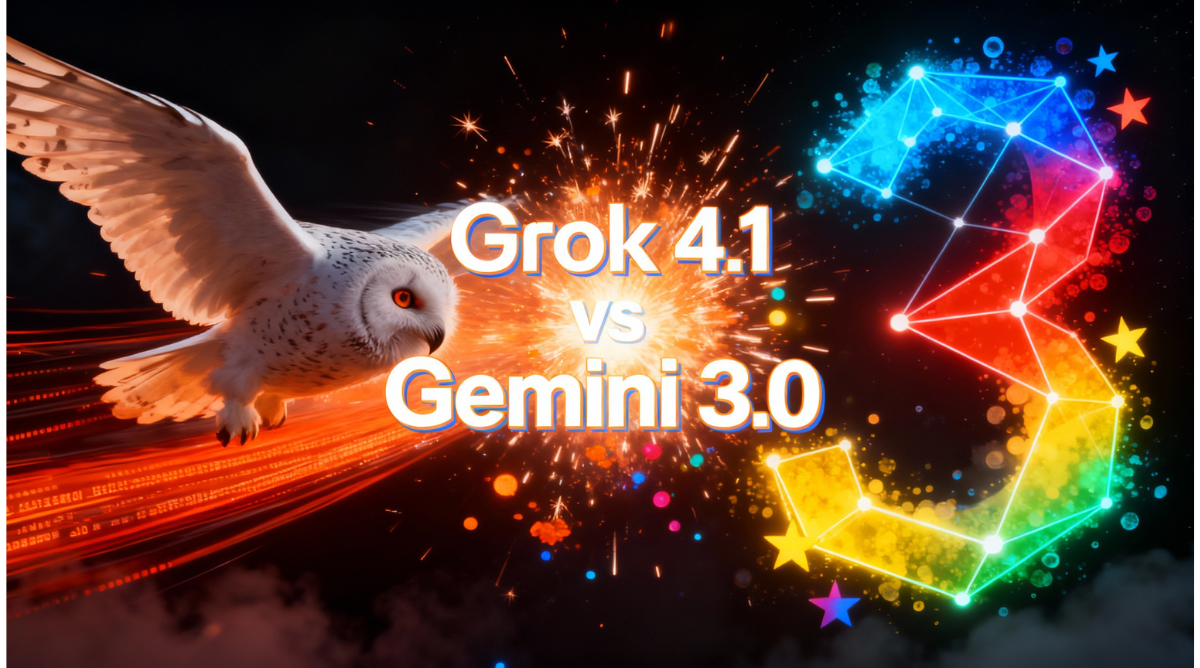
Gemini 3 vs Grok 4.1 (2026): Benchmarks, Censorship, Personality & Which Is Better?
The frontier AI landscape in 2026 is no longer defined by generic text generation. It is shaped by agentic reasoning, multimodality, real-time intelligence, and workflow specialization. This is why the comparison between Gemini 3 and Grok 4.1 matters. Both are frontier-class AI models, but they are built for fundamentally different use cases.
Google’s Gemini 3 is optimized for enterprise-grade reasoning, multimodal understanding, long-context accuracy, and safety-aligned productivity. It excels in research, coding, structured analysis, and high-stakes decision-making, especially within the Google Workspace ecosystem.
xAI’s Grok 4.1, by contrast, prioritizes real-time data access, creative expression, emotional intelligence, and conversational speed. With native integration into X (Twitter) and a low refusal rate, Grok is designed for trend analysis, ideation, and fast iteration.
The core truth in 2026 is simple:
there is no single best AI model, only the best AI for your workflow.
Grok vs Gemini Differences (2026 Overview)
When users search “Grok vs Gemini 2026” or “difference between Grok and Gemini AI 2026,” they usually mean this:
| Category | Gemini 3 | Grok 4.1 |
|---|---|---|
| Philosophy | Safety-first, structured | Truth-seeking, expressive |
| Censorship | Higher refusal rate | Low refusal rate (<5%) |
| Benchmarks | Strong in MMLU, HumanEval | Strong in GSM8K, EQ-Bench |
| Multimodality | Text, image, audio, video | Text + image (fast focus) |
| Real-Time | Google-grounded search | Native X integration |
| Personality | Professional, neutral | Witty, sarcastic, adaptive |
In simple terms:
-
Gemini = disciplined researcher
-
Grok = real-time intellectual sparring partner
Grok 4.1 vs Gemini 3: Key Differentiators at a Glance
At a high level, Gemini 3 and Grok 4.1 lead the 2026 AI market for very different professional reasons. One optimizes reasoning depth and multimodal accuracy, while the other prioritizes speed, emotional intelligence, and real-time awareness.
| Dimension | Gemini 3 (Google) | Grok 4.1 (xAI) |
| Primary Strength | Technical reasoning & deep multimodality | Emotional intelligence & live trend analysis |
| Top Benchmark Signal | LMArena 1501 Elo, GPQA science leadership | EQ-Bench3 leader, conversational preference |
| Context Window | 1M tokens, optimized for agentic loops | 2M tokens (128K hot + retrieval memory) |
| Real-Time Data | Search-grounded Google data (delayed) | Native live X (Twitter) stream |
| Multimodality | Native text, image, video, audio | Text + image focus (video emerging) |
| Pricing Philosophy | Scales efficiently via Flash & Pro tiers | Aggressive low-cost APIs + X Premium |
| Best Use Cases | Enterprise research, coding autonomy, science | Creators, social intelligence, fast iteration |
What matters most in practice:
- Gemini 3 excels at regulated, high-accuracy workflows where hallucinations and compliance risk matter.
- Grok 4.1 excels at real-time reasoning, brand voice, and social trend analysis.
- Reasoning depth favors Gemini 3 Pro; personality and speed favor Grok 4.1.
- Multimodal analysis (PDFs, video, audio) clearly favors Gemini 3.
- Live sentiment and breaking-news awareness clearly favor Grok 4.1.
- Cost efficiency diverges at scale: Gemini for sustained workloads, Grok for bursty, consumer-facing queries.
Grok 4.1 vs Gemini 3: AI Model Comparison Overview
The Grok 4.1 vs Gemini 3 comparison is unique because it reflects the industry’s shift from chatbots to agentic AI systems. In 2026, both models are frontier-class, but they are optimized for very different operational roles. Gemini 3 is built for enterprise reliability, deep multimodal reasoning, and safety-aligned productivity, while Grok 4.1 is designed for real-time social intelligence, emotional nuance, and fast iteration.
This guide evaluates both models using criteria that matter in production, not demos: reasoning depth, hallucination vs refusal behavior, real-time data grounding, multimodal coherence, latency, cost efficiency, and workflow fit.
Compare top coding AIs: gemini-2-5-pro-vs-claude-3-7-sonnet
What Makes This AI Model Comparison Important in 2026?
In 2026, users no longer ask for the “best AI overall.” They want the best AI per workflow. As AI systems move into agentic, multi-step execution, small differences in hallucination rate, refusal behavior, and cost per task now create large real-world risks. Gemini 3 favors compliance, factual grounding, and stability, which matters for enterprise research, RAG pipelines, and regulated industries. Grok 4.1 favors openness, speed, and creative freedom, which matters for content creation, market sentiment, and real-time decision-making.
Google vs xAI: Competing AI Philosophies
At the core, this is a clash of philosophies. Google positions Gemini 3 as an “ambient intelligence” layer safe, structured, and deeply integrated into professional life through Google Workspace and enterprise systems. This yields high benchmark performance and predictable behavior, but also higher refusal rates. xAI, by contrast, positions Grok 4.1 as a “maximum truth-seeking” system fast, expressive, and grounded in live social data from X. This delivers strong emotional intelligence and real-time awareness, but requires greater user verification.
Gemini 3 Overview: Google’s Multimodal Reasoning AI
Gemini 3 is Google’s flagship multimodal reasoning model, active from late 2025 through 2026, and designed as an agentic intelligence rather than a conversational chatbot. Its primary focus is accuracy, scale, and productivity across complex workflows. Unlike personality-driven AI systems, Gemini 3 functions as an analytical co-worker, capable of executing multi-step reasoning, synthesis, and automation across text, images, audio, video, and code within a single cognitive loop.
At a strategic level, Google positions Gemini 3 as part of an ambient productivity layer, deeply embedded in Google Workspace, Search (AI Mode), and enterprise platforms. This makes Gemini especially strong for research, RAG pipelines, document intelligence, coding at scale, and regulated decision-making.
Explore Gemini 3 vs GPT-5.1 to see which AI model performs better for your workflow.
Gemini 3.0 Core Capabilities
At the foundation, Gemini 3.0 uses a hybrid Mixture-of-Experts (MoE) architecture, enabling native multimodality across text, images, audio, video, and code without relying on stitched pipelines. Its Thinking mode introduces internal planning loops that decompose complex prompts into structured reasoning steps before generating an answer.
Key strengths include:
- Massive context handling, supporting up to ~2 million tokens, allowing ingestion of hour-long videos, thousands of documents, or full code repositories in a single session.
- Advanced video and spatial reasoning, including high-frame-rate analysis and pixel-precise object identification, useful in engineering, healthcare, and physical-world analysis.
- Agentic workflow orchestration, where Gemini can autonomously plan and execute tasks such as generating full high-fidelity application prototypes, coordinating business logic, or managing multi-step research processes.
- Multilingual fluency across 100+ languages and safety-aligned reasoning, making outputs stable and suitable for professional environments.
These capabilities underpin Gemini’s strength in multimodal analysis and long-context reasoning, where consistency and coherence matter more than raw speed.
Gemini 3 Pro for Enterprise and Advanced Reasoning
Gemini 3 Pro is the enterprise-grade tier, optimized for high-stakes professional use cases that demand factual grounding, security, and reliability. It leads in technical and academic benchmarks, including LMArena (1501 Elo) and GPQA Diamond (91.9%), reflecting its strength in PhD-level reasoning and structured problem solving.
Beyond benchmarks, Gemini 3 Pro differentiates itself through deep enterprise integration:
- Google Workspace automation (Docs, Sheets, Slides, Gmail), enabling tasks like large-scale document synthesis, financial summaries, and compliance reporting.
- Agentic developer tooling, including the Antigravity IDE, supporting legacy code migration, CI/CD orchestration, and large-repository analysis.
- Sector-specific performance:
- Legal: Simultaneous analysis of hundreds of contracts.
- Finance: Extraction and reconciliation of data from thousands of invoices.
- Healthcare: Assistance with medical imaging analysis (e.g., X-rays, MRIs).
- Enterprise security and governance, with features such as PII redaction, Customer-Managed Encryption Keys (CMEK), and compliance support for HIPAA and FedRAMP High.
Overall, Gemini 3 Pro prioritizes predictable behavior, auditability, and structured intelligence, making it a strong fit for enterprise, research, and regulated environments where errors carry real-world consequences.
Gemini vs Grok Censorship Comparison (2026)
The biggest philosophical divide between Gemini 3 and Grok 4.1 is alignment strictness.
Gemini 3 (Google)
-
Higher refusal rate on medical, legal, political prompts
-
Conservative tone
-
Pre-emptive guardrails
-
Optimized for compliance & enterprise safety
Grok 4.1 (xAI)
-
Refusal rate under ~5%
-
Engages controversial and philosophical topics
-
Allows speculative reasoning
-
Post-correction approach (respond → refine)
Is Grok 4.1 the Least Censored AI Model in 2026?
Among major frontier models:
-
Grok 4.1 is one of the least restrictive.
-
Gemini 3 is one of the most safety-aligned.
Grok 4.1 vs Gemini 3 Benchmarks (GSM8K, Coding & Intelligence)
GSM8K (Math Reasoning)
P(A∩B)=P(A)⋅P(B)(independentprobabilityintersection)P(A ∩ B) = P(A) · P(B) (independent probability intersection)
Math benchmarks test structured reasoning under constraints.
-
Grok 4.1: ~95%+ GSM8K in Thinking mode
-
Gemini 3 Pro: Slightly higher ceiling on structured math suites
Edge: Gemini for symbolic math stability
Speed Edge: Grok for interactive math reasoning
Coding Benchmarks (HumanEval 2026)
| Benchmark | Gemini 3 | Grok 4.1 |
|---|---|---|
| HumanEval | ~94% | ~91–92% |
| MBPP | ~96% | ~93–94% |
| SWE-Bench | ~52% | ~49% |
Interpretation:
-
Gemini scales better with repo size
-
Grok closes the gap on short logic problems
Intelligence Verdict 2026
If “smarter” means:
-
Long structured reasoning → Gemini 3
-
Adaptive real-time reasoning → Grok 4.1
There is no universal intelligence winner.
Best AI Personality in 2026: Grok 4.1 vs Gemini 3
Grok 4.1 Personality
-
High emotional intelligence (EQ-Bench leader)
-
Humor, sarcasm, cultural awareness
-
Maintains character voice across long arcs
-
Adapts tone dynamically
Grok feels like:
A sharp, opinionated debate partner.
Gemini 3 Personality
-
Neutral, structured, professional
-
Consistent across contexts
-
Low emotional variability
-
Optimized for workplace clarity
Gemini feels like:
A reliable corporate analyst.
Verdict: Best AI for Humor & Personality
Winner → Grok 4.1 (clear margin)
Grok vs Gemini Context Window Comparison (2026)
| Model | Context Capacity | Optimization Style |
|---|---|---|
| Gemini 3 | Up to ~2M tokens | Structured retrieval + verification |
| Grok 4.1 | ~2M tokens (128K hot + memory) | Conversational continuity |
Gemini Advantage:
Massive document + video ingestion.
Grok Advantage:
Maintains tone & narrative continuity across long chats.
Grok vs Gemini: Which Is Better in 2026?
Choose Gemini 3 if you need:
-
Enterprise-grade reliability
-
Structured reasoning
-
Multimodal research (PDFs, video, audio)
-
Compliance & audit trails
Choose Grok 4.1 if you need:
-
Real-time trend analysis
-
Low censorship
-
Strong personality & humor
-
Fast iteration
Best AI Model 2026 (Between These Two)
-
For enterprise → Gemini 3
-
For creators & social analysts → Grok 4.1
The strongest AI strategy in 2026 is hybrid deployment.
Grok 4.1 Overview: Real-Time and Conversational AI
xAI’s Grok 4.1 represents the company’s peak achievement in dynamic, real-time intelligence for 2026. It is engineered for rapid-response reasoning, conversational depth, and live context awareness, prioritizing creative iteration and trend analysis over conservative corporate alignment. Grok’s defining advantage is native real-time grounding through X, enabling it to interpret shifting public sentiment, breaking news, and cultural signals within seconds.
Compare GPT-5 vs Grok 4 to see which AI model leads in reasoning, speed, and real-time intelligence.
Grok 4.1 Model Philosophy and Personality
The core philosophy behind Grok 4.1 is “Maximum Truth-Seeking.” Instead of strict neutrality, Grok is designed as a rebellious intellectual partner that engages controversial or ambiguous topics without moralizing lectures. Its witty, creative persona including sarcasm and edgy humor reduces friction in brainstorming, storytelling, and exploratory analysis. Importantly, this personality is configurable: users can toggle a Formal mode for professional contexts. Grok treats the live social web as a primary sensory input, using real-time signals to ground opinions and narratives in what people are actually discussing now. This philosophy explains its high user stickiness in creative workflows.
Grok 4.1 Emotional Intelligence and Low Refusal Rate
A standout differentiator is Grok 4.1’s emotional intelligence (EQ) and low refusal rate. Leading EQ-Bench results reflect its ability to detect nuance, sarcasm, and hidden intent, tailor tone to the user’s emotional state, and maintain character voices and emotional arcs over very long contexts. Its refusal rate remains under ~5%, making it feel less censored than safety-heavy systems. The trade-off is responsibility: while Grok has significantly reduced hallucinations (~4% FactScore) through reinforcement learning, users should verify outputs in high-stakes domains. xAI’s added transparency real-time guardrail logs via the xAI Console helps teams understand when and why constraints apply.
Gemini 3 vs Grok 4.1 Performance Benchmarks
Moving from philosophy to data, benchmarks help explain how each model wins not who wins overall. In 2026, modern benchmarks are best read as directional indicators. They reveal reasoning depth, speed, and reliability trends, but often understate real-world noise (e.g., 15–20% performance drops in messy RAG or SEO pipelines). Use this section to map benchmark signals to Reasoning and Coding outcomes not to crown a universal champion.
AI Benchmarks Explained: MMLU, LMArena, GSM8K, HumanEval
Each benchmark measures a specific capability:
- MMLU (Massive Multitask Language Understanding): Broad knowledge and reasoning across 57 subjects; tests coverage and consistency, not creativity.
- LMArena (Chatbot Arena Elo): Crowdsourced human preference in blind chats; captures conversational quality and helpfulness, but favors style.
- GSM8K: Step-by-step math reasoning under constraints; exposes logical rigor and error recovery.
- HumanEval / SWE-Bench: Coding realism, from function correctness to repository-level fixes.
Interpretation rule: prioritize task alignment over peak scores. No single benchmark predicts production success.
Gemini 3 Reasoning Benchmark Performance
Gemini 3 leads where precision and structure matter. It ranks #1 on LMArena (≈1501 Elo) and sets 2026 standards on MMLU-Pro (~81%) and GPQA Diamond (91.9%), signaling dominance in academic, scientific, and multi-step reasoning. Strong HumanEval (~94%) reflects its ability to plan architectures and sustain logic across longer contexts. These results stem from Thinking-mode planning loops, long-context coherence, and visual/LaTeX aids that reduce drift.
Practical takeaway: fewer logical breaks and higher factual stability for research, RAG, and enterprise coding.
Grok 4.1 Benchmark Results and Speed Metrics
Grok 4.1 shines in human-centric intelligence and speed. It leads EQ-Bench v3 (~92.5), scores strongly on GSM8K (~95.8%), and delivers very low latency (≈180ms/token in Fast modes). Preference-based results (high Elo in Thinking modes) reflect its conversational appeal, while FactScore (~96%) supports live-news reliability. Variability can appear on abstract academic tests, but in practice Grok enables faster iteration loops for debugging, ideation, and live analysis.
Practical takeaway: speed and responsiveness outperform static depth in real-time workflows.
Gemini vs Grok Reasoning and Math Intelligence
In 2026, both Gemini 3 and Grok 4.1 use System-2 (“Thinking”) modes planning, checking logic, and revising before answering. The real difference is how much depth they sustain versus how fast they adapt. Gemini 3 optimizes for methodical accuracy across long chains, while Grok 4.1 optimizes for agile reasoning under uncertainty. Your choice hinges on whether errors are costly or speed is decisive.
Explore Perplexity vs Grok to see which AI is better for real-time search, research, and answers.
AI Math Reasoning: Gemini 3 vs Grok 4.1
On GSM8K-style and harder math suites, Gemini 3 holds a technical edge in symbolic and competitive math. Its Chain-of-Verification checks intermediate steps against known constraints, reducing compounding errors ideal for theorem proving, calculus, and data-science pipelines (e.g., Colab/Vertex AI). Reported results show higher ceilings on GSM8K and MATH (Hard), plus strong HumanEval performance for math-heavy code.
Grok 4.1, while slightly lower on pure symbolic benchmarks, excels at reasoning through ambiguity spotting trick questions, ill-posed premises, and logical traps in word problems. Its conversational math style reaches correct answers quickly and adapts to user intent, which is valuable in interactive debugging and applied logic.
Practical takeaway: choose Gemini for proofs and audits; choose Grok for fast, intent-aware problem solving.
Long-Form Reasoning vs Short-Form Responses
The deciding factor is the required thought trace length. Gemini 3 acts as a deep researcher, sustaining coherence over very long contexts with hidden scratchpads that explore multiple reasoning paths well suited to whitepapers, policy analysis, smart-contract reviews, and large RAG jobs (even if answers take longer).
Grok 4.1 acts as a dynamic strategist. In Fast modes, it delivers near-instant replies for real-time monitoring, trading, or live analysis. In Thinking modes, it remains conversational and self-critical, refining arguments quickly ideal for marketing strategy, debates, and rapid iteration where there’s no single “correct” answer.
Gemini 3 vs Grok 4.1 Coding Capabilities
In 2026, coding is no longer about snippets it’s about agentic coding, where models plan, edit, test, and refactor entire repositories. This is where Gemini 3 and Grok 4.1 diverge sharply. Gemini is optimized for enterprise-scale architecture and autonomous builds; Grok is optimized for rapid logic execution, debugging, and iteration.
Gemini 3 Coding Performance for Developers
Gemini 3 acts as an enterprise architect. Its planning-first Thinking mode decomposes requirements, designs structure, and executes changes with reference integrity across large codebases. With very large context windows, it can ingest entire legacy repos to perform safe refactors, migrations, and test generation without losing variable or dependency links. In practice, teams report full-stack SPA generation in seconds, stable CI/CD orchestration, and consistent style enforcement. Native integration with Vertex AI and the Antigravity IDE supports automated pipelines and repo-level actions.
Best fit: architectural planning, migrations, audits, and production refactors where correctness and stability matter most.
Grok 4.1 Coding Ability and Debugging Support
Grok 4.1 is the logical debugger. In Fast modes, it delivers near-instant snippets for shell scripts, CSS tweaks, and quick Python utilities often in sub-200ms. In Thinking modes, it excels at finding logical traps, edge cases, and security pitfalls, especially when problems hinge on human intent rather than syntax. Its conversational flow makes rubber-duck debugging and iterative fixes efficient (often resolved in 2–3 turns). Developers favor Grok via the xAI Console for high-concurrency tasks where latency is critical.
Best fit: rapid debugging, unit logic checks, and speed-critical iteration.
Coding Benchmarks Comparison Using HumanEval
Benchmarks corroborate the workflow split:
| Benchmark (2026) | Gemini 3 | Grok 4.1 | What It Signals |
| HumanEval (Python) | 94.2% | 91.5% | Function correctness & planning |
| MBPP (Basics) | 96.1% | 93.8% | Small program reliability |
| SWE-Bench | 52.4% | 48.9% | Repo-level engineering realism |
Interpretation: Gemini 3 scales better as scope and context grow; Grok 4.1 closes gaps on edits but trades depth for speed. Benchmarks underweight iteration velocity a real-world advantage for Grok so validate with repo tasks you actually run.
Multimodal AI Comparison: Text and Image Generation
In 2026, multimodality is defined by how tightly reasoning is fused across inputs, not just whether a model accepts images. Gemini 3 and Grok 4.1 take opposite approaches: Gemini treats text, images, video, and audio as a single reasoning stream, while Grok emphasizes speed, expressiveness, and real-time context for creative outputs. This distinction determines whether a model excels at enterprise analysis or fast visual ideation.
Gemini 3 Multimodal AI Strengths
Gemini 3 is a multimodal powerhouse built for analytical depth. It natively fuses text, images, video, audio, and large documents into one reasoning loop avoiding mode-switching friction. Standout capabilities include:
- Document intelligence: extracting tables, charts, and entities from scanned PDFs and reports.
- Vision & spatial reasoning: interpreting diagrams and performing pixel-precise pointing/editing on images.
- Video understanding: analyzing long-form video (up to ~2 hours), answering questions about motion and visual cues; strong results on MMMU-Pro and Video-MMMU signal reliability for charts, medical scans, and engineering diagrams.
- Scientific multimodality: coherent cross-referencing between visuals and text (e.g., explaining a chart while citing a paragraph).
These strengths make Gemini ideal for enterprise, research, and RAG pipelines where accuracy, auditability, and coherence matter more than speed.
Image Generation AI: Gemini 3 vs Grok 4.1
Image generation is best evaluated by workflow fit, not raw artistry. Gemini 3 supports structured image workflows analyzing and editing visuals to align with documents and data, with strong safety controls that favor consistency over edginess. Grok 4.1, by contrast, prioritizes creative speed and personality. With its Flux-based image generation, Grok produces visuals quickly (often seconds) and adapts style to trending topics using live context from X useful for memes, social content, and rapid ideation.
Limitations to note: both models rely on external image engines; cinematic quality and fine-grained style control are improving but not uniform.
Real-Time Data vs Enterprise Integration
In 2026, the choice between frontier AI models often comes down to speed of insight versus structured scale. Grok 4.1 is optimized for what’s happening now, while Gemini 3 is optimized for what your organization already knows and does every day. This isn’t a feature gap it’s a strategic trade-off between live signal intelligence and curated productivity ecosystems.
Grok 4.1 Real-Time Data and X Integration
Grok 4.1 excels at trends, breaking news, and social analysis because it has native, low-latency access to the X firehose. This enables Grok to summarize events as they unfold, not hours later. Key advantages include:
- Rapid trend detection and narrative shifts from live posts
- Sentiment analysis that captures not just what happened, but how people react
- Live claim checking via frequent web searches, supporting high real-time reliability
- Developer-grade access through the xAI Console for high-speed API retrieval
This makes Grok especially valuable for creators, marketers, journalists, analysts, and traders who depend on minute-by-minute context and fast pivots.
Gemini 3 Workspace Integration with Google Docs and Gmail
Gemini 3 delivers compounding value through deep, secure integration with Google Workspace, effectively acting as an AI employee inside Docs, Gmail, Sheets, Slides, and Drive. Its strengths include:
- End-to-end task execution across apps (e.g., finding emails, extracting data, creating Sheets)
- Context-aware drafting and summarization based on internal files and threads
- Grounded Search for technical responses backed by web citations
- Enterprise-grade security, including Customer-Managed Encryption Keys (CMEK) and strict data-use boundaries
Because Gemini works inside existing workflows, teams reduce context switching and gain repeatable, compliant productivity at scale especially important for enterprise, finance, legal, and operations.
2026 Decision Guide (Quick Match)
| Use Case | Recommended Model | Why |
| Breaking news & trends | Grok 4.1 | Fastest access to live social data |
| Market sentiment | Grok 4.1 | Reads public mood in real time |
| Document management | Gemini 3 | Native Drive/Docs integration |
| Project coordination | Gemini 3 | Cross-app agentic actions |
| Compliance-heavy workflows | Gemini 3 | Security, grounding, governance |
Context Window, Accuracy, and Hallucination Rate
In 2026, the real differentiator between frontier AI models is reliability under load. As workflows shift toward agentic systems handling long documents, live data, and multi-step execution the cost of small factual errors rises sharply. What matters most is how context is managed, how facts are grounded, and how hallucinations are controlled across time.
This section explains why Gemini 3 and Grok 4.1 behave differently even when their raw intelligence appears similar.
Gemini 3 Context Window and Long Prompt Handling
Gemini 3 is optimized for precision over massive inputs. While it supports ultra-large context windows, its key advantage lies in how it retrieves information not just how much it can store.
Gemini 3 uses structured retrieval and verification loops to maintain accuracy across long documents. This makes it especially strong at:
- Extracting specific facts from thousands of pages
- Maintaining variable and entity consistency in large codebases
- Analyzing long videos, contracts, and financial reports without mid-prompt drift
Its architecture favors stable recall over conversational memory, which is why it performs reliably in legal, medical, research, and compliance-heavy environments.
Grok 4.1 Context Retention in Conversations
Grok 4.1 approaches context from a different angle: continuity of interaction rather than forensic recall.
Grok’s context window is tuned for:
- Remembering user preferences and intent
- Preserving emotional tone and narrative arcs
- Sustaining long, natural conversations across many turns
This makes Grok feel more personal and adaptive, particularly in brainstorming, coaching, and creative strategy. The trade-off is intentional: in extremely large technical inputs, Grok may occasionally lose hyper-specific figures in favor of conversational flow.
Hallucination Rate Comparison: Which AI Is More Accurate?
Accuracy in 2026 is contextual, not absolute. The key difference between these models lies in what type of facts they are best at preserving.
- Gemini 3 achieves lower hallucination risk for static, verifiable knowledge scientific constants, legal definitions, medical facts by grounding responses in Google Search and enterprise data sources with internal verification.
- Grok 4.1 excels at dynamic accuracy breaking news, market sentiment, live events because it continuously corrects itself using real-time social and web signals.
Practical reliability guide:
- Choose Gemini 3 when errors are unacceptable and claims must be traceable and defensible.
- Choose Grok 4.1 when timeliness, openness, and adaptability matter more than formal verification.
AI Safety, Alignment, and Refusal Philosophy
In 2026, choosing between Gemini 3 and Grok 4.1 is fundamentally a choice between predictable safety and unfiltered intellectual freedom. Both models are frontier-class, but they enforce trust in radically different ways directly impacting reliability, creativity, and legal risk.
Modern users no longer ask “Which AI is smartest?”
They ask “Which AI fails safely for my workflow?”
Safety-First Design in Gemini 3
Gemini 3 is aligned as a “Safe Professional AI”, built for environments where mistakes are expensive.
Core alignment characteristics
- Pre-emptive guardrails using red-teaming, constitutional alignment, and refusal heuristics
- Higher refusal rate on:
- Medical, legal, or financial advice without verification
- Sensitive demographic or political inference
- Chain-of-Verification reasoning, rechecking outputs against known facts and constants
Why enterprises prefer Gemini 3
- Supports HIPAA, FedRAMP, and enterprise data isolation
- Workspace data is never used for training
- Outputs are auditable, neutral, and citation-friendly
- Lower downstream risk in finance, healthcare, legal review, and compliance
Trade-off
- Less creative freedom
- More refusals on speculative or controversial prompts
- Tone can feel conservative in brainstorming or narrative tasks
Grok 4.1 Refusal Policy and Alignment Trade-Offs
Grok 4.1 is aligned as a “Maximum Truth-Seeking AI”, prioritizing openness over neutrality.
Core alignment characteristics
- Low refusal rate (<5%), even on controversial topics
- Answers political, philosophical, and social prompts more directly
- Post-correction philosophy: respond first, refine later
Why creators and researchers choose Grok
- Fewer interruptions during ideation
- Will engage with edge cases, taboo topics, and speculative reasoning
- More natural debate, critique, and adversarial questioning
Risk profile
- Slightly higher factual risk in high-stakes domains
- Requires human verification for compliance-sensitive outputs
- Uses public X data (enterprise data can be opted out via API)
Pricing and Cost Efficiency Comparison (2026)
In 2026, pricing strategy often outweighs feature lists. The real question is not “Which AI is cheaper?” but:
“Which AI is cheaper at scale for my workload?”
Gemini 3 Pricing and Enterprise Plans
Gemini’s pricing is optimized for volume, stability, and automation.
Consumer
- Included with Google One AI Premium (~$20–25/month)
- Access to Gemini 3 Pro + large context + Workspace features
Developer / Enterprise (Vertex AI)
- Gemini 3 Flash: ~$0.05 per 1M input tokens (high-volume, fast)
- Gemini 3 Pro: ~$1.25 per 1M input tokens (deep reasoning)
- Volume discounts + SLAs for large deployments
Why it scales well
- Extremely cost-efficient for millions of documents
- Ideal for RAG, SEO pipelines, internal tooling, and agents
- Cost per task decreases as usage grows
Grok 4.1 Pricing via X Premium
Grok’s pricing favors individual power users and creators.
Consumer
- Access via X Premium+ (~$16–22/month)
- Unlimited conversational use + image generation
Developer / API
- Grok 4.1 Fast: ~$0.10 per 1M tokens
- Grok 4.1 Thinking: ~$5.00 per 1M tokens (compute-heavy reasoning)
Why users like it
- Flat subscription feels cheaper for heavy chat users
- No per-prompt anxiety for brainstorming or social analysis
- Real-time data included in the value proposition
Free vs Paid AI Models: Cost vs Capability
Free tiers are useful but not production-ready.
When free is enough
- Casual questions
- Learning and experimentation
- Low-risk personal use
When paid makes sense
- Long-context documents
- Coding, SEO, RAG, or agents
- Any workflow where time saved = money earned
Rule of thumb
- Pay for Gemini 3 when errors are costly
- Pay for Grok 4.1 when speed, creativity, and openness drive value
Best AI Model for Different Use Cases
In 2026, choosing between Gemini 3 and Grok 4.1 is no longer about raw intelligence.
It’s about workflow fit.
The winning strategy is persona-based: what you do, how fast you need results, and how much risk you can tolerate. This section translates benchmarks and features into real decisions.
Best AI for Developers and Coding Workflows
Winner (overall): Gemini 3
Fast alternative: Grok 4.1
Gemini 3 is the stronger choice for serious engineering work:
- Large codebases & refactoring: Handles entire repositories with long-context reasoning
- Agentic coding: Excels at “vibe coding,” generating full-stack apps from high-level prompts
- Architecture & migrations: Better at system design, dependency analysis, and CI/CD workflows
- Tooling advantage: Native integration with Vertex AI, Colab, Firebase, and Android Studio
Grok 4.1 shines as a developer accelerator rather than an architect:
- Faster at debugging logic, edge cases, and reasoning traps
- Excellent for iterative problem-solving and rapid scripting
- Lower refusals make it useful when exploring unconventional solutions
Pro insight (often missed): Hybrid workflow
- Use Gemini 3 to design and refactor
- Use Grok 4.1 to debug, stress-test logic, and iterate quickly
This combination consistently reduces development time in real-world stacks.
Best AI for Content Creators and Social Analysis
Winner: Grok 4.1 (by a wide margin)
Grok 4.1 is purpose-built for live culture, audience emotion, and speed:
- Real-time trend access via direct X (Twitter) firehose
- Industry-leading Emotional Intelligence (EQ) for tone, sarcasm, and intent
- Low refusal rate, enabling edgy, opinionated, or speculative content
- Strong creative momentum for:
- Social media strategy
- Newsletters and commentary
- Brand voice and storytelling
- Meme and trend-driven visuals
Gemini 3 can help with polish, structure, and multimodal edits, but it consistently lags on freshness and creative freedom.
Practical recommendation
- Use Grok 4.1 for 80–90% of ideation and drafting
- Use Gemini 3 only when structure, summaries, or compliance matter
Best AI for Enterprise and High-Stakes Tasks
Winner: Gemini 3 (clear choice)
Gemini 3 dominates environments where errors have consequences:
- Security & compliance: CMEK, HIPAA, FedRAMP support
- Higher factual reliability for static and scientific data
- Multimodal productivity:
- Analyze hours of video
- Extract data from thousands of PDFs
- Work natively inside Docs, Gmail, Sheets, and Drive
- Benchmark leader in structured data extraction and long-form reasoning
Grok 4.1’s openness is valuable for brainstorming but risky for:
- Legal review
- Financial reporting
- Healthcare analysis
- Internal enterprise automation
Enterprise rule
- Gemini 3 for production
- Grok 4.1 only for ideation or sentiment analysis
Quick Persona Decision Matrix (2026)
| Persona / Task | Recommended Model | Why |
| Large-scale software engineering | Gemini 3 | Architecture + refactoring |
| Rapid debugging & logic checks | Grok 4.1 | Speed + reasoning agility |
| Content creation & social media | Grok 4.1 | Real-time + EQ |
| Journalism & trend tracking | Grok 4.1 | Live sentiment access |
| Enterprise operations | Gemini 3 | Security + integration |
| Scientific & legal research | Gemini 3 | Accuracy + verification |
Final Verdict: Choosing the Best AI Model for Your Needs in 2026
In 2026, the decision between Gemini 3 and Grok 4.1 comes down to workflow fit, not raw power. Gemini 3 is the clear choice for users who prioritize technical precision, multimodal reasoning, and enterprise-scale reliability. Its deep integration with Google Workspace, strong performance in scientific and coding benchmarks, and safety-first alignment make it ideal for developers, researchers, and regulated industries.
Grok 4.1, by contrast, excels where speed, personality, and real-time insight matter most. With live X (Twitter) data, high emotional intelligence, and a low-refusal philosophy, it is better suited for content creators, journalists, marketers, and trend analysts.