GPT-5 vs Grok 4: Which AI Model Leads the 2026 Landscape?
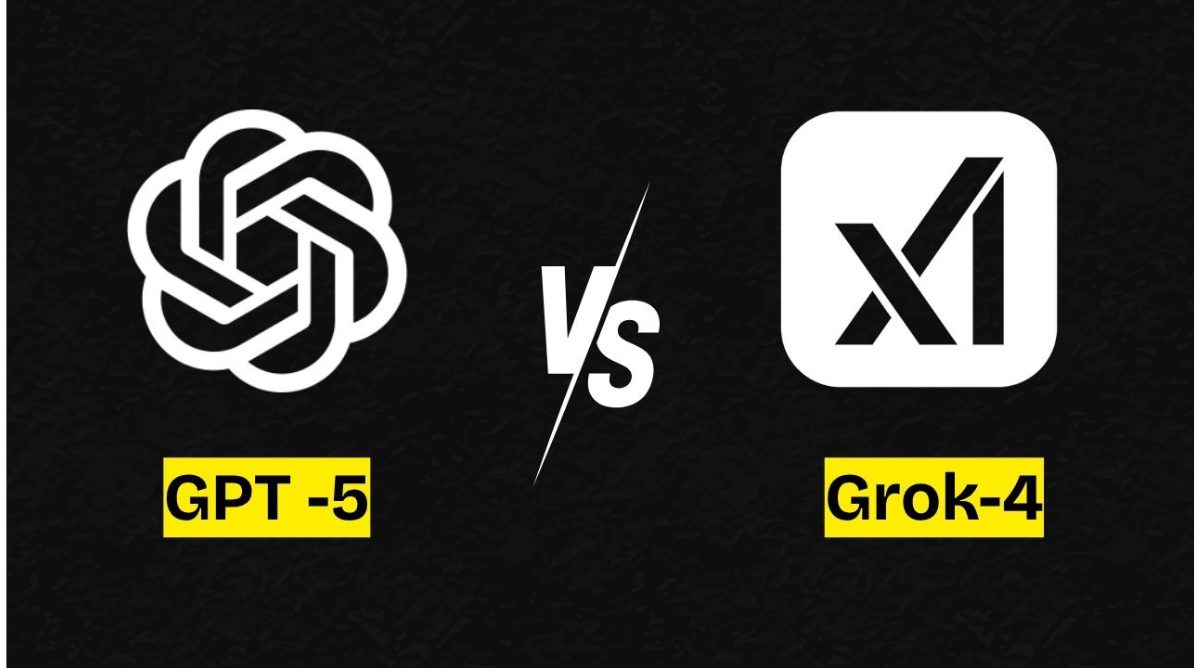
The AI conversation entering 2026 has fundamentally changed. The question is no longer which model has the most parameters or which tops a benchmark chart. Instead, decision-makers now ask which system can operate reliably inside real organizations, support agentic workflows, and deliver measurable ROI at scale. This shift reframes the comparison between GPT-5 vs Grok 4 as a strategic choice rather than a technical curiosity.
On one side, OpenAI’s ChatGPT-5 represents a disciplined, enterprise-grade approach focused on adaptive reasoning, safety alignment, and long-horizon workflows. On the other, xAI’s Grok 4 positions itself as a real-time, socially aware challenger built for speed, scale, and cultural relevance.
This article evaluates GPT-5 vs Grok 4 through the lens that matters most in 2026: system-level capability, agentic reliability, and deployment readiness. Rather than declaring a single “best AI,” we map each model to the environments where it actually wins so you can align your AI strategy with the realities of the year ahead.
What Is OpenAI’s ChatGPT-5?
OpenAI’s ChatGPT-5 is the flagship enterprise-grade large language model for 2026, engineered as a reliable, all-around performer rather than a novelty-driven system. Its core value lies in structured thinking, predictable behavior, and platform maturity, making it suitable for mission-critical environments where consistency matters more than speed alone.
Unlike experimental challengers, ChatGPT-5 is designed as a production-first reasoning engine, hardened through years of real-world deployment. It consistently leads traditional benchmarks while serving as the “safe default” for organizations that require explainability, governance, and long-term operational stability. The sections below explore how its architecture, context handling, and market positioning reinforce this role.
See how GPT-5 compares to Claude Opus 4.1 for long-context reasoning and enterprise use.
Read: gpt-5-vs-claude-opus-4-1
ChatGPT-5 Architecture and Adaptive Reasoning Model
At the architectural level, ChatGPT-5 builds on a transformer-based core enhanced with adaptive reasoning layers that dynamically adjust computational depth based on task complexity. Rather than applying uniform inference, the model selectively invokes deeper reasoning for logic-heavy, mathematical, or governance-bound problems, improving accuracy while controlling cost.
A critical refinement is its Mixture-of-Experts (MoE) routing, which directs queries to specialized sub-networks optimized for reasoning, synthesis, or execution. This design reduces unnecessary compute while maintaining precision, resulting in lower hallucination rates and stronger performance on long-horizon analytical tasks. As a result, ChatGPT-5 is well suited for environments where explainability, auditability, and reasoning traceability are non-negotiable.
ChatGPT-5’s 400K Token Context and Workflow Handling
The 400K-token context window is a defining capability of ChatGPT-5, enabling it to process extensive documents, datasets, and multi-stage workflows in a single coherent session. This is particularly valuable for enterprise research synthesis, legal analysis, technical audits, and large-scale content or SEO pipelines.
Beyond raw length, ChatGPT-5 excels at context persistence, allowing prior outputs to feed seamlessly into subsequent steps without truncation. This continuity supports agentic workflows, where intermediate reasoning, decisions, and references must remain consistent across hours or days. In production systems, this makes ChatGPT-5 a stable reasoning hub rather than a stateless query tool.
Market Positioning: The Reliable, Enterprise-Focused Benchmark Leader
In the 2026 market, ChatGPT-5 is positioned as the “consummate professional” an enterprise-first AI optimized for formal, academic, and regulated environments. Its neutral tone, reduced sycophancy, and governance-oriented design distinguish it from more personality-driven competitors.
Organizations in finance, healthcare, legal services, and large-scale SEO operations favor ChatGPT-5 because it combines benchmark leadership with operational trust. Features such as audit-ready outputs, safety-aligned responses, and high availability make it easier to scale pilots into production without retraining or behavioral risk. In practice, ChatGPT-5 functions less as a chatbot and more as a reliable benchmark baseline for enterprise AI systems.
What Is xAI’s Grok 4?
xAI’s Grok 4 is a real-time, socially aware challenger model built for environments where speed, live context, and cultural relevance outweigh formal governance. Released in mid-2025, Grok 4 positions itself as an alternative to enterprise-first systems by prioritizing immediacy, parallel reasoning, and a visibly opinionated interaction style.
Rather than functioning as a conservative reasoning core, Grok 4 is optimized to operate in fast-moving domains tracking trends, reacting to breaking events, and synthesizing social discourse as it unfolds. The sections below explain how its architecture, context design, and market stance reinforce this real-time strategy.
See how Perplexity compares with Grok for live data, search accuracy, and speed.
Read: perplexity-vs-grok
Grok 4’s 1.7T-Parameter Architecture and Real-Time Design
At the architectural level, Grok 4 uses a ~1.7 trillion–parameter hybrid Mixture-of-Experts (MoE) system, trained on xAI’s Colossus supercomputing cluster. This scale is not aimed at slow deliberation, but at maximizing throughput and responsiveness under real-time workloads.
A defining feature is its multi-agent inference modes, particularly Heavy, which spawns parallel reasoning agents to explore multiple hypotheses simultaneously. This favors breadth and speed over strict, linear problem decomposition. The result is faster iteration and higher responsiveness in time-sensitive scenarios, with the acknowledged trade-off that deeply governed, step-by-step reasoning may be less rigid than enterprise-first counterparts.
~256K Token Context and Native X Data Integration
Grok 4 supports a ~256K-token context window in its standard configuration, optimized for continuous, high-velocity conversations rather than archival analysis. While smaller than some enterprise-focused models, this context length aligns with its design goal: staying current rather than exhaustive.
Its primary differentiator is native integration with X. Instead of relying on delayed tool-based retrieval, Grok 4 directly ingests live social data streams, enabling real-time access to trending topics, sentiment shifts, and breaking narratives. This capability is especially valuable in media monitoring, market intelligence, and social-first content workflows, where freshness consistently outweighs historical depth.
Positioning: The Conversational, Real-Time Challenger
In the 2026 AI landscape, Grok 4 is positioned as the conversational, unfiltered challenger optimized for engagement, immediacy, and cultural alignment. Its interaction style is intentionally opinionated and informal, designed to feel responsive to the tone and pace of online discourse.
This positioning resonates with developers, analysts, and marketers who value speed, trend awareness, and personality over strict neutrality. At the same time, it introduces governance trade-offs that limit its suitability for compliance-heavy environments. Rather than replacing enterprise-first systems, Grok 4 excels where real-time awareness and execution velocity are the primary success metrics a contrast that becomes central in the final verdict.
Grok 4 Parameter Count (1.7T or 3T?)
xAI has indicated that Grok 4 uses approximately 1.7 trillion parameters in a hybrid Mixture-of-Experts (MoE) configuration.
However, this does not mean 1.7T parameters are active per query.
Like most MoE systems:
ActiveParameters<TotalParametersActive Parameters < Total Parameters
Only a subset of experts activate during inference. This allows:
Higher theoretical capacity
Lower effective inference cost
Parallel multi-agent reasoning modes
Some speculation references “3T parameters,” but no verified documentation confirms Grok 4 as a 3T active model. As of 2026, ~1.7T MoE capacity is the widely cited figure.
Why Parameter Count Matters Less in 2026
Raw parameter count ≠ strongest AI.
Modern performance depends on:
Training data quality
Inference-time compute
Routing efficiency
Alignment tuning
System orchestration
GPT-5’s parameter count has not been publicly disclosed, but its adaptive MoE routing likely places it in a similar frontier class.
GPT-5 vs Grok 4 Benchmarks (Latest 2026 Results)
SWE-Bench Verified (Real-World Software Issues)
GPT-5: Strong consistency on multi-file refactors
Grok 4: Competitive but more variable under long chains
Edge: GPT-5 for production engineering.
HumanEval (Code Generation Accuracy)
Grok 4: Often higher raw synthesis speed
GPT-5: More deterministic across retries
Edge: Grok 4 for speed, GPT-5 for stability.
AIME (Advanced Math Benchmarks)
Grok 4 Heavy: Extremely strong frontier reasoning
GPT-5: Slightly more stable structured math reasoning
Edge: Task-dependent.
Humanity’s Last Exam
Grok 4: Strong performance in niche PhD-level knowledge
GPT-5: More generalized reasoning reliability
Edge: Grok 4 for breadth exploration.
Benchmark Reality (2026)
Benchmarks show capability ceilings, not system reliability.
GPT-5 → stronger governance + structured workflows
Grok 4 → stronger burst reasoning + frontier compute
GPT-5 vs Grok 4 Coding Performance (2026)
Full-Stack Development
GPT-5 performs better in:
Large codebases
Dependency tracing
Architecture-level refactors
Long debugging chains
Best for: Production engineering.
Rapid Prototyping
Grok 4 excels at:
Fast script generation
Competitive programming
Multi-path experimentation
Short execution bursts
Best for: Technical exploration.
Long-Chain Agentic Coding
GPT-5 maintains:
Higher instruction persistence
Lower hallucination drift
More predictable tool invocation
Grok 4 Heavy:
Faster hypothesis generation
Parallel debugging attempts
Coding Verdict 2026
Best AI for enterprise coding → GPT-5
Best AI for rapid experimentation → Grok 4
Best overall hybrid strategy → Route planning to GPT-5, execution bursts to Grok 4
Is Grok 4 the Strongest AI Model in 2026?
Grok 4 is one of the strongest AI models in 2026 particularly in:
Multi-agent reasoning
Real-time data synthesis
Frontier math benchmarks
Parallel compute inference
However, “strongest” depends on criteria.
If strength means:
Governance + long-horizon reliability → GPT-5
Real-time intelligence + burst compute → Grok 4
There is no universal strongest model in 2026.
The strongest systems are orchestrated stacks, not standalone models.
Grok 4 vs GPT-5 vs Claude 4 (2026)
| Model | Primary Strength | Best For |
|---|---|---|
| GPT-5 | Governance + enterprise reliability | Long workflows, compliance |
| Grok 4 | Real-time + multi-agent speed | Trend analysis, R&D |
| Claude 4 | Structured reasoning + coding discipline | Production refactoring |
In 2026:
GPT-5 = enterprise controller
Grok 4 = frontier execution engine
Claude 4 = precision engineering layer
Core Technical Comparison: Architecture and Performance
In 2026, a technical comparison between GPT-5 and Grok 4 cannot rely on raw specifications alone. Parameter counts, context size, and peak benchmark scores now represent potential, not operational performance. What differentiates frontier models today is how they reason over time, recover from errors, and behave inside real systems under cost, latency, and governance constraints.
At a high level, OpenAI’s ChatGPT-5 follows a unified reasoning architecture optimized for long-chain stability, while xAI’s Grok 4 adopts a modular, multi-agent system optimized for speed and real-time responsiveness. The sections below unpack why this architectural split defines performance far more than headline specs.
See how Microsoft Copilot compares with ChatGPT for productivity, reliability, and everyday workflows.
Read: copilot-vs-chatgpt
Advanced Step-by-Step vs. Dynamic Contextual Reasoning
ChatGPT-5 is optimized for advanced step-by-step reasoning, using internal scaffolding to preserve structure and logical integrity across long outputs. Its reasoning model deliberately minimizes logical drift, making it especially reliable for multi-page documents, policy analysis, legal drafting, and enterprise code reviews where small errors compound over time.
Grok 4, particularly in its multi-agent (“Heavy”) mode, relies on dynamic contextual reasoning. Instead of linear deliberation, it spawns parallel reasoning paths that explore multiple hypotheses simultaneously, often invoking tools like live search or code execution mid-reasoning. This enables faster synthesis and broader exploration, but with looser structural guarantees. In practice, GPT-5 favors discipline and predictability, while Grok 4 favors speed, adaptability, and conversational flow a distinction that directly impacts agentic and coding workflows.
Benchmark Deep Dive: SWE-Bench, Human Eval, and AIME Dominance
Benchmarks such as SWE-Bench, HumanEval, and AIME remain valuable but only as partial signals. They measure isolated capabilities under controlled conditions, not system reliability under load.
- GPT-5 consistently performs strongly on SWE-Bench Verified, reflecting its ability to identify architectural issues and maintain correctness across complex codebases.
- Grok 4 often leads on HumanEval and advanced math benchmarks when parallel compute is enabled, demonstrating raw execution power and breadth.
- On frontier tests like Humanity’s Last Exam, Grok 4 shows a clear edge in niche, PhD-level knowledge exploration, while GPT-5 prioritizes generalized stability.
What benchmarks do not measure is instruction persistence, governance behavior, recovery from partial failure, or cost predictability factors that dominate real-world outcomes in 2026.
Interpreting Benchmarks for Real-World 2026 Applications
To translate benchmark scores into production value, teams must evaluate error tolerance, latency, cost, and trust not just accuracy. GPT-5’s higher deliberation cost is justified in environments where mistakes are expensive and outputs must be auditable. Grok 4’s lower latency and faster iteration cycles make it ideal for time-sensitive, exploratory, or trend-driven workloads.
In practice, benchmarks should inform architectural placement, not model loyalty. Many 2026 systems use tiered or hybrid deployments, reserving GPT-5 for high-stakes reasoning and Grok 4 for rapid execution layers. The winning strategy is not picking the highest score, but aligning benchmark strengths with operational realities.
Core Technical Comparison Table GPT-5 vs Grok 4 (Technical Reality)
| Dimension | ChatGPT-5 | Grok 4 |
| Reasoning Architecture | Unified, long-chain reasoning | Modular, multi-agent parallel reasoning |
| Strength Focus | Stability, correctness, governance | Speed, breadth, real-time synthesis |
| Benchmark Profile | Strong on SWE-Bench, AIME (structured tasks) | Leads on HumanEval, Humanity’s Last Exam |
| Latency Trade-off | Slower on complex queries due to deliberation | Faster responses via parallel inference |
| Error Behavior | Minimizes drift over long outputs | Tolerates messier intermediate reasoning |
| Best-Fit Workloads | Enterprise logic, audits, long-form analysis | Live analysis, rapid prototyping, research exploration |
| Production Risk | Low, predictable | Higher, context-dependent |
The 2026 Pivot: From Model-Centric to System-Centric Competition
By 2026, the industry has moved past evaluating isolated chatbots. Frontier models like GPT-5 and Grok 4 now function as the central nervous system inside compound AI systems coordinating tools, memory, agents, and verification loops. As the raw intelligence gap narrows, orchestration quality becomes the primary differentiator.
Success is no longer measured by a single prompt’s brilliance, but by a system’s ability to execute multi-step workflows without drift, integrate cleanly with existing software, and recover from partial failures. In this reality, models become components, not products selected, routed, and governed by the surrounding stack.
See how Grok stacks up against Claude for real-time insight, reasoning depth, and daily use.
Read: grok-vs-claude
Why Orchestration and Workflow Matter More Than Isolated Models
In production, reliability beats novelty. Orchestration layers convert probabilistic outputs into repeatable operations, enabling agents to plan, act, verify, and escalate across dozens or hundreds of steps without compounding errors.
Key system moats in 2026 include:
- Pipelines
Deterministic sequencing across models, tools, and data. - Memory
Scoped persistence that preserves context while respecting privacy. - Chain-of-verification
Self-checks between steps to prevent hallucination drift. - Observability
Real-time monitoring of errors, latency, and token spend.
These capabilities deliver ROI through repeatability and recovery, not peak accuracy. Teams that master orchestration can swap models as needs change; teams that don’t remain fragile regardless of benchmark gains.
GPT-5 and Grok 4 as Components in Larger AI Systems
Within system-centric architectures, GPT-5 and Grok 4 are routinely deployed side by side, each assigned to the role it performs best. Orchestration frameworks dynamically route tasks, prioritizing governance where risk is high and velocity where freshness matters.
AI Overview Comparison Roles in 2026 Systems
| Model | System Role | Primary Advantage |
| GPT-5 | Enterprise Controller | Long-chain reliability, policy enforcement, consistent synthesis |
| Grok 4 | Technical Specialist | Parallel test-time compute, live context, rapid execution |
In practice, enterprises often use GPT-5 for high-stakes oversight planning, validation, and synthesis while deploying Grok 4 for real-time execution such as trend monitoring or rapid analysis. This modularity reduces lock-in, improves cost control, and future-proofs deployments. In 2026, the winning strategy is not choosing the “smartest” model, but designing systems where multiple models collaborate under strong orchestration.
Agentic AI: The Defining 2026 Capability
In 2026, the defining leap in AI capability is agentic execution systems that move beyond answering questions to planning, acting, verifying, and adapting across long task chains. Agentic workflows now underpin real production outcomes: software delivery, research synthesis, content factories, and enterprise operations. The differentiator is not raw intelligence, but reliable autonomy at scale.
Agentic maturity determines whether AI can execute 50–100+ step workflows without hallucination drift, integrate tools safely, and recover from failure.
From Assistants to Autonomous “Super Agents” and Teams
AI has evolved from reactive assistants into autonomous “super agents” that function like team leads. These agents decompose high-level goals into sub-tasks, assign work to specialist agents, and verify outputs against live data often with minimal human intervention.
Core capabilities that enable this shift:
- Task decomposition
Breaks goals into ordered, executable steps. - Persistent memory
Retains context across sessions and retries. - Recursive self-correction
Pauses, reflects, and restarts when errors are detected. - Swarm collaboration
Coordinates planner, executor, and reviewer agents.
This team-based autonomy multiplies throughput, but it also raises the stakes making control and verification essential as autonomy grows.
Evaluating GPT-5 and Grok 4 for Agentic Workflow Potential
ChatGPT-5 leads in long-horizon agentic reliability. Its structured reasoning and strong instruction persistence deliver high success-per-step rates across extended workflows, making it suitable for agents that must plan carefully, maintain consistency, and produce auditable outputs within enterprise guardrails.
Grok 4 excels in high-velocity agentic execution. Native tool use, parallel reasoning, and live data access enable rapid exploration and short-burst autonomy ideal for trend detection, technical sprints, and real-time analysis. The trade-off is higher volatility over very long chains, where structure matters more than speed.
Agentic Capability Comparison (2026)
| Capability | GPT-5 | Grok 4 |
| Task persistence | Industry-leading on long chains | Strong on short sprints |
| Tool orchestration | Deep enterprise integrations | Native real-time + engineering tools |
| Self-correction style | Safety-first, halts on ambiguity | Goal-first, creative workarounds |
| Best-fit agents | Compliance, planning, synthesis | Trends, R&D, rapid execution |
The Critical Role of Governance and Bounded Autonomy
As agents gain permissions to move data, execute code, and trigger actions, bounded autonomy becomes mandatory. Governance defines what an agent may do, when it must stop, and how failures are handled preventing cascading errors or unauthorized actions.
Effective 2026 governance includes:
- Guardrails
Hard limits on actions and data access. - Verification checkpoints
Mandatory reviews between steps. - Human-in-the-loop escalation
Required approval for high-risk actions. - Auditability
Logs that explain decisions and outcomes.
In practice, governance is an enabler of scale, not a brake. Organizations that embed control into agentic systems deploy autonomy more confidently turning agents into durable assets rather than operational risks.
Practical Application Showdown
In 2026, choosing between GPT-5 and Grok 4 comes down to how work actually gets done not abstract capability. Daily outcomes are shaped by trade-offs between structure vs. speed, authority vs. immediacy, and verification vs. velocity. This section maps each model to real workflows so you can select the best fit for your priorities.
Coding: Full-Stack Development vs. Rapid Prototyping
GPT-5 is the stronger choice for full-stack, production-grade development. Its long context and structured reasoning support deep architectural work: multi-file refactors, dependency analysis, and extended debugging. Teams benefit from consistent logic, clearer explanations, and higher confidence when shipping code that must scale.
Grok 4 excels at rapid prototyping and scripting. Faster iteration and parallel reasoning enable quick experiments one-shot scripts, demos, or small apps built from a single prompt. The trade-off is less emphasis on long-horizon consistency, which is acceptable for spikes and proofs of concept.
Coding Fit (Quick Reference)
| Requirement | Better Fit |
| Large repos, refactors, audits | GPT-5 |
| One-shot scripts, demos | Grok 4 |
| Explainability & reviews | GPT-5 |
| Iteration speed | Grok 4 |
Content Creation: Long-Form Authority vs. Trend-Driven Engagement
For long-form authority, GPT-5 leads. It sustains structure, tone, and factual grounding across extended drafts ideal for SEO pillars, whitepapers, and compliance-sensitive content. Its long context preserves narrative continuity and supports E-E-A-T–aligned outputs.
Grok 4 is optimized for trend-driven engagement. With a bold, conversational style and live context awareness, it produces timely hooks, headlines, and social-first copy. This favors immediacy and cultural resonance over evergreen depth.
Content Fit (Quick Reference)
| Goal | Better Fit |
| SEO pillars, research, evergreen | GPT-5 |
| Viral hooks, social posts | Grok 4 |
| Brand consistency | GPT-5 |
| Cultural immediacy | Grok 4 |
Real-Time Analysis: Tool-Assisted Data vs. Native X Integration
GPT-5 relies on tool-assisted retrieval (search/RAG) to access fresh data with emphasis on verification and traceability. This approach suits professional contexts where accuracy, citations, and audit trails matter even if results arrive slightly slower.
Grok 4 benefits from native X integration, delivering immediate access to live discourse, sentiment shifts, and breaking events. It excels where freshness and speed are paramount, though users must manage social-data noise and bias.
Real-Time Fit (Quick Reference)
| Requirement | Better Fit |
| Verified, citeable data | GPT-5 |
| Live trends & sentiment | Grok 4 |
| Governance & audit trails | GPT-5 |
| Speed-first insights | Grok 4 |
Comparison Practical Workflows (2026)
| Workflow | Recommended Model | Primary Reason |
| Enterprise software | GPT-5 | Structural reliability in large codebases |
| Social media & marketing | Grok 4 | Live trends and engaging personality |
| Scientific exploration | Grok 4 (Heavy) | Strong frontier reasoning for niche domains |
| Long-form SEO | GPT-5 | Sustained context and factual grounding |
| Time-sensitive analysis | Grok 4 | Native real-time social intelligence |
The Enterprise Scaling Gap in 2026
By 2026, the real divide is not between “smart” and “smarter” models but between organizations that run AI demos and those that operate AI factories. While most teams can launch pilots, many fail to scale due to cost overruns, workflow drift, and weak governance. At enterprise scale, success depends on industrialization: repeatable pipelines, predictable economics, and auditable outcomes.
Moving from Experimentation to Production with AI “Factories”
AI factories convert ad-hoc prompting into agentic production lines systems that trigger thousands of automated tasks with SLAs, versioning, and rollback. Models become raw materials, routed by orchestration to deliver throughput with quality.
Factory roles in practice
- ChatGPT-5 Compliance Manager
Oversees long-horizon workflows, validates outputs against brand/legal standards, and maintains consistency across large volumes. - Grok 4 Technical Engineer
Executes high-complexity, low-latency tasks (e.g., instant refactors, live analysis) where speed and depth matter.
Operational maturity markers
- Standardized pipelines with A/B testing and rollbacks
- Human-in-the-loop for edge cases
- Observability across errors, latency, and spend
- Model tiering to separate planning from execution
Factories replace one-off wins with repeatable value.
Cost-Performance and FinOps: A Core 2026 Architectural Concern
In 2026, FinOps is architecture. Teams design systems around model routing to optimize cost-per-insight and avoid viral overruns.
What works
- Tiered routing: frontier models plan; cheaper models execute
- Burst control: caps and alerts to prevent spend spikes
- Throughput tuning: batching and context minimization
Cost reality (illustrative)
- GPT-5 is more predictable for high-volume scaling (≈ $1.25 / 1M input tokens)
- Grok 4 remains premium (≈ $3.00 / 1M) best reserved for tasks that require live X data or frontier reasoning
Data, Governance, and the Path to Measurable ROI
ROI in 2026 is driven by trusted data + governance, not benchmarks. Enterprises isolate proprietary data in private instances, enforce redaction and access controls, and require audit trails to accelerate adoption.
Why governance multiplies ROI
- Trust → faster user adoption
- Auditability → regulatory readiness
- Control → fewer costly errors
- Measurement → KPIs tied to dollars saved or earned
AI Factory ROI Profiles (2026)
| Metric | GPT-5 Factory Profile | Grok 4 Factory Profile |
| Scalability | High (global enterprise infra) | Emerging (rapidly expanding cloud) |
| Audit trail | Comprehensive reasoning logs | Technical execution logs |
| Cost predictability | Strong | Variable (burst-prone) |
| ROI focus | Efficiency & compliance | Innovation speed & edge |
Bottom line: Enterprises that scale succeed by measuring task completion per dollar, pairing governance with FinOps, and routing work to the right model at the right time.
The Broader 2026 AI Context: Strategy and Sovereignty
In 2026, AI strategy is shaped less by feature comparisons and more by sovereignty, efficiency, and economic realism. Decisions around GPT-5 and Grok 4 are increasingly constrained by where data can live, how models are governed, and whether deployments deliver measurable value at scale. The competitive edge now comes from deployable stacks, not parameter races.
AI Sovereignty, Regulation, and the Evolving Global Landscape
AI sovereignty has become a geopolitical imperative. Nations and regions are asserting control over data, infrastructure, and models to meet security and regulatory requirements. This has fragmented the global AI landscape and reshaped vendor strategies.
Key realities in 2026:
- Data locality mandates
Jurisdictions require in-country or regional processing for sensitive data. - Regulatory enforcement
Risk-based frameworks demand documentation, audits, and controls. - Geopolitical hedging
Enterprises adopt multi-model stacks to avoid vendor or region lock-in.
In practice, ChatGPT-5 aligns more easily with compliance-by-design deployments (audit trails, private instances), while Grok 4 may face geographic constraints due to its real-time social data ties often leading to region-specific configurations. Strategy now means matching models to regulatory zones, not forcing a one-size-fits-all rollout.
The Efficiency Frontier: The Rise of Smaller, Optimized Models
The industry has crossed the efficiency frontier. “Bigger is better” has given way to smaller, optimized models that deliver most of the value at a fraction of the cost. Enterprises increasingly deploy SLMs (Small Language Models) for routine tasks and reserve frontier models for complex reasoning.
What defines the efficiency-first stack:
- Model routing
80–90% of tasks handled by small, specialized models. - Frontier escalation
GPT-5 or Grok 4 invoked only for high-value reasoning. - Specialization
Domain-tuned models outperform generalists in targeted workflows.
This approach shifts competition to system efficiency how well orchestration routes tasks rather than raw scale.
Market Realism: Deflating the Bubble and Focusing on Value
The exuberance of earlier AI cycles has given way to market realism. In 2026, leaders demand proof: What does it cost? What breaks? What value does it deliver? Benchmarks are secondary to operational KPIs.
Signals of realism:
- ROI-first metrics
Cost per task, completion rate, uptime SLAs. - Infrastructure focus
Compute, energy, data pipelines, and security now dominate planning. - Selective autonomy
Agents deployed where value is provable, not everywhere.
FAQ: GPT-5 vs Grok 4 (2026)
Which AI model is better overall in 2026?
There is no single winner ChatGPT-5 excels in enterprise reliability, long-horizon reasoning, and governed workflows, while Grok 4 leads in real-time intelligence, speed, and socially aware analysis. The better choice depends on whether your priority is structured system reliability or live, high-velocity insight.
Which model is safer for enterprise and regulated use?
GPT-5 is widely considered the safer enterprise default due to bounded autonomy, audit logs, and compliance alignment with regulations such as GDPR and the EU AI Act. Grok 4 can be used in enterprises but typically requires additional governance layers because it prioritizes transparency and speed over strict moderation.
Which AI model is faster?
Grok 4 is faster in most real-time and exploratory scenarios, benefiting from parallel reasoning modes and native live-data access. GPT-5 intentionally trades some speed for verification and reasoning stability, especially on complex, multi-step tasks.
Which AI is cheaper in 2026?
For high-volume, predictable workloads, GPT-5 is more cost-efficient with lower standard token pricing and better model routing support. Grok 4 is a premium option, justified mainly when real-time X data or frontier technical reasoning materially impacts outcomes.
Which model is better for coding?
GPT-5 performs better in full-stack development, large codebases, and architectural review, where consistency and error control matter. Grok 4 shines in rapid prototyping and scripting, especially when speed outweighs long-term maintainability.
Which AI is better for content creation and SEO?
GPT-5 is stronger for long-form, authoritative, and compliance-sensitive content, including whitepapers and evergreen SEO assets. Grok 4 is better suited for trend-driven, social-first content that benefits from live discourse and cultural relevance.
Does Grok 4 really have better real-time data?
Yes, Grok 4 has a clear advantage in real-time awareness due to its native integration with live X data streams. GPT-5 relies on tool-assisted retrieval, which is more controlled and verifiable but less immediate.
How do context windows compare?
GPT-5 supports a larger 400K-token context window, making it ideal for document-heavy workflows and long research sessions. Grok 4 supports around 256K tokens, with specialized fast variants extending this for burst analysis.
Which model is better for agentic workflows?
GPT-5 is more reliable for long-horizon agent chains, maintaining stability across dozens of steps with minimal drift. Grok 4 performs best in short, high-intensity agent tasks where rapid execution and live data matter most.
Which AI is more future-proof?
The most future-proof strategy in 2026 is not choosing one model, but orchestrating both within a system-centric stack. Organizations that combine GPT-5 for governance and synthesis with Grok 4 for real-time execution consistently outperform single-model deployments.
Final Verdict: Aligning Choice with 2026’s Realities
In 2026, the GPT-5 vs Grok 4 decision is no longer about which model is “smarter,” but which one aligns with your operational reality. ChatGPT-5 is the safest choice for organizations that prioritize institutional reliability, governance, and predictable ROI, making it ideal for enterprise workflows, regulated industries, and large-scale AI factories where consistency matters more than speed. In contrast, Grok 4 delivers a technical and real-time edge, excelling in live data analysis, frontier research, and rapid prototyping where immediacy and creative latitude drive value.
For most mid-to-large organizations, the optimal strategy is hybrid: route high-volume, compliance-sensitive tasks through GPT-5, while reserving Grok 4 for high-impact, real-time or breakthrough work.