10 Best AI Tools for Developers in 2026
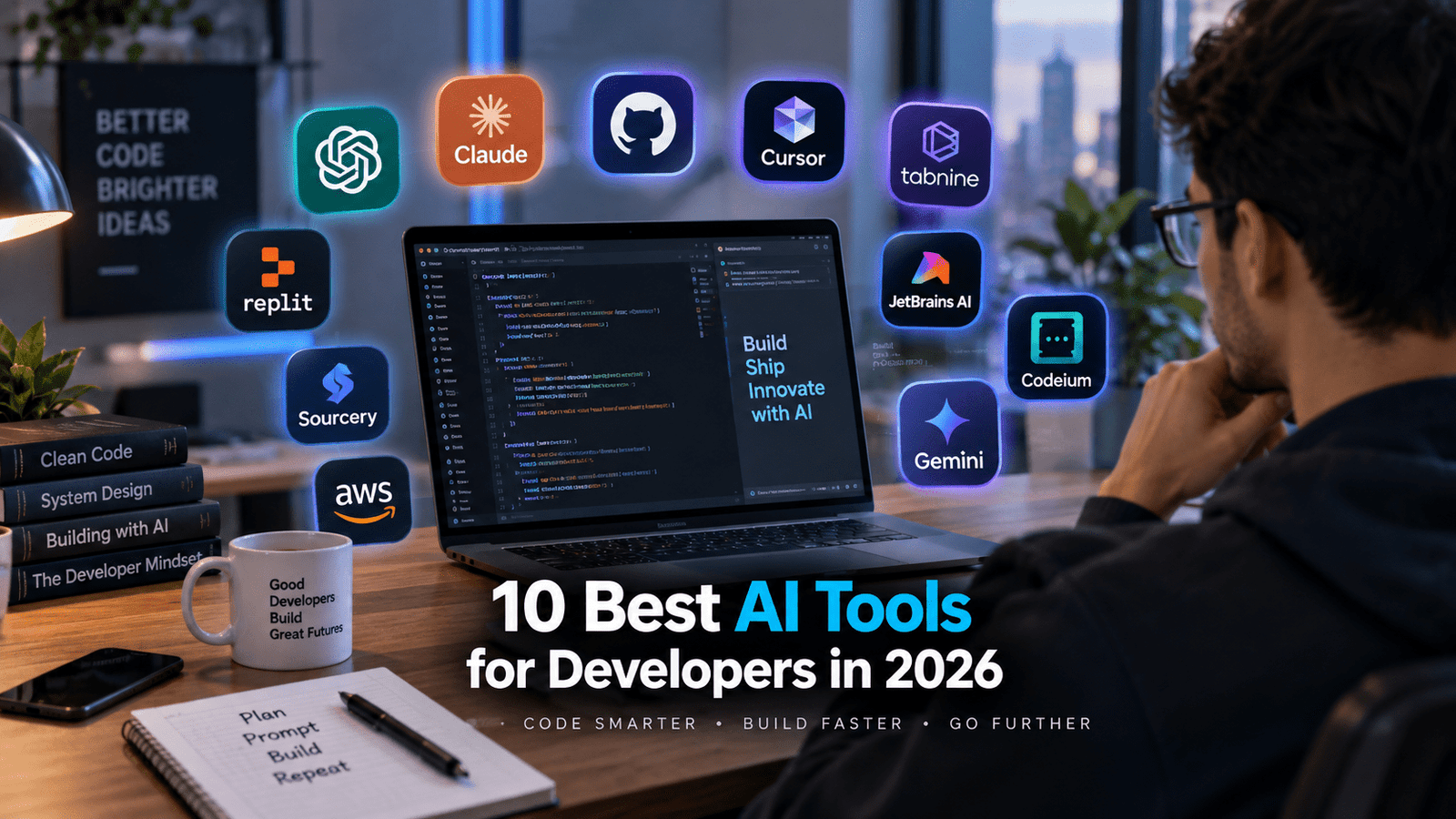
I have accounts open on six of these tools right now, and I switch between three of them in a normal week depending on the task. If you only pick one AI tool for developers in 2026, start with GitHub Copilot for GitHub-based teams or Claude Code for repo-wide agentic work — then add a second tool once you hit that first one’s limits. No single assistant covers autocomplete, agentic refactors, and plain-language debugging equally well. For a related comparison, see AI Comparison.
This roundup covers 8 AI tools for developers: GitHub Copilot, Claude Code, Cursor, Gemini Code Assist, Amazon Q Developer, JetBrains AI Assistant, Windsurf, and ChatGPT. Each entry lists verified pricing, real feature specs, and who it actually fits — not a generic “great for everyone” writeup.
How We Evaluated These AI Tools for Developers
We scored each tool against five criteria: IDE and language support, code-completion and agentic quality, context window size, pricing per seat, and platform stability. Every price below was checked against the tool’s official pricing page on September 17, 2026. We favored tools with documented benchmarks or vendor-published specs over marketing claims, and flagged any tool with pending platform changes (like Amazon Q Developer‘s transition to Kiro).
Quick Comparison Table
| Tool | Best For | Starting Price | Standout Feature |
|---|---|---|---|
| GitHub Copilot | Teams already living in GitHub | Free (Pro $10/mo) | Unlimited inline completions on paid plans, usage-based AI Credits for chat/agent mode |
| Claude Code | Repo-wide agentic engineering | Bundled in Claude Pro, $20/mo | Reads, plans, and diffs across a full codebase in one session |
| Cursor | Daily in-editor coding | Free (Pro $20/mo) | Credit-pooled access to multiple frontier models with Auto routing |
| Gemini Code Assist | Google Cloud-native teams | $19/user/mo (Standard) | Deep Google Cloud and Workspace integration |
| Amazon Q Developer | Existing AWS shops | Free (Pro $19/user/mo) | Native AWS service awareness plus IP indemnity |
| JetBrains AI Assistant | JetBrains IDE users | Free (Pro $10/mo) | Local model support (Ollama, LM Studio) works fully offline |
| Windsurf | Agentic “flow” sessions | Free (Pro $20/mo) | Proprietary SWE-1.5 model with background cloud agents |
| ChatGPT | Debugging/explaining outside the IDE | Free (Plus $20/mo) | Codex coding agent plus general-purpose reasoning |
1. GitHub Copilot — Best for Teams Already Building on GitHub
GitHub Copilot is the most practical pick for any team that already runs its workflow through GitHub issues, pull requests, and Actions. As of September 2026, Copilot uses usage-based billing: Free, Pro at $10/month, Pro+ at $39/month, and Max at $100/month for individuals, plus Business at $19/user/month and Enterprise at $39/user/month for teams. Paid plans include a monthly pool of GitHub AI Credits — $15 on Pro, $70 on Pro+, $200 on Max — that only chat, agent mode, code review, and the Copilot CLI draw from.
Inline code completions and next-edit suggestions stay free and unlimited on every paid plan and never touch the credit pool.
Pros:
– Native integration with GitHub pull requests, Actions, and code review — no separate account or context switch.
– Unlimited inline completions on paid tiers regardless of credit usage.
– Enterprise tier adds org-wide policy controls and audit logging for regulated teams.
Cons:
– Usage-based credits mean heavy agent-mode or chat users can burn through the monthly pool and hit overage charges.
– Less capable than dedicated agentic tools for large, multi-file refactors.
Copilot fits developers who want AI assistance layered directly onto a GitHub-centric workflow without adopting a new editor or platform.
2. Claude Code — Best for Repo-Level Agentic Engineering
Claude Code is the strongest option for reading an unfamiliar codebase, planning a multi-file change, and producing a working diff in one pass. There’s no standalone Claude Code subscription — it ships bundled with Claude Pro ($20/month, or $17/month billed annually), Max 5x ($100/month), Max 20x ($200/month), or a Team Premium seat ($100/seat/month, five-seat minimum). The free Claude tier does not include Claude Code at all.
Anthropic’s current flagship coding model has been reported scoring 80.8% on the SWE-bench Verified benchmark, a third-party measure of real GitHub issue resolution — worth confirming against Anthropic’s own release notes before quoting to a team. For a related comparison, see Best AI Coding Assistant.
Pros:
– Handles repo-scale context: reading multiple files, tracing dependencies, and planning before editing.
– Runs from the terminal, so it fits into existing CLI-based workflows without an IDE switch.
– Heavy daily users typically pay less on a Max plan than on metered API billing.
Cons:
– No free tier and no standalone low-cost plan — the cheapest access is a full $20/month Claude Pro subscription.
– Terminal-first workflow has a learning curve for developers used to inline IDE suggestions.
Claude Code fits developers who spend more time understanding and restructuring existing code than writing net-new boilerplate.
3. Cursor — Best for Daily In-Editor Coding
Cursor is the better daily driver when you already know what change you want to make and just need the editor to move fast with you. Pricing in September 2026 spans Hobby (free), Pro ($20/month), Pro+ ($60/month), Ultra ($200/month), and Teams — a Standard seat at $40/month or a Premium seat at $120/month, both discounted roughly 17% annually. Enterprise pricing is custom.
Cursor runs on a shared credit pool sized to the plan price: Auto mode routes requests across models without a flat rate, while manually selecting a specific frontier model like Claude Sonnet draws down the pool faster.
Pros:
– Fast, VS Code-based editor with minimal workflow disruption for existing VS Code users.
– Auto mode gives unlimited-feeling usage for routine edits without manual model selection.
– Multi-model access (Claude, GPT, Gemini variants) inside one interface.
Cons:
– Manually picking premium models for every task can exhaust monthly credits and trigger overage billing.
– Team pricing jumped in 2026 with the new $120/month Premium seat, raising costs for teams that want the best models by default.
Cursor suits developers who want an AI-native editor rather than a plugin bolted onto an existing one. For a closer look at how it stacks up against the other GitHub-native option, see Cursor vs Copilot.
4. Gemini Code Assist — Best for Google Cloud-Native Teams
Gemini Code Assist is the strongest choice for teams already standardized on Google Cloud and Workspace. Google discontinued the free individual Code Assist tier on June 18, 2026, redirecting solo and Gemini AI Pro/Ultra users toward Antigravity instead. Teams now need the Standard plan at $19/user/month (annual) or $22.80/user/month (monthly), or Enterprise at $45/user/month annual, which adds private codebase customization and admin controls.
Usage-based API calls on top of the seat fee are billed at the underlying Gemini model’s token rate.
Pros:
– Deep integration with Google Cloud services, IAM, and Workspace for teams already in that ecosystem.
– Enterprise tier supports private codebase customization so suggestions reflect internal patterns.
– Admin controls and org-wide policy management built for regulated environments.
Cons:
– No more free tier for individual developers as of mid-2026 — solo devs are pushed toward a separate product.
– Less useful outside a Google Cloud-centric stack compared to editor-agnostic tools like Copilot or Cursor.
Gemini Code Assist fits engineering teams whose infrastructure, identity, and CI/CD already run on Google Cloud.
5. Amazon Q Developer — Best for Existing AWS Shops (With a Caveat)
Amazon Q Developer still makes sense for teams deep in AWS today, but it comes with an expiration date worth knowing before you commit. The Free tier includes unlimited code completions, 50 agent chat interactions per month, and 1,000 lines of code transformation per month. The Pro tier costs $19/user/month and adds unlimited agent interactions, IP indemnity, and automatic opt-out of data retention and model training.
AWS closed new Q Developer signups on May 15, 2026, and support for the existing IDE plugins and paid subscriptions ends April 30, 2027, as the company shifts focus to its successor, Kiro.
Pros:
– IP indemnity on the Pro plan protects teams if AI-generated code triggers a licensing claim.
– Deep native awareness of AWS services for teams building directly on AWS infrastructure.
– Automatic data-retention opt-out on Pro, useful for compliance-sensitive teams.
Cons:
– New signups are already closed, and support ends April 30, 2027 — a real migration deadline, not a hypothetical one.
– Teams starting fresh should evaluate Kiro, Copilot, or Cursor instead of onboarding onto a sunsetting product.
Amazon Q Developer is a reasonable holdover for existing AWS-heavy teams, but not a tool to newly adopt in 2026.
6. JetBrains AI Assistant — Best for JetBrains IDE Users
JetBrains AI Assistant is the natural pick for anyone already paying for IntelliJ IDEA, PyCharm, WebStorm, or another JetBrains IDE. The Free tier includes 3 AI credits every 30 days plus unlimited local code completion and local model support through Ollama, LM Studio, and llama.cpp. AI Pro costs $10/month with 10 monthly credits, and AI Ultimate costs $30/month with 35 monthly credits — each credit corresponds to $1 of usage, with a roughly 17% discount for annual billing.
For developers already on a JetBrains IDE subscription, AI Assistant adds no incremental licensing cost beyond the AI plan itself — it’s a feature inside the IDE they already own, not a separate product to install.
Pros:
– Local model support means completions can run fully offline with no data leaving the machine.
– Tight integration with JetBrains’ refactoring tools and project indexing.
– Transparent, dollar-equivalent credit system that’s easy to budget against.
Cons:
– Full agentic capability is gated behind paid credits — the free tier is completion-only, not agent-driven.
– Only makes sense as a primary tool if you’re already committed to a JetBrains IDE.
JetBrains AI Assistant fits developers who value staying inside one IDE ecosystem and want an offline-capable option. If you’re torn between it and Cursor for a JetBrains-heavy team, see Cursor vs JetBrains AI.
7. Windsurf — Best for Agentic “Flow” Sessions
Windsurf is built around longer, semi-autonomous coding sessions rather than line-by-line suggestions. Its 2026 pricing is Free, Pro at $20/month, Max at $200/month, Teams at $40/user/month, and custom Enterprise pricing. On March 19, 2026, Windsurf retired its credit-based system in favor of daily and weekly usage quotas, and Pro’s price moved from $15 to $20 as part of that overhaul.
Windsurf runs on its own proprietary SWE-1.5 model and offers cloud sessions that keep working on a task in the background while a developer moves to something else; tab autocomplete stays unlimited on every plan, including Free.
Pros:
– Background cloud sessions let an agent keep working on a task without blocking the editor.
– Unlimited tab autocomplete on every tier, including Free.
– Proprietary SWE-1.5 model tuned specifically for coding workflows.
Cons:
– Daily/weekly quotas replaced the more granular credit system, making usage limits less predictable to plan around.
– Max tier at $200/month is a steep jump from Pro for teams that outgrow standard quotas.
Windsurf suits developers who want to hand off a defined task and check back later, rather than staying in a constant suggest-and-accept loop.
8. ChatGPT — Best for Debugging and Explaining Code Outside the IDE
ChatGPT is the tool I reach for when a bug needs a plain-language explanation rather than an inline fix. ChatGPT Plus costs $20/month and includes general coding help through chat, while OpenAI’s dedicated coding agent, Codex, has required a ChatGPT Pro subscription at $200/month for its newest model releases. Codex itself ships as a web app feature, a CLI, a desktop app, and IDE integrations, and had grown past 2 million weekly active users by March 2026.
Because ChatGPT isn’t tied to a single editor or repo, it works well for one-off questions — pasting a stack trace, asking for a second opinion on an approach, or getting a concept explained without opening a project.
Pros:
– Editor-agnostic — useful for quick questions without opening a project or repo.
– Codex agent extends it into real coding-agent territory for developers on the Pro tier.
– Broad general-reasoning ability helps with architecture questions, not just syntax.
Cons:
– The newest Codex model capability sits behind the $200/month Pro tier, not the $20 Plus plan.
– Lacks the persistent repo-level context that Claude Code or Cursor maintain across a session.
ChatGPT fits developers who want a general-purpose thinking partner alongside a dedicated in-editor tool, not as a replacement for one.
How to Choose the Right AI Coding Tool
Match the tool to your IDE first, then to your team’s structure. JetBrains shops get more value from JetBrains AI Assistant than from an IDE-agnostic tool; VS Code-based teams have Copilot, Cursor, and Windsurf all as native fits.
Pricing structure matters as much as the sticker price. Solo developers should weigh flat monthly fees (Claude Pro, ChatGPT Plus) against credit-metered plans (Copilot, Cursor) based on how much agent/chat usage they actually expect, not just the advertised minimum.
Security and compliance needs narrow the field quickly. Regulated teams should check for IP indemnity (Amazon Q Developer Pro), data-retention opt-outs (Amazon Q Developer Pro, Enterprise tiers generally), and admin/audit controls (GitHub Copilot Enterprise, Gemini Code Assist Enterprise) before rolling a tool out org-wide.
Language and framework support is usually broad across all eight tools, so the deciding factor is typically integration depth — how well the tool understands your specific cloud provider, IDE, or existing CI/CD pipeline — rather than raw language coverage.
Final Recommendation
Choose GitHub Copilot if you’re a solo developer or small team already living in GitHub and want unlimited inline completions without managing a separate credit budget for basic autocomplete.
Choose Claude Code if you’re an enterprise team doing frequent large-scale refactors and repo-wide changes, and can justify a $20-$200/month-per-seat Claude subscription for that depth of context.
Choose JetBrains AI Assistant if your team standardized on IntelliJ, PyCharm, WebStorm, or another JetBrains IDE and wants AI assistance without leaving that ecosystem or paying for a second tool.
Choose Cursor or Windsurf if you’re a VS Code power user who wants agentic, multi-step workflows built into the editor itself rather than bolted on as an extension. If you’re specifically weighing Claude Code against OpenAI’s coding agent, see Claude Code vs OpenAI Codex for a direct breakdown.
FAQ
Is GitHub Copilot worth it for solo developers?
Yes, for most solo developers on GitHub — the $10/month Pro plan includes unlimited inline completions plus a $15 monthly AI Credit pool for chat and agent mode. It’s the lowest-cost entry point among the agent-capable tools in this list.
Can AI coding tools see my private repositories or code?
It depends on the tool and plan. Enterprise and Pro tiers from GitHub Copilot, Amazon Q Developer, and Gemini Code Assist typically include data-retention opt-outs and org-level policy controls, while free tiers often have looser data-handling terms — always check the specific tool’s data policy before connecting a private repo.
What’s the difference between code completion and an agentic coding tool?
Code completion suggests the next few lines or a single function as you type, while an agentic tool like Claude Code or Windsurf’s cloud sessions can read multiple files, plan a change, and produce a multi-file diff with less step-by-step guidance. Most tools in this list, including Copilot and Cursor, now offer both modes.
Which AI coding tool works best on large codebases?
Claude Code is built specifically for repo-scale context — reading a codebase, tracing dependencies, and planning before editing. Cursor and Windsurf also handle larger projects well through their agentic modes, though exact context-window limits vary by the underlying model selected.
Is Amazon Q Developer still worth adopting in 2026?
Not for new signups — AWS closed new Q Developer registrations on May 15, 2026 and ends support on April 30, 2027, redirecting new users to Kiro. Existing AWS teams already on Q Developer can keep using it until then, but should plan a migration.
Do AI coding tools replace the need to learn to code?
No. Every tool in this list still requires a developer to review, test, and understand generated code before shipping it — none of them remove the need for underlying programming knowledge, especially for debugging and architectural decisions.
Final Verdict
There’s no single best AI tool for developers in 2026 — the right pick depends on your IDE, your team size, and how much agentic autonomy you actually want. GitHub Copilot and JetBrains AI Assistant are the safest starting points for individuals already committed to an ecosystem, while Claude Code and Cursor lead for teams that want deeper, repo-wide agentic work. Most professional developers end up running two tools, not one — a completion-focused assistant for daily editing and an agentic tool for larger, less-supervised tasks.

Arslan Abid
AI tools reviewer · AIComparison.ai
5 years analyzing AI platforms, pricing, and feature comparisons across the AI tools landscape. Last updated: September 2026.