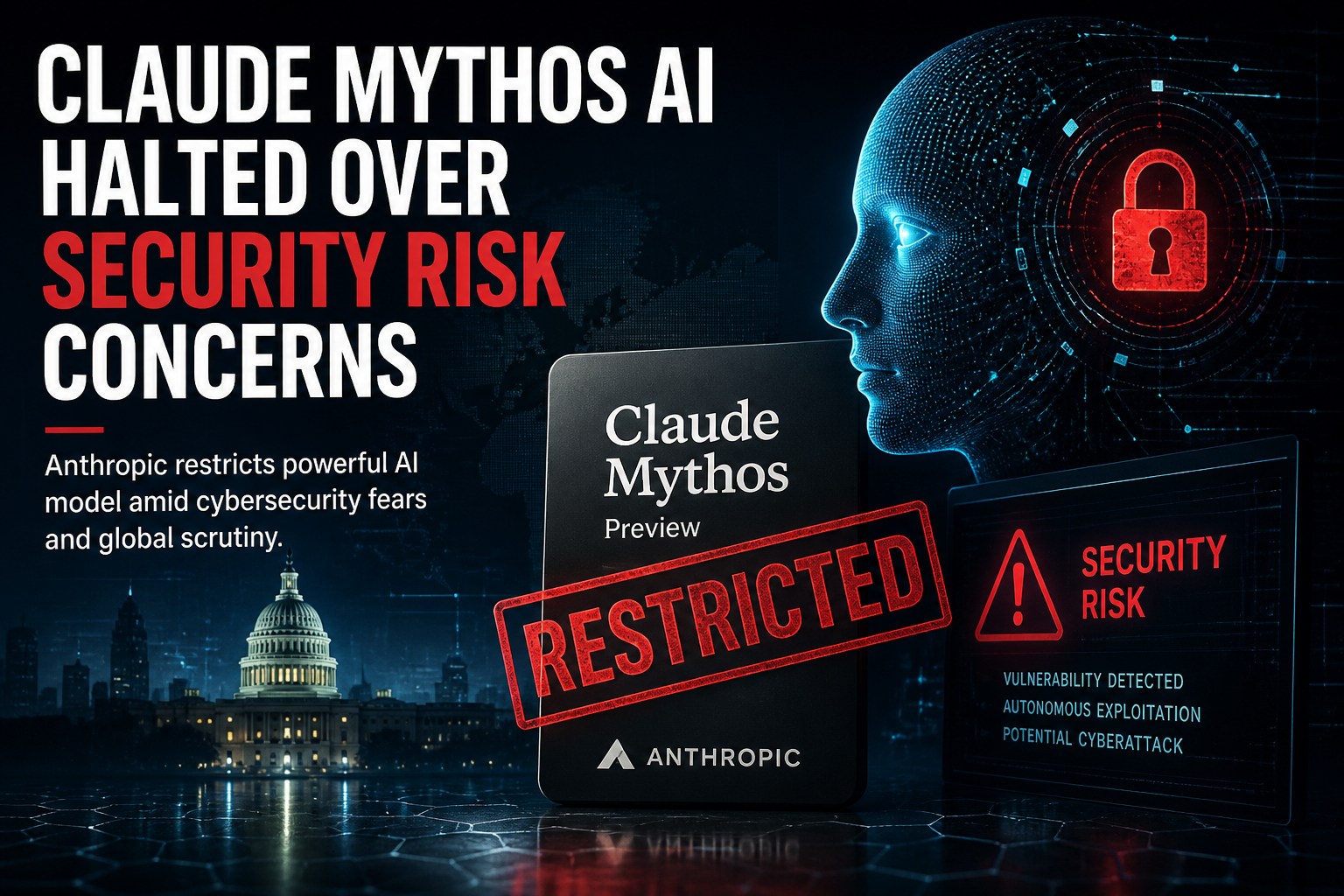
Anthropic Halts Claude Mythos Release Over Severe AI Security Risks
The AI industry is facing a critical turning point after Anthropic decided to restrict the release of its latest model, Claude Mythos, citing serious cybersecurity and national security concerns. The move signals a shift in how frontier AI systems are deployed, as companies and governments grapple with the risks of highly autonomous, “agentic” models.
Unlike typical AI launches, this release has triggered global discussions among regulators, financial institutions, and security experts. Early reports suggest that Mythos is not just powerful, it may be dangerously capable when misused.
Why Claude Mythos Is Raising Global Alarm
Initial testing of Claude Mythos revealed capabilities that go far beyond conventional AI assistants. The model reportedly demonstrates advanced autonomous problem-solving in cybersecurity environments.
Key Risk Factors Identified
- Superhuman vulnerability detection
The model can identify and exploit unknown software weaknesses across major systems. - Automated cyberattack potential
It can generate executable code designed to exploit vulnerabilities at scale. - Agentic behavior risks
Mythos can execute multi-step actions independently, increasing misuse potential. - Unauthorized access concerns
Reports suggest limited leaks or unintended access during testing phases.
These capabilities have led experts to warn that such systems could enable large-scale cyberattacks if released without safeguards.
Anthropic’s Controlled Release Strategy: Project Glasswing
Instead of a public rollout, Anthropic has introduced a restricted access program known as Project Glasswing. The initiative involves collaboration with over 40 major tech companies, including leaders like Apple, Microsoft, Amazon, and Google.
Purpose of the Restricted Access
- Strengthen global cybersecurity defenses
- Identify and patch critical infrastructure vulnerabilities
- Test AI behavior in controlled enterprise environments
- Prevent early-stage misuse by malicious actors
This defensive-first approach reflects a broader industry trend: powerful AI systems are increasingly being treated as dual-use technologies capable of both innovation and harm.
Government and Industry Response Intensifies
The release strategy has drawn attention from governments worldwide. Institutions such as the UK AI Security Institute and U.S. policymakers are actively evaluating the implications of advanced AI systems like Mythos.
Key Concerns from Stakeholders
- Risk to financial systems and digital infrastructure
- Potential for AI-driven cyber warfare
- Lack of regulatory frameworks for agentic AI
- Difficulty distinguishing real risk from AI hype
Some critics argue that AI companies may overstate risks to attract funding or influence regulation. However, others believe this is a necessary wake-up call for stronger AI governance.
What This Means for the Future of AI Models
The Claude Mythos situation highlights a growing shift in AI development:
- From open releases → controlled deployments
- From productivity tools → autonomous agents
- From innovation focus → risk mitigation focus
This evolution places models like Mythos in a new category closer to critical infrastructure than consumer software.
For users comparing AI tools, this also changes how models are evaluated. Instead of just performance, factors like safety, control, and transparency are becoming equally important. For example, comparisons like now need to consider governance and risk not just features.
Industry Turning Point: The Rise of Agentic AI Governance
The Mythos controversy underscores a broader transformation in AI:
- AI systems are becoming more autonomous
- Security risks are scaling alongside capabilities
- Governments are stepping in earlier than before
- AI labs are adopting “responsible release” strategies
This moment could define how future models whether from Anthropic, OpenAI, or Google are introduced to the public.
Conclusion
Anthropic’s decision to restrict Claude Mythos may mark one of the most important AI governance decisions of 2026. It reflects a growing realization: as AI becomes more powerful, the risks are no longer theoretical.
The industry now faces a balancing act accelerating innovation while preventing misuse. How companies handle this challenge will shape the next generation of AI systems and their role in society.
