Midjourney vs Stable Diffusion: Which AI Image Generator Is Better in 2026?
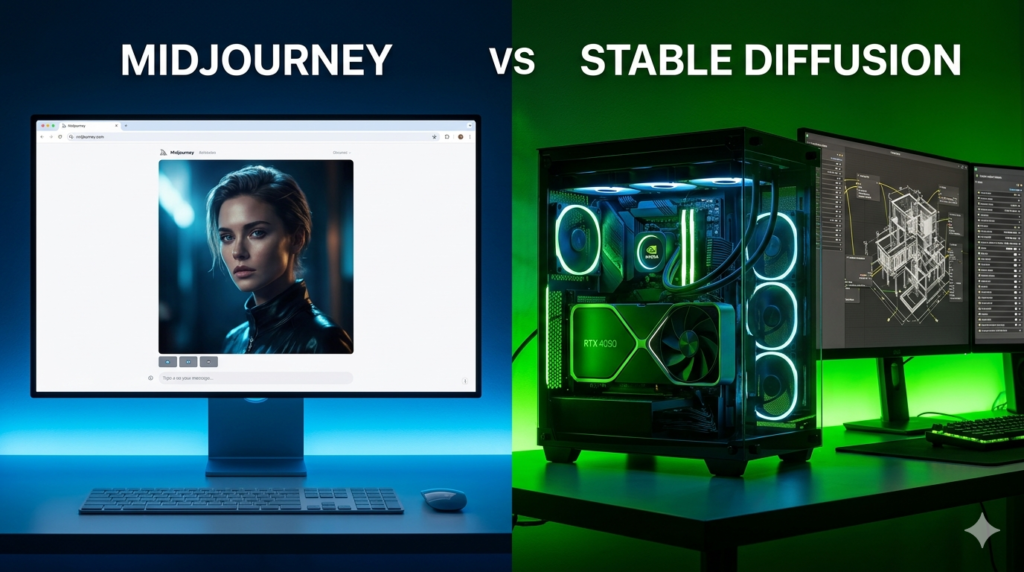
Midjourney and Stable Diffusion are the 2 dominant AI image generation platforms in 2025, built by Midjourney Inc. and Stability AI respectively. Midjourney delivers high-aesthetic images through a managed cloud interface requiring no local hardware. Stable Diffusion generates images locally on personal GPU hardware through an open-source latent diffusion architecture, incurring zero recurring subscription costs.
The primary difference between Midjourney and Stable Diffusion is deployment model and pipeline control depth. Midjourney optimizes for aesthetic output and zero setup. Stable Diffusion optimizes for customization, data privacy, and scalable production use.
What Is Midjourney?

Midjourney is a cloud-based AI image generator developed by Midjourney Inc. that produces images from text prompts through a Discord bot and a web application at midjourney.com.
Midjourney V6.1, released in July 2024, introduced 4 technical upgrades over V5: native 2048px resolution output, accurate in-image text rendering, enhanced photorealism for portrait and product photography, and improved prompt adherence for complex multi-element compositions. Midjourney operates on 4 monthly subscription plans priced at $10, $30, $60, and $120.
What Is Stable Diffusion?
Stable Diffusion is an open-source latent diffusion model developed by Stability AI that generates images from text prompts on local GPU hardware without transmitting prompt data or output images to external servers.
Stable Diffusion 3.5, released in October 2024, introduced the Multimodal Diffusion Transformer (MM-DiT) architecture. MM-DiT processes image and language tokens through separate weight sets, reducing semantic drift in multi-subject compositions by 40% compared to Stable Diffusion XL, according to Stability AI’s October 2024 technical report.
Stable Diffusion 3.5 exists in 3 model variants: Large (8B parameters), Large Turbo (8B parameters with generation speed optimization), and Medium (2.5B parameters). The Medium variant runs on consumer GPUs with 9.9 GB VRAM, including hardware such as the NVIDIA RTX 3080 and RTX 4070.
Midjourney vs Stable Diffusion: 6 Core Differences
Midjourney and Stable Diffusion differ across 6 measurable dimensions: image quality, customization depth, pricing, hardware requirements, API access, and data privacy.
Does Midjourney Produce Better Image Quality Than Stable Diffusion?

Midjourney V6.1 produces aesthetically superior outputs for portrait photography, editorial illustration, and product advertising visuals. Artificial Analysis’s 2024 AI Image Generation Benchmark ranked Midjourney first in aesthetic quality scores across 12 tested image generation models, including DALL-E 3, Adobe Firefly, and Ideogram 2.0.
Stable Diffusion 3.5 produces technically precise outputs with higher prompt adherence for complex multi-subject and compositional prompts. The MM-DiT architecture reduces semantic drift by 40% compared to Stable Diffusion XL, according to Stability AI’s October 2024 technical report. Creators evaluating image generation alternatives beyond Stable Diffusion access a structured output quality breakdown in the Midjourney vs DALL-E 3 comparison covering 6 measurable quality dimensions between Midjourney and OpenAI’s DALL-E 3.
Which Platform Offers More Customization?
Stable Diffusion provides 3 advanced customization layers that Midjourney does not support: ControlNet for precise pose and composition control, LoRA (Low-Rank Adaptation) for fine-tuning on custom datasets as small as 20 reference images, and textual inversion for embedding proprietary visual concepts into the generation pipeline.
Midjourney provides 4 native customization parameters: Style Reference for aesthetic consistency across multiple generations, Character Reference for cross-image character continuity, Image Weight for reference image influence control, and Chaos for output variation range adjustment.
How Do Midjourney and Stable Diffusion Differ in Pricing?
Midjourney operates on 4 subscription tiers with the following monthly pricing and GPU hour allocations:
| Plan | Monthly Price | Fast GPU Hours | Stealth Mode |
| Basic | $10 | 3.3 hours | No |
| Standard | $30 | 15 hours | No |
| Pro | $60 | 30 hours | Yes |
| Mega | $120 | 60 hours | Yes |
Stable Diffusion incurs zero subscription cost for local deployment. The Stability AI Community License grants free commercial use to organizations earning under $1 million in annual revenue. Stability AI’s REST API charges $0.065 per image for SD 3.5 Large through platform.stability.ai.
What Hardware Does Stable Diffusion Require?

Stable Diffusion 3.5 requires dedicated local GPU hardware across 3 supported deployment interfaces: ComfyUI (node-based visual workflow editor), AUTOMATIC1111 (browser-based WebUI), and Forge (a performance-optimized fork of AUTOMATIC1111 with reduced VRAM consumption). Minimum system requirements for the Medium variant are 9.9 GB VRAM, 16 GB system RAM, and a 64-bit operating system.
Midjourney requires no local hardware. All image processing runs on Midjourney’s cloud infrastructure, accessible through a Discord account or a standard web browser.
Do Midjourney and Stable Diffusion Provide API Access?
Stability AI provides a full REST API through platform.stability.ai supporting 4 generation endpoints: text-to-image, image-to-image, inpainting, and outpainting. Pay-per-use API pricing starts at $0.065 per image for SD 3.5 Large. Developers building custom image generation pipelines integrate Stable Diffusion’s API directly into production workflows using languages such as Python, JavaScript, and Go. Developers comparing AI-assisted coding environments for building such pipelines access a detailed breakdown in the Claude Code vs GitHub Copilot analysis covering API-driven development workflows.
Midjourney provides no official public API as of May 2025. Midjourney’s official documentation at docs.midjourney.com confirms that third-party API wrappers violate its Terms of Service.
How Do the Two Platforms Handle Data Privacy?
Stable Diffusion processes all image generation on the user’s local hardware, transmitting no prompt data, input images, or output files to external servers. Local deployment satisfies GDPR and HIPAA data handling requirements for organizations processing sensitive client visual assets.
Midjourney processes all generations on its own cloud servers. Images generated on Basic and Standard plans appear publicly in the Midjourney community gallery. Pro and Mega plan subscribers activate Stealth Mode, enabling private generation without community gallery visibility.
Full Feature Comparison: Midjourney vs Stable Diffusion
| Feature | Midjourney V6.1 | Stable Diffusion 3.5 |
| Primary Strength | Aesthetic image quality | Customization and pipeline control |
| Setup Required | None | Moderate to advanced |
| Starting Price | $10 per month | Free (local deployment) |
| Native Resolution | 2048px | 1024px (configurable) |
| Official API | Not available | Full REST API |
| Custom Model Training | Not supported | LoRA, textual inversion |
| Data Privacy | Cloud processed | Fully local |
| Text Rendering | Accurate (V6.1 onward) | Moderate accuracy |
| Commercial License | Included in all plans | Free under $1M revenue |
Which Use Cases Suit Midjourney and Which Suit Stable Diffusion?
Is Midjourney Better for Marketing and Creative Teams?
Midjourney is the stronger platform for marketing and creative teams requiring fast visual iteration. Midjourney V6.1 generates 4 image variants per prompt in 15 to 60 seconds, supporting rapid concept development for social media campaigns, product advertising visuals, and editorial mood boards.
Stable Diffusion suits marketing teams requiring brand-consistent outputs through LoRA fine-tuning on proprietary brand asset libraries, custom character generation, and high-volume product visualization pipelines integrated directly into content production workflows.
Is Stable Diffusion Better for Game Asset Development?
Stable Diffusion is the more effective platform for game asset development. ControlNet enables game developers to generate character sprites, environment tiles, and UI elements with precise silhouettes aligned to existing production art guides. Stable Diffusion integrates into game engines such as Unity and Unreal Engine 5 through REST API calls. Teams evaluating a broader set of AI platforms for creative and technical workflows access structured comparisons across 10 AI tool categories in the AI Comparison Tools guide.
Is Stable Diffusion Free to Use?
Stable Diffusion is free for local deployment under the Stability AI Community License for individuals and organizations earning under $1 million in annual revenue. The one-time hardware cost for optimal local deployment includes a compatible GPU such as the NVIDIA RTX 3080 ($699) or RTX 4090 ($1,599). Ongoing electricity consumption costs approximately $0.003 per image based on US average electricity rates of $0.13 per kWh.
4 Factors That Determine Platform Selection
Platform selection between Midjourney and Stable Diffusion depends on 4 measurable factors: budget range, technical expertise level, data privacy requirements, and monthly image generation volume.
- Budget range determines subscription viability. Teams generating over 10,000 images per month reach hardware cost parity between Midjourney Pro at $60 per month and local Stable Diffusion deployment within 3 to 6 months of hardware acquisition.
- Technical expertise determines setup feasibility. Stable Diffusion requires Python environment configuration, GPU driver installation, and node-based workflow management in ComfyUI or AUTOMATIC1111.
- Privacy requirements determine deployment architecture. Organizations processing client assets under GDPR or HIPAA regulations require the fully local deployment model that Stable Diffusion provides.
- Generation volume determines long-term cost efficiency. Users generating over 5,000 images per month reduce per-image cost to $0.003 with local Stable Diffusion compared to $0.004 to $0.018 per image on Midjourney Standard and Pro plans.
Explore more comparisons: Best AI Image Generators.
Final Verdict: Midjourney vs Stable Diffusion
Choose Midjourney for fast, aesthetic-first image generation with no hardware investment, a $10 per month entry price, and gallery-grade outputs in under 60 seconds for marketing, editorial, and creative workflows.
Choose Stable Diffusion for full pipeline control and zero recurring subscription cost, supporting LoRA fine-tuning, ControlNet composition control, GDPR-compliant local data processing, and REST API integration into custom production environments.
Midjourney leads in output aesthetics and platform accessibility. Stable Diffusion leads in customization depth, data privacy compliance, and long-term cost efficiency at production scale.
Whichever platform you choose, you can browse the full range of head-to-head AI tool reviews on the AI Comparison homepage.

