Elicit vs Scite: Which AI Research Platform Performs Better in 2026?
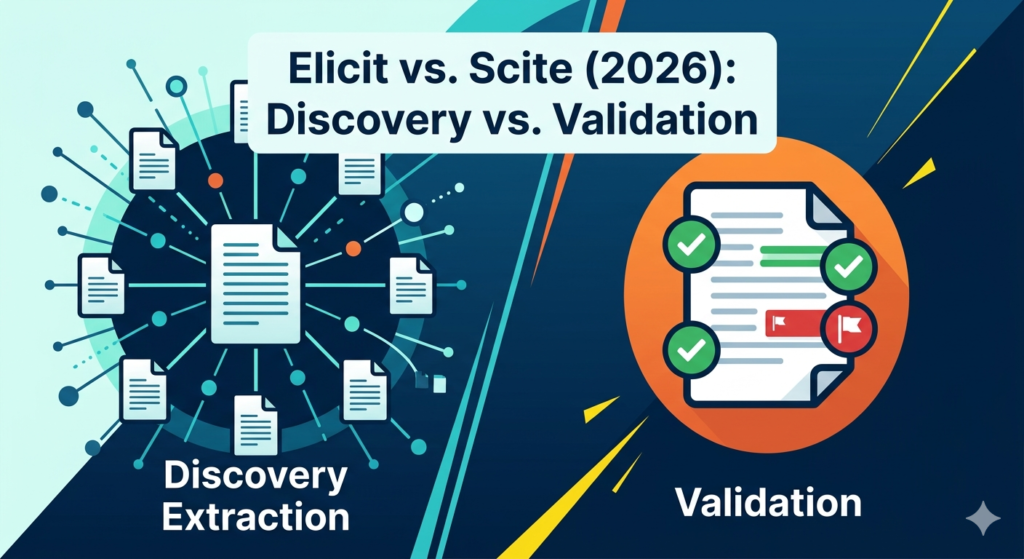
Elicit performs better for literature discovery, evidence extraction, and systematic review automation. Scite performs better for citation validation, contradiction detection, and reproducibility analysis. Researchers conducting PRISMA reviews, Cochrane reviews, and biomedical meta-analyses use both platforms in sequence Elicit for discovery, Scite for validation because retrieval and reliability require different analytical systems.
| Research Workflow | Better Platform |
| Literature discovery | Elicit |
| Structured evidence extraction | Elicit |
| Citation validation | Scite |
| Contradiction detection | Scite |
| Scientific consensus analysis | Scite |
What Is the Main Difference Between Elicit and Scite?
Elicit uses semantic vector retrieval to surface contextually related research papers. Scite uses Smart Citations to classify whether later studies support, contradict, or mention earlier findings. The 2 platforms solve different problems retrieval and validation which is why combining them strengthens systematic review quality more than using either platform alone.
Elicit retrieves papers through transformer-based embeddings rather than exact keyword matching. Scite indexes 1.6 billion citation statements from 250 million research papers, according to Scite’s official 2024 platform documentation. Researchers use Elicit to locate evidence faster. Researchers use Scite to assess whether that evidence remains scientifically reliable.
| Comparison Layer | Elicit | Scite |
| Core Function | Semantic retrieval | Citation intelligence |
| Main Output | Structured evidence tables | Smart Citation scores |
| Primary Database | Semantic Scholar, PubMed, arXiv | 250M+ indexed papers |
| Best Use Case | Systematic reviews | Reproducibility analysis |
Which Research Workflow Does Elicit Optimize?
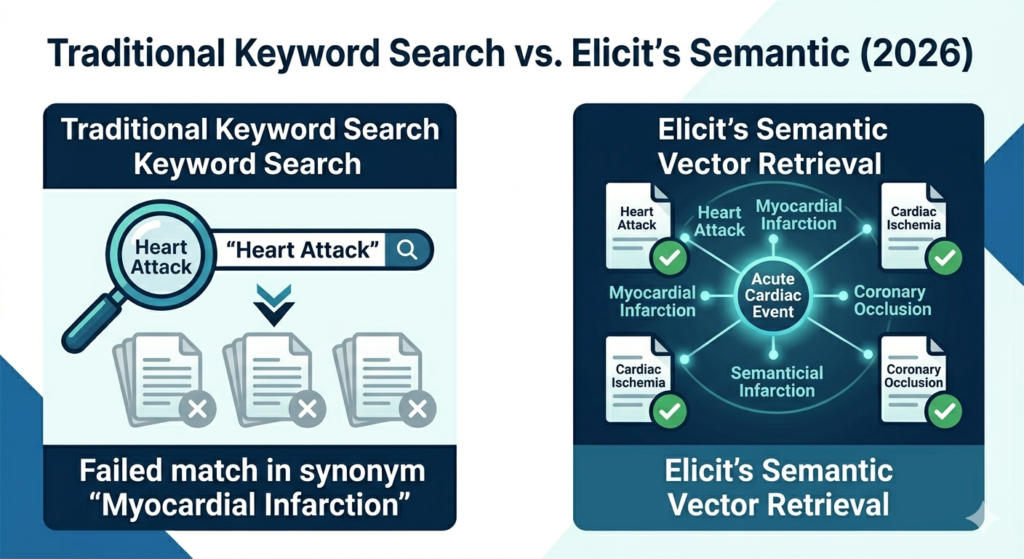
Elicit optimizes 5 research workflows: literature discovery, PRISMA systematic reviews, biomedical meta-analyses, dissertation literature reviews, and public policy evidence synthesis. Researchers screening papers for a single systematic review spend an average of 30 to 40 hours on manual abstract screening, according to a 2023 BMJ study on AI-assisted literature tools. Elicit reduces this workload through semantic retrieval.
Instead of matching exact phrases, Elicit evaluates contextual meaning through vector embeddings. Medical concepts like “heart attack,” “myocardial infarction,” and “cardiac ischemia” cluster together semantically researchers capture related studies without writing multiple keyword variants. This retrieval method reduces 4 screening problems: retrieval gaps from terminology variation, duplicate searches across PubMed and Crossref, keyword bias toward dominant terminology, and incomplete screening from missed synonyms.
How Does Elicit Extract Structured Evidence?
Elicit extracts structured evidence from retrieved papers by auto-populating research tables with outcomes, sample sizes, methodologies, and confidence intervals. A healthcare researcher analyzing Type 2 diabetes intervention trials extracts treatment outcomes, p-values, and sample sizes into a unified comparison table in minutes instead of hours.
According to Elicit’s published user research, researchers complete literature screening 73% faster using semantic extraction compared to manual database searches. The extraction workflow runs in 5 steps:
- Enter a research question in natural language
- Retrieve semantically matched studies from Semantic Scholar and PubMed
- Filter by study type randomized controlled trials, cohort studies, or meta-analyses
- Extract outcome variables automatically into structured columns
- Export evidence tables in CSV or BibTeX format for synthesis
Which Research Workflow Does Scite Optimize?
Scite optimizes citation validation, contradiction detection, and reproducibility analysis through Smart Citations a system that classifies 1.6 billion citation statements by whether they support, contradict, or mention a source paper. Traditional citation databases like Google Scholar and Web of Science measure citation count. Scite measures citation intent, which reveals whether a finding holds up under subsequent scrutiny.
This distinction matters because citation count and citation reliability are not correlated. A 2021 PLOS ONE study found that 12% of highly cited biomedical papers contain findings later contradicted by larger trials. Scite’s NLP classification surfaces these contradictions before researchers build evidence tables on flawed foundations.
What Are Smart Citations?
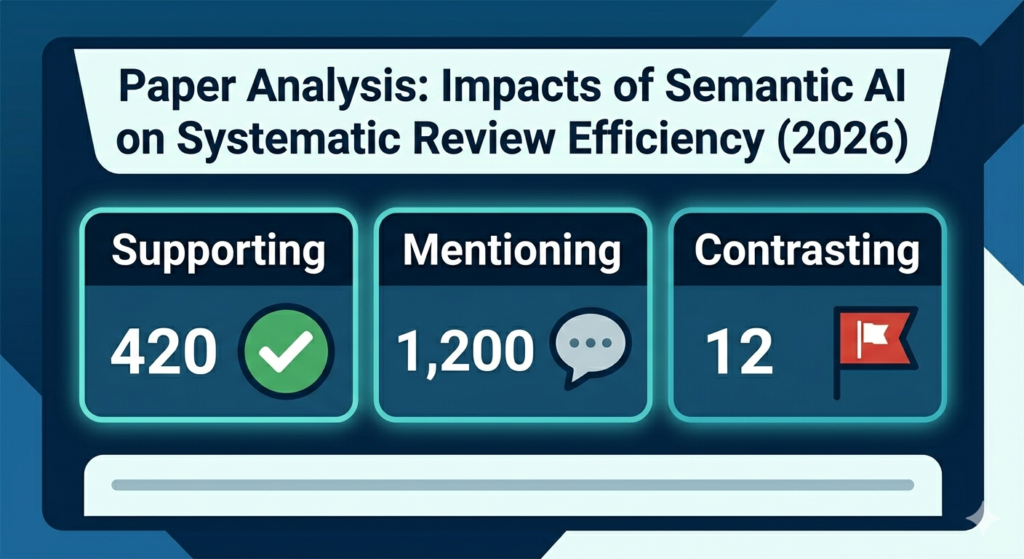
Smart Citations are citation classifications that identify whether later studies support, contradict, or neutrally mention an earlier paper’s findings, based on sentence-level NLP analysis of 1.6 billion indexed citation statements. Scite’s system analyzes the semantic polarity of every cited sentence across its full paper index, according to Scite’s 2023 technical documentation.
| Citation Type | Meaning | Signal Language |
| Supporting | Later studies confirm findings | confirmed, replicated, consistent with |
| Contrasting | Later studies dispute findings | contradicted, failed to replicate, inconsistent with |
| Mentioning | Neutral reference | cited, noted, referenced |
A clinical trial with 420 supporting citations and 12 contrasting citations demonstrates strong reproducibility. A psychology study with 42 supporting citations and 90 contrasting citations signals contested evidence requiring verification before inclusion in a systematic review.
Which Platform Performs Better for Systematic Reviews?
Elicit performs better for systematic reviews because the platform automates all 5 PRISMA 2020 stages: study identification, abstract screening, eligibility filtering, evidence extraction, and synthesis table organization. According to a 2024 Journal of Clinical Epidemiology analysis, AI-assisted screening tools reduce systematic review completion time by 57% compared to manual methods across trials with 300 or more abstracts.
Scite strengthens systematic reviews at the validation stage. After Elicit identifies and extracts the evidence pool, Scite verifies whether retained studies remain scientifically reliable a critical step for Cochrane reviews and clinical practice guideline development. The combined workflow reduces 3 systematic review risks: incomplete retrieval from semantic gaps, inclusion of contradicted studies, and reproducibility failures in synthesized conclusions.
Which Platform Performs Better for Medical Research?
Elicit performs better for medical evidence synthesis. Scite performs better for medical evidence reliability verification. A 2023 Systematic Reviews journal study found that AI-assisted platforms reduce abstract screening time from 12 hours to 3.5 hours in oncology literature reviews covering 300 or more papers.
Medical researchers analyzing cardiovascular treatments, oncology trials like KEYNOTE-001, and psychiatric therapies face a reproducibility crisis. A 2022 Nature Medicine analysis found that 38% of landmark medical studies published before 2015 produce weaker effects under replication. Scite’s Smart Citation system identifies these replication failures before researchers finalize evidence tables.
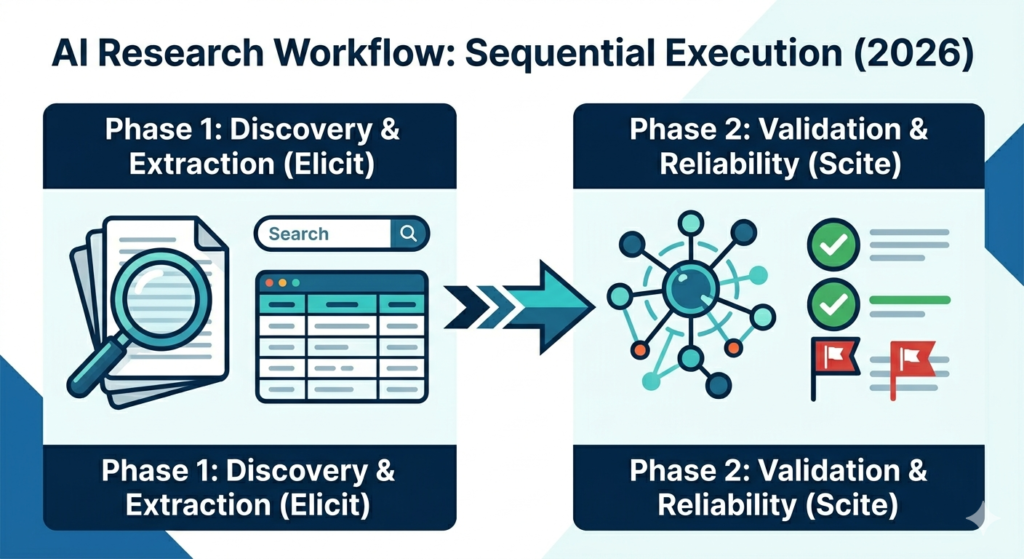
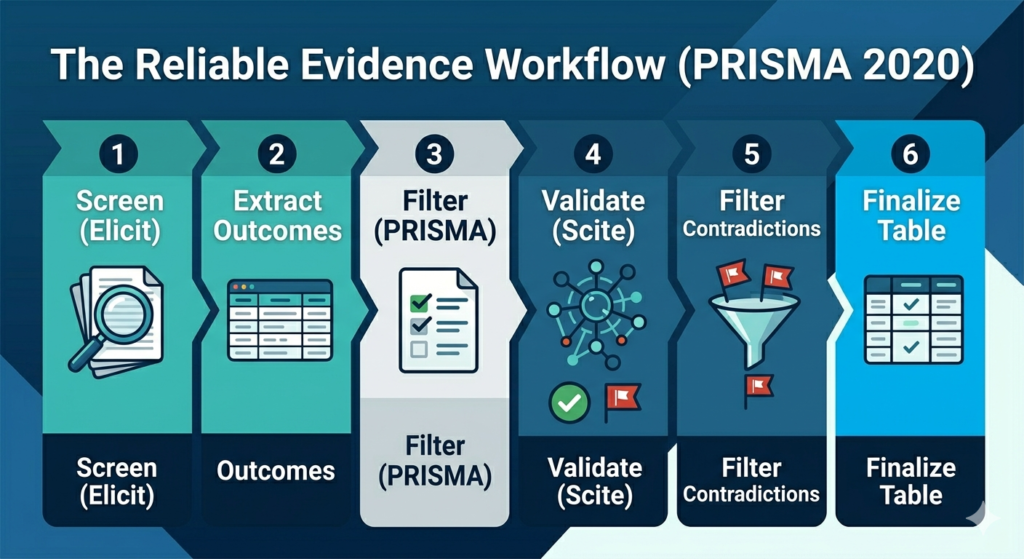
The 6-step evidence-reliable workflow runs as follows:
- Use Elicit for trial screening across PubMed and Semantic Scholar
- Extract outcomes from randomized controlled trials automatically
- Filter retained studies by PRISMA 2020 eligibility criteria
- Validate retained studies through Scite Smart Citations
- Remove studies with high contrasting citation ratios
- Finalize evidence synthesis tables for review submission
Does Elicit Follow PRISMA 2020 Guidelines?
Elicit supports PRISMA 2020 compliance by generating structured screening logs, PRISMA flow diagrams, and reproducible search records exportable for peer-reviewed journal submission. PRISMA 2020 the Preferred Reporting Items for Systematic Reviews and Meta-Analyses updated standard requires researchers to document 27 checklist items covering search strategy, screening decisions, and evidence synthesis, according to the PRISMA Group’s 2021 BMJ publication.
Elicit automates 4 of the most time-intensive PRISMA documentation tasks: search strategy recording, abstract screening logs, inclusion and exclusion reason tracking, and evidence table generation. Scite contributes to PRISMA compliance at item 22, which requires authors to assess the certainty of evidence and risk of bias tasks directly supported by Smart Citation contradiction scores. Researchers submitting to journals like The Lancet, JAMA, and Cochrane Database of Systematic Reviews reduce PRISMA compliance gaps by combining both platforms.
Which Platform Performs Better for PhD Research?
Elicit performs better for dissertation literature discovery. Scite performs better for citation reliability verification before thesis submission. Doctoral researchers screen an average of 300 to 800 papers during dissertation literature reviews, according to a 2022 Higher Education Research and Development study.
| Dissertation Stage | Recommended Platform | Key Function |
| Topic exploration | Perplexity AI | Conversational research scoping |
| Literature discovery | Elicit | Semantic paper retrieval |
| Evidence extraction | Elicit | Structured table generation |
| Citation validation | Scite | Smart Citation analysis |
| Consensus analysis | Elicit vs Consensus | Evidence scoring |
Researchers completing interdisciplinary dissertations across psychology, neuroscience, and public health benefit most from combining Elicit’s cross-domain semantic retrieval with Scite’s contradiction detection particularly for chapters drawing on studies published before 2018 where replication rates are lower.
Which Platform Provides Better Value?
Elicit’s paid plan costs $12 per month and includes unlimited PDF extraction, advanced evidence columns, and team workspaces. Scite’s individual paid plan costs $20 per month and includes full Smart Citation access, reference manager integration, and contradiction analysis. Both platforms offer free tiers with limited extraction and citation features.
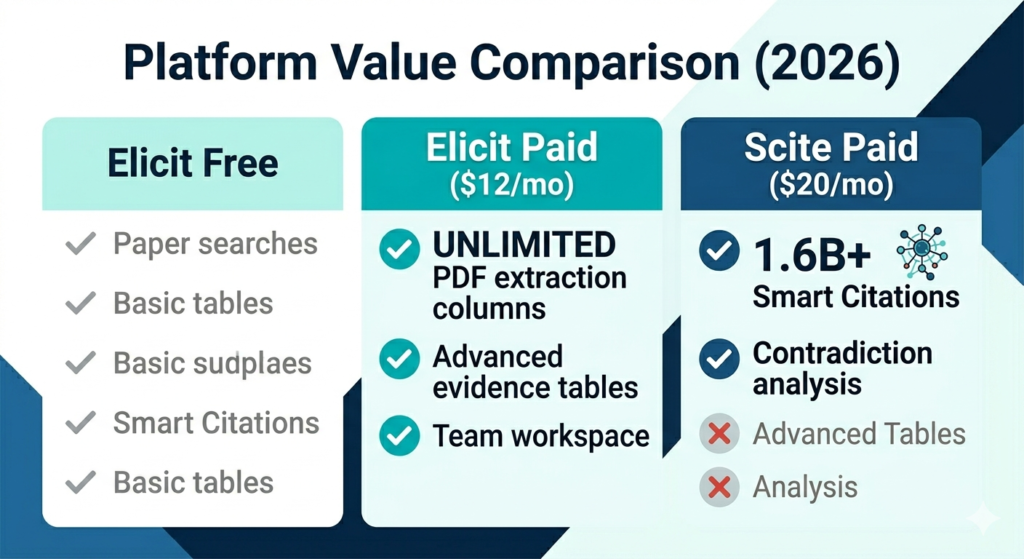
| Feature | Elicit Free | Elicit Paid ($12/mo) | Scite Paid ($20/mo) |
| Paper searches | Unlimited | Unlimited | Unlimited |
| Smart Citations | No | No | Yes (1.6B+ statements) |
| PDF extraction | Limited (5 cols) | Unlimited columns | Moderate |
| Evidence tables | Basic | Advanced | No |
| Team workspace | No | Yes | Yes |
| Zotero / BibTeX export | Yes | Yes | Yes |
| Institutional license | No | No | Yes (flat annual fee) |
Graduate students conducting 1 to 2 systematic reviews annually gain stronger value from Elicit’s $12/month plan. University research departments conducting ongoing clinical literature validation gain stronger value from Scite’s institutional licensing.
What Are the 3 Best Alternatives to Elicit and Scite?
The 3 best alternatives to Elicit and Scite are Semantic Scholar, SciSpace, and Consensus each covering a distinct research workflow gap. Semantic Scholar indexes 220 million papers and provides citation graphs, author networks, and semantic search at no cost. SciSpace (formerly Typeset) specializes in AI-powered PDF annotation and equation explanation across 270 million papers. Consensus extracts claims from research papers and provides aggregated evidence scores across multiple studies without requiring researchers to screen full papers.
Related resources:
- Perplexity vs ChatGPT
- Elicit vs Consensus
- Perplexity Alternatives
- ChatGPT Alternatives
- AI Comparison Tools
Final Verdict: Which AI Research Platform Performs Better?
Elicit performs better for literature discovery, semantic retrieval, structured evidence extraction, and PRISMA systematic review automation. Scite performs better for citation validation, contradiction detection, and reproducibility analysis across 1.6 billion indexed citation statements.
Researchers conducting systematic reviews benefit most from running both platforms in sequence Elicit for retrieval, Scite for validation reducing both retrieval gaps and reliability failures simultaneously.
Choose Elicit if:
- Automated abstract screening reduces systematic review workload
- Semantic retrieval captures terminology variants across PubMed and Semantic Scholar
- Structured evidence tables accelerate meta-analysis preparation
- PRISMA 2020 workflow compliance drives the review process
Choose Scite if:
- Smart Citation scores verify evidence reliability before synthesis
- Contradiction detection in biomedical or psychology research matters
- Replication failures in pre-2018 studies affect evidence quality
- Citation reliability analysis strengthens Cochrane review credibility
Elicit reduces retrieval time. Scite reduces reliability risk. Combined, both platforms improve systematic review accuracy, reproducibility confidence, and evidence synthesis quality across medical, doctoral, and policy research workflows.