NotebookLM vs Elicit (2026): Which AI Research Tool Is Better for Academics?
NotebookLM is an AI-powered document synthesis assistant developed by Google, built on the Gemini 1.5 Pro model. Elicit is an AI literature discovery engine that searches 138 million academic papers using semantic understanding. These 2 tools serve researchers at different stages of the academic workflow Elicit discovers papers, NotebookLM synthesizes them.
How Does NotebookLM Work as an AI Research Assistant?
NotebookLM is a source-grounded AI research assistant that generates contextual responses, audio overviews, and study guides from user-uploaded documents. Google developed NotebookLM under Google Labs, powered by the Gemini 1.5 Pro model.
NotebookLM accepts 5 primary source formats: PDFs, Google Docs, Google Slides, web pages, and YouTube videos. Every response links directly to the uploaded source, reducing AI hallucination risk through source grounding.
NotebookLM offers 2 pricing tiers. The free tier provides full feature access with no hard monthly query limits. NotebookLM Plus costs $20/month and adds custom AI personas, enhanced team collaboration, and higher notebook source limits.
How Does Elicit Search 138 Million Academic Papers?
Elicit searches 138 million academic papers using natural language queries, identifying relevant research without requiring exact keyword matches. It is an AI research assistant purpose-built for systematic literature review and structured data extraction.
Elicit automates 4 core research tasks: paper discovery, structured data extraction, citation retrieval, and systematic review screening. A VDI/VDE benchmark case study measured Elicit’s extraction accuracy at 99.4%. Elicit correctly extracted 1,502 out of 1,511 data points from peer-reviewed academic papers.
Elicit integrates with 3 major academic databases: Semantic Scholar, PubMed, and ClinicalTrials.gov, which indexes 545,000+ clinical studies. Elicit also supports Zotero imports for reference management.
Elicit offers 3 pricing tiers. The Basic plan is free and includes unlimited search across 138 million papers and 2 automated reports per month. The Plus plan costs $12/month. The Pro plan costs $49/month and includes PRISMA-grade systematic review workflows, 2,400 data extractions per year, and 20 custom extraction columns.
What Are the 6 Core Differences Between NotebookLM and Elicit?
There are 6 fundamental differences between NotebookLM and Elicit as AI research tools:
- Research stage Elicit operates at the discovery stage; NotebookLM operates at the synthesis stage
- Data source Elicit searches 138 million external academic papers; NotebookLM analyzes only user-uploaded documents
- Output format Elicit produces structured extraction tables; NotebookLM produces audio overviews, study guides, and Q&A sessions
- Academic specialization Elicit supports PRISMA-grade systematic review workflows; NotebookLM supports general document comprehension
- AI model Elicit uses Claude Opus 4.5 for extraction and report generation; NotebookLM uses Gemini 1.5 Pro
- Pricing entry point Elicit Pro costs $49/month; NotebookLM Plus costs $20/month
| Feature | NotebookLM | Elicit |
| Developer | Elicit (nonprofit AI lab) | |
| AI Model | Gemini 1.5 Pro | Claude Opus 4.5 |
| Paper Database | None user uploads only | 138 million papers |
| Systematic Review Support | No | Yes PRISMA-grade |
| Audio Overviews | Yes | No |
| Extraction Accuracy | Source-grounded | 99.4% (VDI/VDE benchmark) |
| PubMed Integration | No | Yes |
| ClinicalTrials.gov | No | Yes |
| Free Tier | Yes unlimited queries | Yes 2 reports/month |
| Paid Plan | $20/month (Plus) | $49/month (Pro) |
Literature Discovery: Which Tool Finds More Relevant Papers?
Elicit is the stronger tool for academic literature discovery. It identifies relevant papers across 138 million indexed studies using semantic search, without requiring exact keyword matches.
Elicit’s semantic search identifies papers through conceptual relationships rather than exact keyword proximity. A PhD researcher studying gut-brain axis mechanisms in autism used Elicit to surface 40 previously overlooked papers. The same researcher identified 3 novel research gaps and saved 100+ hours of manual search time (AI Tools Cloud, August 2025).
NotebookLM does not search any external academic database. It analyzes only documents the researcher uploads manually. This limits NotebookLM to the researcher’s existing library, while Elicit searches 138 million external studies beyond the researcher’s uploaded documents.
Read Elicit vs Consensus for a direct comparison of Elicit’s discovery capabilities against Consensus’s 200-million-paper database.
Document Synthesis: Which Tool Organizes Research Better?
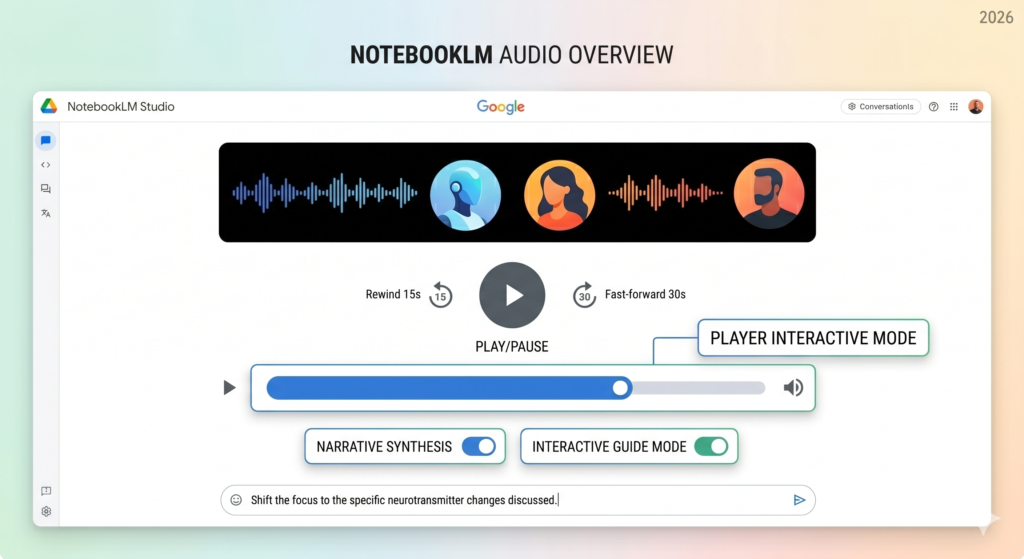
NotebookLM is the stronger tool for synthesizing documents a researcher already possesses. It converts PDFs, Google Docs, and web pages into structured study guides, contextual Q&A responses, and AI-generated audio overviews.
NotebookLM’s Audio Overview feature converts uploaded documents into a 2-person podcast-style conversation. According to Motif.bio’s 2026 researcher survey, no other tool in the AI research category offers a native podcast-format audio synthesis output.
Elicit’s document synthesis focuses on structured tabular extraction. It automatically pulls p-values, sample sizes, study methods, and adverse events from research papers. A systematic review team processed 87 papers on SGLT2 inhibitors for heart failure using Elicit’s extraction tables. The task previously required 3 weeks of manual copy-paste work, according to an AI Tools Cloud case study (August 2025).
How Do NotebookLM and Elicit Work Together in a Research Workflow?
The optimal academic research workflow combines Elicit for discovery and NotebookLM for synthesis across 3 sequential stages.
The 3-stage workflow includes:
- Discovery stage Use Elicit to search 138 million papers, apply PRISMA-grade screening criteria, and generate structured extraction tables with p-values, methods, and outcomes
- Synthesis stage Import selected papers into NotebookLM, generate source-grounded audio overviews, and conduct interactive Q&A sessions against the uploaded document set
- Analysis stage Use Claude’s 200K-token context window for long-form synthesis, critical analysis, and structured critique across dozens of full papers simultaneously
Most scientists use multiple AI models simultaneously to cross-check results and reduce hallucination risk, according to Motif.bio’s 2026 researcher survey. Power users run Elicit for initial extraction matrices. Results move into Claude for critical analysis. NotebookLM handles the final audio-format synthesis layer.
Read Perplexity vs Claude for a detailed comparison of Claude’s synthesis depth against Perplexity’s real-time web search capabilities.
How Does NotebookLM Pricing Compare to Elicit?
NotebookLM’s free tier outperforms Elicit’s Basic plan on query limits. Elicit Pro at $49/month delivers deeper systematic review capabilities than NotebookLM Plus at $20/month.
| Plan | NotebookLM | Elicit |
| Free | Full features, no query limit | 2 automated reports/month |
| Entry Paid | $20/month (Plus) | $12/month (Plus) |
| Professional | N/A | $49/month (Pro) |
| Enterprise | Via Google Workspace | Custom includes SSO, SAML, 2FA |
NotebookLM’s free tier provides unrestricted access to audio overviews, study guides, and source-grounded Q&A with no monthly query ceiling. Elicit’s Basic free tier restricts users to 2 automated reports and 2 extraction columns per table per month.
Elicit Pro at $49/month delivers 2,400 structured data extractions per year and 20 custom extraction columns. It also includes dedicated systematic review workflows, PRISMA-grade screening accuracy, and enterprise-level security controls including SSO and SAML.
NotebookLM Plus at $20/month provides custom AI personas, expanded collaboration features, and higher source limits per notebook. It is the lower-cost option for student researchers and knowledge workers outside formal academic institutions.
What Are the Limitations of NotebookLM for Academic Research?
NotebookLM has 4 measurable limitations in academic research workflows:
- No external paper search researchers manually upload all source documents, creating dependency on a pre-existing library
- No structured data extraction outputs are conversational and narrative, not tabular or exportable as structured data
- No systematic review support PRISMA-grade workflows, screening criteria, and study coding are absent
- No citation depth consistency notebooks sourced from open web pages produce variable citation quality compared to peer-reviewed sources
NotebookLM performs effectively for note synthesis, student study guides, and cross-format document comprehension. Non-academic content types supported include YouTube videos and web articles.
What Are the Limitations of Elicit for General Research Users?
Elicit has 3 primary limitations for researchers outside empirical science domains:
- Empirical domain dependency Elicit excels in biomedical, clinical, and machine learning research. It underperforms on theoretical, humanities, or non-empirical subjects with limited peer-reviewed coverage
- Free tier restrictions the Basic plan limits users to 2 automated reports and 2 extraction columns per month, reducing utility for high-volume casual users
- Multimedia output absence Elicit produces tables, reports, and structured summaries only, with no audio overviews, podcast-style content, or visual knowledge maps
Elicit’s general AI output accuracy ranges from 80% to 90%. Researchers verify extracted data before including it in published systematic reviews or meta-analyses.
Claude Alternatives covers 8 tools evaluated on context window size, hallucination rates, and research workflow support, for researchers evaluating document synthesis tools beyond NotebookLM.
Which AI Research Tools Do Academics Use in 2026?
The 4 most-used AI research tools among academics are NotebookLM, Elicit, Consensus, and Claude, according to Motif.bio’s 2026 researcher survey. NotebookLM leads for paper summaries and working memory expansion. Consensus and Elicit excel at finding and validating existing research. ChatGPT and Claude accelerate coding tasks in bioinformatics and data analysis.
Researchers also use 3 specialized companion tools alongside Elicit and NotebookLM. ResearchRabbit maps visual citation networks. scite classifies 1 billion+ citation contexts as supporting or contradicting. Litmaps enables serendipitous discovery through citation graph visualization.
AI Comparison Tools covers 50+ tools with side-by-side feature breakdowns, for researchers evaluating the full AI research tool landscape.
NotebookLM or Elicit: Which Tool Fits Your Research Workflow?
Elicit is the stronger tool for systematic literature discovery and structured data extraction. NotebookLM is the stronger tool for synthesizing documents through audio overviews and source-grounded Q&A.
Choose NotebookLM if:
- Research workflows center on synthesizing documents already in a personal or team library
- Audio-format literature absorption improves information retention
- Source materials include non-academic formats like YouTube videos, Google Docs, and web articles
- Work occurs within the Google Workspace ecosystem
- A free tier with no monthly query ceiling meets budget requirements
Choose Elicit if:
- Research involves systematic reviews, meta-analyses, or PRISMA-compliant literature screening
- Literature discovery from 138 million papers using natural language queries is a core need
- Structured data extraction including p-values, sample sizes, and study methods from large paper sets is required
- Research integrates with PubMed, ClinicalTrials.gov, or Zotero reference management
- Work falls within biomedical, clinical, or evidence-based scientific research domains
Use both tools if:
- Full research workflows span discovery, synthesis, and audio-format review simultaneously
- Cross-validation across multiple AI tools reduces hallucination risk in published research
- Elicit handles upstream extraction and NotebookLM handles downstream synthesis
FAQ
Can NotebookLM replace Elicit for academic research?
NotebookLM does not replace Elicit. NotebookLM synthesizes user-uploaded documents through source-grounded Q&A and audio overviews. Elicit discovers and extracts structured data from 138 million external academic papers. These 2 tools address different stages of the research workflow.
Is Elicit free to use for researchers?
Elicit’s Basic plan is free and includes unlimited search across 138 million papers, unlimited paper summaries, and 2 automated reports per month. Elicit Pro costs $49/month and adds PRISMA-grade systematic review workflows, 2,400 annual data extractions, and 20 custom extraction columns.
Does Elicit hallucinate?
Elicit uses sentence-level citations that link every extracted data point to the exact source sentence in the original paper. The VDI/VDE benchmark recorded a 99.4% data extraction accuracy rate across 1,511 data points. Elicit’s general output accuracy ranges from 80% to 90%, requiring manual verification before publication.
What AI model does Elicit use?
Elicit uses Claude Opus 4.5 for data extraction and report generation. Claude Opus 4.5 outperforms Google Gemini 3 Pro and OpenAI GPT-5 on structured data extraction accuracy and hallucination reduction in systematic review tasks. This benchmark data comes from Elicit’s official product changelog.
Which tool is better for PhD students?
PhD students conducting literature reviews gain the most value from Elicit for semantic paper discovery and structured extraction tables. NotebookLM complements Elicit by converting selected papers into audio overviews and interactive study guides, supporting passive literature review through different cognitive absorption formats.