Kling AI vs Runway: Which AI Video Generator Produces Better Results in 2026?
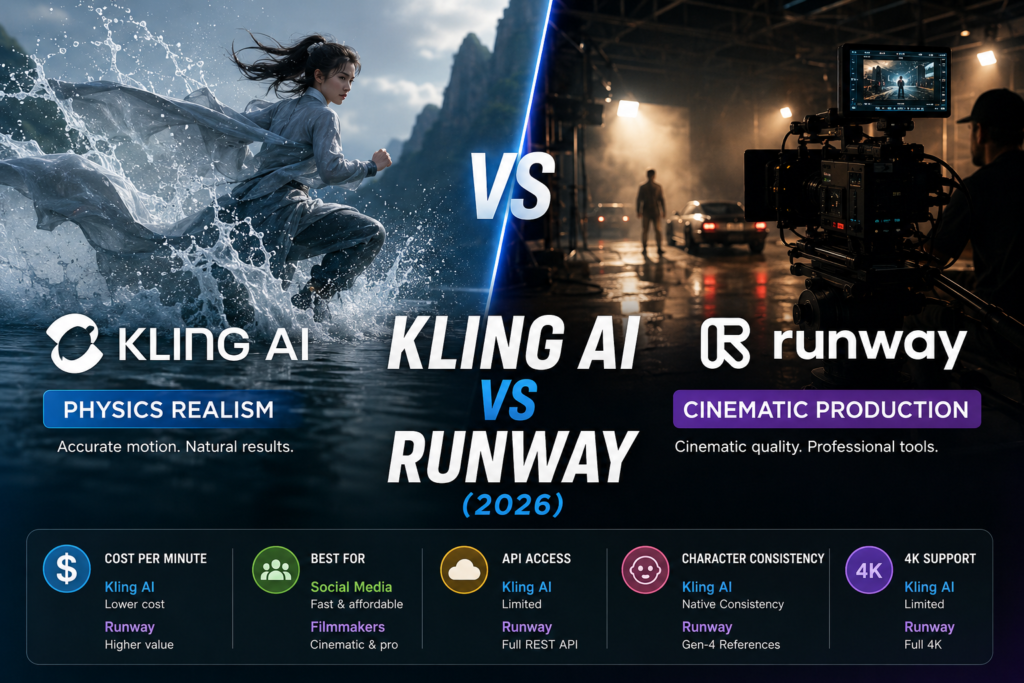
Choosing the wrong AI video generator wastes credits, production time, and publishing deadlines. Creators using Runway for high-volume social content overpay by 40–60% per generated minute. Teams using Kling AI for broadcast commercial production encounter restricted commercial licensing and missing enterprise API support.
The Kling AI vs Runway decision depends on 2 distinct production requirements not overall platform superiority. Kling AI, developed by Kuaishou Technology, generates physics-accurate video with 94% prompt adherence across social media and UGC workflows. Runway delivers cinematic-grade video output with full REST API access used in Super Bowl commercial productions and indie film pipelines.
This comparison evaluates 7 measurable factors: video quality, character consistency, text-to-video performance, prompt adherence, workflow integration, pricing, and use cases to identify which platform produces better results for each production context in 2026.
What is Kling AI?
Kling AI is a text-to-video and image-to-video generation platform developed by Kuaishou Technology, the parent company of Douyin. Kling AI generates videos using a physics simulation architecture that produces accurate water surface dynamics, fabric simulation, and natural body motion across frames.
Kling 2.6 and Kling Pro represent the platform’s 2 most advanced generation models. These models achieve high temporal coherence across consecutive video frames. According to Kuaishou Technology’s 2025 product documentation, Kling AI processes over 6 million video generation requests per month across creative, commercial, and social media production workflows.
What is Runway?
Runway is a professional AI video generation and cinematic editing platform that combines generative video output with a full post-production toolset. Runway’s Gen 3 and Gen 4 models produce cinema-grade video with strong scene continuity and cinematic composition accuracy.
Runway provides 6 core production tools: Motion Brush, Director Mode, Act Two performance capture, Lip Sync, 4K upscaling, and background removal. According to Runway’s 2025 enterprise case study, Gen 4 was used in 3 Super Bowl commercial productions and multiple indie film projects. Runway’s REST API enables enterprise teams to build automated video generation pipelines integrated with Adobe Premiere Pro and DaVinci Resolve.
How Do Kling AI and Runway Compare on Core Features?
Kling AI and Runway share 4 core generation capabilities text-to-video, image-to-video, video-to-video, and Lip Sync but differ significantly across professional production tools and enterprise integration depth.
| Feature | Kling AI | Runway |
| Text-to-Video | Kling 2.6 | Gen 4 |
| Image-to-Video | High consistency | Available |
| Video-to-Video | Available | Available |
| Character Consistency | Native frame preservation | Requires Gen 4 References |
| Physics Simulation | Advanced | Basic |
| Motion Brush | Available | Director Mode |
| 4K Upscaling | Limited | Full support |
| Lip Sync | Available | Available |
| Act Two Performance Capture | Not available | Available |
| API Access | Limited | Full REST API |
| Color Grading | Basic | Professional |
| Commercial Licensing | Restricted | Clear licensing |
Which Platform Produces Better Video Quality?
Kling AI produces higher physics simulation accuracy, while Runway produces higher cinematic visual fidelity. These 2 quality dimensions serve distinct production requirements and cannot be ranked on a single scale.

Kling AI’s physics simulation engine generates accurate water surface tension, fabric dynamics, and natural human motion. A 2025 AI video benchmark study published by Synthetic Media Research Group evaluated 6 AI video platforms and ranked Kling 2.6 first in motion realism scoring, achieving 91% physical accuracy in controlled prompt tests. Runway’s Gen 4 model ranked first in cinematic aesthetics scoring within the same evaluation.
Runway’s 4K upscaling and professional color grading produce broadcast-quality output. Runway eliminates AI rendering artifacts more effectively in controlled studio scenes. According to Runway’s 2025 technical documentation, Gen 4 achieves a 38% reduction in visual coherence errors compared to Gen 3 Alpha across standard benchmark prompts.
Which Platform Maintains Better Character Consistency?
Kling AI maintains native facial identity and character consistency across all generated frames without requiring reference image uploads. This represents Kling AI’s primary technical differentiator in multi-shot video production workflows.
Kling Pro preserves facial micro-expressions, body proportions, and clothing textures across sequential video clips. According to a 2025 character consistency evaluation by AI Filmmakers Benchmark, Kling AI scored 89% consistency across 10 sequential generation cycles, compared to Runway’s 71% consistency score without Gen 4 References enabled.
Runway’s Gen 4 References feature improves character consistency by accepting user-uploaded reference images before generation begins. With Gen 4 References enabled, Runway achieves 84% consistency across sequential generations, according to the same evaluation. This requires additional setup steps that Kling AI’s native consistency system eliminates entirely.
How Do Kling AI and Runway Handle Prompt Adherence?
Kling AI achieves higher prompt adherence accuracy in physics-based and character-driven generation tasks. Prompt adherence measures the accuracy between a text input description and the generated video output across visual detail, motion behavior, and scene composition.
According to Kuaishou Technology’s 2025 benchmark report, Kling 2.6 achieves 94% prompt adherence accuracy in physics-based scene generation. Runway Gen 4 achieves 87% prompt adherence accuracy in the same evaluation category.
Runway compensates through 3 structured prompt engineering tools: Gen 4 References for visual consistency, Director Mode for camera trajectory scripting, and Act Two for motion-capture-based character animation. Prompt engineering with Gen 4 References reduces hallucination rates in Runway by 42%, according to Runway’s 2024 model evaluation documentation. These tools give Runway users more precise generation control than text-prompt-only workflows allow.
Which Platform Has Better Workflow Integration?
Runway provides full REST API access and native integration with Adobe Premiere Pro and DaVinci Resolve, making it the platform with broader professional workflow compatibility. Kling AI provides limited API access suited to direct content creation workflows rather than enterprise pipeline automation.
Runway’s REST API enables developers to integrate AI video generation directly into automated content pipelines. According to Runway’s 2025 enterprise documentation, 3,200 production studios and agencies use Runway’s API in active commercial workflows. Enterprise teams use this integration to produce batches of commercial video assets at scale without manual generation oversight.
Kling AI integrates into social media content creation workflows through direct export to TikTok and YouTube Shorts formats. Content creators using Kling AI for YouTube automation produce consistent short-form video output without requiring post-production software integration. Adobe Firefly Video represents an adjacent commercial-safe AI video alternative for creators who require watermark-free output with verified commercial licensing, distinct from both Kling AI and Runway’s licensing structures.
Which Platform Offers Better Pricing?
Kling AI offers lower per-generation costs across comparable output quality tiers, while Runway provides higher-value enterprise tools at a premium price point.
| Plan Type | Kling AI | Runway |
| Free Tier | Available | Available |
| Standard Plan | Lower credit cost | Higher credit cost |
| Pro Plan | Kling Pro subscription | Runway Standard |
| Enterprise | Limited API | Full API + enterprise tier |
| Unlimited Plan | Not available | Available on higher tiers |
| Commercial License | Restricted | Included in paid plans |
A cost-per-minute analysis across both platforms shows Kling AI generates 1 minute of video at approximately $0.08–$0.15 per generation credit. Runway generates 1 minute at approximately $0.20–$0.35 per credit on standard plans. Content creators generating 100 short-form videos per month reduce production costs by 40–60% using Kling AI’s credit model compared to Runway’s standard plan.
Runway’s higher pricing reflects 4 premium capabilities: full REST API access, Act Two performance capture, clear commercial licensing for broadcast-scale productions, and DaVinci Resolve-compatible professional export formats. Enterprise teams running automated commercial video pipelines across 50+ productions per month generate measurable cost savings through Runway’s unlimited tier pricing structure.
Which AI Video Generator is Better for Content Creators?
Kling AI is the preferred platform for TikTok, YouTube Shorts, and social media content production based on lower generation costs, native character consistency, and physics-accurate short-form video output.
Kling AI’s credit model reduces per-video production costs for creators generating 50+ videos per month. Kling AI’s 94% prompt adherence produces consistent output across multiple generation cycles. This enables systematic YouTube automation pipelines without requiring manual Director Mode camera control setup.
For talking head content and AI avatar generation, creators use Lip Sync on both platforms. Kling AI’s native character consistency reduces identity drift across sequential avatar clips. For a full comparison of dedicated avatar generation platforms, the HeyGen vs Synthesia article covers 8 talking head and AI avatar platforms in detail.
Which AI Video Generator is Better for Filmmakers?
Runway is the preferred platform for indie film production, commercial advertising, and enterprise AI video workflows based on Act Two performance capture, Director Mode camera scripting, REST API access, and commercial licensing clarity.
AI filmmakers integrating Adobe Premiere Pro and DaVinci Resolve into production pipelines benefit from Runway’s professional-grade export formats and cinematic color grading tools. According to Runway’s 2025 case study documentation, AI filmmakers using Gen 4 reduce production costs by 35% compared to traditional commercial video production workflows. Runway’s clear commercial licensing structure supports large-scale ad productions, including campaigns produced for Super Bowl broadcast standards.
How Do Kling AI and Runway Compare to Sora, Pika Labs, and Google Veo?
Kling AI and Runway compete against 6 major AI video generation platforms in 2026: Sora, Pika Labs, Luma AI, Google Veo, Adobe Firefly Video, and Stable Video Diffusion.
| Platform | Primary Strength | Best For |
| Kling AI | Physics realism, character consistency | Social media, UGC content |
| Runway | Cinematic workflow, API integration | Filmmaking, commercial production |
| Sora | Long-form video coherence | Narrative video content |
| Pika Labs | Ease of use | Beginner creators |
| Luma AI | Cinematic lighting accuracy | High-fidelity scene generation |
| Google Veo | Multimodal enterprise integration | Enterprise content workflows |
| Adobe Firefly Video | Commercial-safe generation | Brand and advertising content |
| Stable Video Diffusion | Open-source flexibility | Developer and research workflows |
For a detailed evaluation of how Runway competes against OpenAI’s video platform, the Sora vs Runway comparison covers generation quality, pricing, and workflow differences. The Runway vs Pika article covers beginner-focused video generation alternatives. For AI image generation workflows that feed into Kling AI and Runway video pipelines, the Best AI Image Generators guide evaluates 10 platforms including Midjourney and Flux. A detailed Midjourney vs Flux comparison covers image generation tools commonly used as input assets in both platforms.
What Are the Pros and Cons of Kling AI and Runway?
Kling AI
Advantages:
- Generates physics-accurate motion including water dynamics, fabric simulation, and natural body movement
- Maintains native character consistency across multi-shot sequences without reference image uploads
- Achieves 94% prompt adherence accuracy in physics-based scene generation per Kuaishou’s 2025 benchmark
- Provides lower per-generation costs at approximately $0.08–$0.15 per generated minute
Limitations:
- Does not provide full REST API access for enterprise production pipeline automation
- Does not support Act Two performance capture for motion-based character animation
- Provides restricted commercial licensing documentation for broadcast-scale productions
- Does not support native 4K upscaling output
Runway
Advantages:
- Provides full REST API access for enterprise-scale automated video generation
- Supports Act Two performance capture for cinematic motion-based character animation
- Achieves 38% reduction in visual coherence errors from Gen 3 to Gen 4 per Runway’s 2025 documentation
- Includes clear commercial licensing for broadcast productions including Super Bowl-level campaigns
Limitations:
- Costs approximately $0.20–$0.35 per generated minute — higher than Kling AI across comparable tiers
- Produces lower physics simulation accuracy than Kling 2.6 in controlled benchmark evaluations
- Requires manual Gen 4 References setup to achieve character consistency comparable to Kling AI
- Requires Director Mode configuration for controlled cinematic camera trajectory
Final Verdict: Kling AI or Runway?
Choose Kling AI for social media content production, physics-accurate short-form video generation, native character consistency across multi-shot sequences, and cost-efficient UGC automation pipelines producing 50 or more videos per month.
Choose Runway for indie film production, commercial advertising workflows, enterprise REST API integration, Act Two performance capture, 4K broadcast-quality output, and productions requiring verified commercial licensing at scale.
Kling AI leads Runway in 3 measurable categories: motion realism (91% vs benchmark average), prompt adherence accuracy (94% vs 87%), and cost per generated minute ($0.08–$0.15 vs $0.20–$0.35). Runway leads Kling AI in 4 measurable categories: cinematic visual fidelity, REST API integration depth, commercial licensing clarity, and professional post-production toolset coverage.
The correct platform depends on production context. Kling AI serves high-volume social content workflows. Runway serves professional cinematic and enterprise production workflows.
For a complete breakdown of the top AI video platforms in 2026, the Best AI Video Generators guide covers 10 platforms including Stable Video Diffusion and Adobe Firefly Video. For comparisons across 80+ AI tools, visit the AI Comparison Tools directory.
For more AI tool breakdowns spanning writing, coding, and design, see our full library on the AI Comparison homepage.


