Claude Code vs Windsurf: Which AI Coding Tool Is Better in 2026?
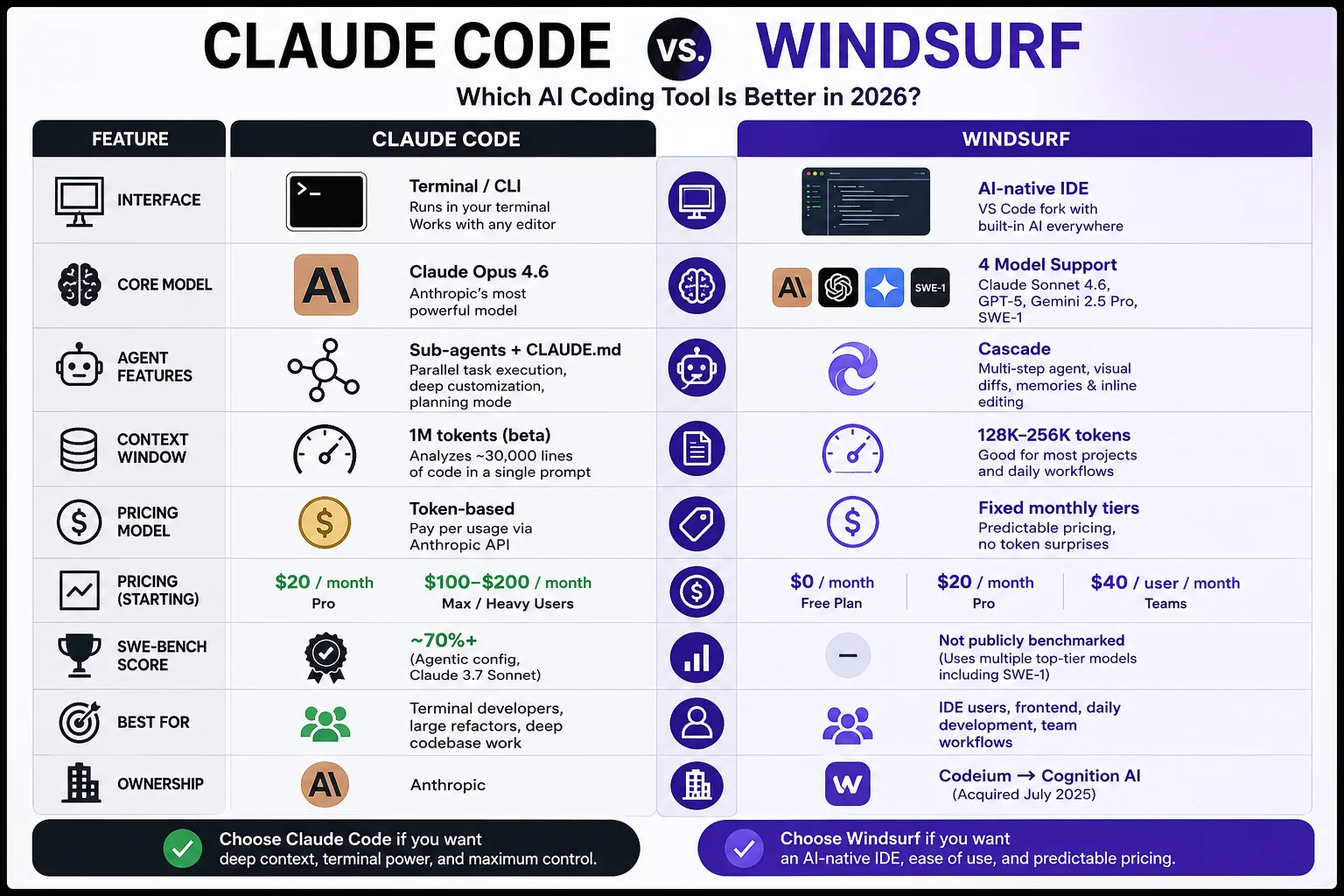
Developers evaluating Claude Code and Windsurf face 3 concrete problems: unpredictable token costs that spike during large refactoring sessions, context window limits that break down on codebases spanning 40+ files, and the fundamental workflow mismatch between terminal-native agents and IDE-based agentic editors. Choosing the wrong tool costs engineering teams both money and productivity a developer locked into a token-based pricing model on light daily tasks overpays by $80–$150/month, while a team relying on an IDE-bound agent for large backend migrations loses hours to manual context re-injection.
Claude Code, built by Anthropic on Claude Opus 4.6, solves the deep-context problem. Its 1M token context window (beta) and autonomous tool-use loop handle cross-file architectural tasks database migrations, API restructuring, authentication refactors that exceed the 128K–256K token limit of IDE-based competitors. Windsurf, built by Codeium with the Cascade agentic engine, solves the accessibility and cost-predictability problem. Its visual diff workflow, 4-model support (Claude Sonnet 4.6, GPT-5, Gemini 2.5 Pro, SWE-1), and fixed monthly pricing at $20/month deliver agentic coding inside a familiar VS Code-style environment without token billing surprises.
This comparison covers 6 decision dimensions interface, context window, agentic capabilities, model flexibility, pricing, and use cases with exact figures from Anthropic’s official documentation, the Stack Overflow Developer Survey 2025, and SWE-bench Verified benchmark results, so developers and engineering teams select the tool that matches their workflow, codebase size, and budget before committing to a subscription.
Claude Code vs Windsurf: Quick Comparison
| Feature | Claude Code | Windsurf |
| Interface | Terminal / CLI | AI-native IDE (VS Code fork) |
| Core Model | Claude Opus 4.6 | Claude Sonnet 4.6, GPT-5, Gemini 2.5 Pro, SWE-1 |
| Agent Feature | Sub-agents + CLAUDE.md | Cascade |
| Context Window | 1M tokens (beta) | 128K–256K tokens |
| Free Plan | No | Yes unlimited completions |
| Pro Pricing | $20/month | $20/month |
| Max / Teams Plan | $100–$200/month | $40/user/month (Teams) |
| Pricing Model | Token-based (Anthropic API) | Fixed monthly tiers |
| SWE-bench Score | ~70%+ (agentic config, Claude 3.7 Sonnet) | Not publicly benchmarked |
| Best For | Terminal developers, large refactors | IDE users, frontend, team workflows |
| Ownership | Anthropic | Codeium → Cognition AI (July 2025) |
What Is Claude Code?
Claude Code is a terminal-based agentic coding tool built by Anthropic that connects to Claude models through the Anthropic API and operates inside a developer’s local environment.
Claude Code reads local files, executes shell commands, runs test suites, spawns sub-agents for parallel workstreams, and commits changes from the command line. Developers who evaluate the best AI coding assistant options consistently rank Claude Code highest for cross-file reasoning on large codebases. Claude Code supports deep project customization through CLAUDE.md files, where developers define code style rules, testing instructions, and custom slash commands. It also integrates with MCP (Model Context Protocol) servers, enabling direct connections to external platforms including GitHub, Linear, Slack, and custom deployment pipelines.
Claude Code uses Claude Opus 4.6 as its default model. According to SWE-bench Verified results, Claude models in agentic configurations score approximately 70%+ on real-world coding task resolution, placing Claude Code among the 3 top-performing terminal agents available in 2025.
5 Key Features of Claude Code
- 1M token context window (beta) analyzes approximately 30,000 lines of code in a single prompt, per Anthropic’s documentation
- Sub-agent spawning runs parallel coding tasks across multiple files simultaneously
- CLAUDE.md configuration stores persistent project memory, code style rules, and testing instructions across sessions
- MCP server integration connects to external tools including GitHub, Linear, Slack, and custom APIs
- Planning mode displays all proposed changes for developer review before execution
4 Strengths and 3 Limitations of Claude Code
Strengths:
- Executes cross-file refactoring across 40+ interconnected files without losing context
- Operates alongside any editor including VS Code, JetBrains, Vim, Neovim, and Emacs without IDE lock-in
- Prevents unintended production changes through Planning Mode review before execution
- Enables parallel workstreams for large architectural tasks through sub-agent spawning
Limitations:
- Requires CLI proficiency no visual interface exists for the core terminal experience
- Accumulates token costs rapidly during intensive agentic sessions, with heavy users reporting $100–$200/month on API pricing
- VS Code and JetBrains plugins (launched beta December 2025) remain less mature than the terminal experience
What Is Windsurf?
Windsurf is an AI-native IDE built by Codeium as a VS Code fork, with autonomous agentic capabilities integrated into every layer of the editor environment.
Windsurf was acquired by Cognition AI the company behind Devin in July 2025, following the collapse of a $3 billion OpenAI acquisition deal. Cognition began integrating Windsurf into the Devin ecosystem in 2026. The Windsurf IDE continues operating under active development. Cascade, Windsurf’s agentic execution engine, reads the full codebase, plans multi-step changes across files, executes them autonomously, and presents diffs inside the editor for developer approval at each stage. Windsurf supports 4 model options Claude Sonnet 4.6, GPT-5, Gemini 2.5 Pro, and Codeium’s proprietary SWE-1 giving developers the flexibility to route different task types to different models.
5 Key Features of Windsurf
- Cascade agent multi-step autonomous task execution with visual diff preview inside the IDE
- Memories learns codebase patterns and stores project context across sessions automatically
- Arena Mode runs 2 Cascade agents side-by-side on the same prompt for blind model comparison (Wave 13)
- Parallel multi-agent sessions runs concurrent Cascade agents using Git worktrees simultaneously
- Workflow automation saves repeatable tasks as markdown slash commands, such as /deploy and /pr-review
4 Strengths and 3 Limitations of Windsurf
Strengths:
- Provides a generous free tier with unlimited code completions and no time limit
- Delivers predictable monthly pricing without token cost variability
- Renders live web previews with click-to-edit UI element functionality
- Guides multi-step changes through visual diffs, keeping developers in control of each decision
Limitations:
- Context window of 128K–256K tokens struggles on very large, cross-cutting refactors spanning 40+ files
- Locks developers into its VS Code fork JetBrains, Neovim, and Emacs are unsupported
- Roadmap uncertainty under Cognition AI introduces risk for long-term enterprise adoption decisions
Feature-by-Feature Comparison
Which Has the Better Interface: Claude Code or Windsurf?
Claude Code operates from the terminal. Windsurf operates inside a full IDE. This architectural difference separates 2 distinct developer personas not capability levels.

Claude Code fits developers who already work in the CLI and want an agent that operates alongside their existing editor without switching environments. Windsurf fits developers who prefer visual feedback, inline diffs, and a familiar VS Code-style environment with AI integrated at every layer.
Which Tool Has the Larger Context Window?
Claude Code’s 1M token context window (beta, via Claude Opus 4.6, per Anthropic documentation) handles cross-cutting refactors that touch auth layers, API routes, middleware, database queries, and frontend components across 40+ files in a single prompt. Windsurf’s Cascade operates within 128K–256K tokens depending on model selection, covering most medium-sized SaaS projects without losing coherence.

For large enterprise codebases where a single refactor touches 20+ interconnected services, Claude Code’s context advantage is decisive. For medium-sized projects, Windsurf’s Cascade performs comparably with less setup overhead.
Which Tool Has Stronger Agentic Capabilities?
Claude Code and Windsurf both support autonomous multi-step task execution, but their execution models differ in 2 fundamental ways:
- Claude Code runs a continuous tool-use loop read file → edit → run tests → read output → iterate executing autonomously until the task completes and presenting the finished diff for review
- Windsurf Cascade presents diffs at each execution stage for developer approval, maintaining a collaborative visual flow rather than background autonomy
Claude Code suits developers who require full autonomous execution on complex tasks. Windsurf Cascade suits developers who prefer to review and approve each decision as the agent works. The broader landscape of AI comparison tools shows this terminal-vs-IDE split is a consistent theme across agentic coding platforms in 2025.
Which Tool Offers More Model Flexibility?
Windsurf supports 4 models Claude Sonnet 4.6, GPT-5, Gemini 2.5 Pro, and SWE-1 giving teams the ability to route different task types to the model best suited for each workflow. Claude Code is locked to Anthropic’s Claude family, with Claude Opus 4.6 as the default and Claude Sonnet 4.6 available for faster, lighter tasks.
Multi-model routing gives Windsurf a measurable advantage for teams running diverse workloads. Claude Code’s single-vendor architecture is a justified constraint for developers who prioritize reasoning depth over model variety.
How Do Claude Code and Windsurf Handle Integrations?
Claude Code integrates with MCP servers, providing direct programmatic connections to GitHub, Linear, Slack, and custom APIs from the terminal environment. Windsurf integrates with GitHub natively, enabling automated PR creation and code review workflows inside the IDE. Both tools support standard development stacks including React, Python, FastAPI, and Next.js projects. For deeper pipeline integrations requiring custom server configurations, Claude Code’s MCP architecture provides broader extensibility.
Pricing Comparison
Claude Code Pricing
| Plan | Price | What’s Included |
| Pro | $20/month | Claude Code access, Claude Sonnet 4.6, standard usage limits |
| Max (5x) | $100/month | 5× higher usage limits than Pro |
| Max (20x) | $200/month | 20× higher usage limits than Pro |
| API (pay-per-use) | Variable | Claude Opus 4.6 at $5 input / $25 output per 1M tokens |
Claude Code has no standalone free tier. Developers access it through the Claude.ai Pro plan at $20/month. Token costs accumulate rapidly during intensive agentic sessions multi-file refactors using Claude Opus 4.6 generate significant token volume, with heavy users consistently reporting $100–$200/month on direct API pricing.
Windsurf Pricing
| Plan | Price | What’s Included |
| Free | $0/month | Unlimited code completions, ~25 prompt credits/month, 1 app deploy/day |
| Pro | $20/month | Daily and weekly usage quota refresh, frontier model access (Claude Sonnet 4.6, GPT-5, Gemini 2.5 Pro) |
| Teams | $40/user/month | Admin dashboard, centralized billing, access controls |
| Enterprise | Custom | 200+ seats, SSO, RBAC, zero-day data retention, hybrid deployment |
Windsurf updated its billing structure in March 2026, shifting from monthly credit balances to daily and weekly usage quotas and raising the Pro plan price to $20/month. The free plan remains among the 3 most generous in the AI coding IDE category, with unlimited code completions and no expiration.
Which Tool Delivers Better Value?
Windsurf delivers better value for developers with predictable, medium-intensity workflows where fixed monthly billing matters. Claude Code delivers better value for senior engineers running large autonomous sessions where token cost is justified by time savings. According to the Stack Overflow Developer Survey 2025, 76% of developers report AI coding tools save at least 2 hours per week. At a $150/hour senior engineer rate, $200/month in Claude Code usage pays for itself within a single saved workday.
Use Case Comparison
Which Is Better for Beginners?
Windsurf is the stronger choice for beginners. The IDE interface, live web previews, and Cascade’s visual diff workflow eliminate the terminal setup and CLI proficiency that Claude Code requires. The free plan allows beginners to explore agentic coding without financial commitment.
Which Is Better for Senior and Terminal-First Developers?
Claude Code is the stronger choice for senior developers who work primarily in the terminal. Tasks including authentication refactors, database migrations, and multi-service API restructuring where context must span 40+ files simultaneously exceed Windsurf’s context window and benefit directly from Claude Code’s autonomous tool-use loop.
Which Is Better for Development Teams?
Windsurf Teams at $40/user/month includes 3 critical enterprise capabilities: admin dashboards for usage oversight, centralized billing for finance teams, and role-based access controls for security compliance. Claude Code’s enterprise API tier adds data residency controls and hybrid deployment options, making it the stronger choice for regulated industries including finance, healthcare, and government where data locality requirements exist.
Which Is Better for Frontend Development?
Windsurf is the stronger choice for frontend development. Its live web preview feature renders project output inside the IDE developers click any UI element and prompt Cascade to adjust styling or functionality, with changes applied and previewed immediately. Claude Code has no visual rendering capability.
Which Is Better for Backend and Large-Scale Refactoring?
Claude Code is the stronger choice for backend development and large-scale refactoring. Its 1M token context window, sub-agent parallelism, and autonomous tool-use loop handle multi-service backend changes, database schema migrations, and API restructuring tasks that exceed Windsurf’s 128K–256K token limit. Developers comparing coding-focused tools in detail find the context window gap most pronounced on legacy codebases where a single change ripples across dozens of interconnected modules. The Claude Code vs Cursor comparison covers this context window advantage in depth against the other leading IDE-based competitor.
Claude Code vs Windsurf: Final Decision
Claude Code is the correct choice for developers who:
- Work in terminal-first, CLI-heavy environments daily
- Manage large codebases with 40+ interconnected files requiring deep cross-file reasoning
- Use mixed editor environments including JetBrains, Neovim, or Emacs alongside VS Code
- Run backend, infrastructure, API-heavy, or database-intensive projects
- Accept variable token-based pricing in exchange for maximum autonomous execution depth
Windsurf is the correct choice for developers who:
- Prefer a visual IDE over a terminal-first workflow
- Build frontend or full-stack projects on medium-sized codebases
- Require predictable monthly pricing without token cost risk
- Onboard junior or mid-level developers to AI-assisted coding workflows
- Need collaborative visual diffs and guided step-by-step agentic execution
Professional development teams run both tools in practice: Windsurf handles daily interactive coding, inline completions, and quick multi-file edits, while Claude Code handles weekly deep analysis, large architectural refactors, and long autonomous sessions. The Claude Code vs GitHub Copilot comparison is also relevant for teams evaluating terminal agents against the dominant enterprise IDE tool. For teams evaluating Windsurf against its closest IDE competitor, the Copilot vs Windsurf breakdown covers the key pricing and agentic feature differences. Developers who want a complete picture of all leading AI coding tools across terminal agents and IDEs can use the best AI tools guide on aicomparison.ai as a starting point.
Frequently Asked Questions
Is Claude Code Better Than Windsurf?
Claude Code scores higher than Windsurf on agentic task completion for large, complex codebases approximately 70%+ on SWE-bench Verified versus no published benchmark for Windsurf’s SWE-1 model in agentic configurations. Windsurf outperforms Claude Code on interface accessibility, model flexibility, and predictable pricing for medium-sized projects.
What Is Windsurf Cascade?
Windsurf Cascade is an autonomous agentic execution engine built into the Windsurf IDE that plans multi-step coding tasks, edits multiple files simultaneously, runs terminal commands, and presents visual diffs inside the editor for developer approval at each stage. Cascade pioneered persistent session context and downstream dependency awareness in the IDE-based agentic coding category.
Does Claude Code Work in VS Code?
Claude Code is primarily a terminal-based CLI agent. Anthropic launched VS Code and JetBrains plugin betas in December 2025. The terminal experience remains more feature-complete than the plugin versions as of 2025.
How Much Does Windsurf Cost Per Month?
Windsurf costs $0/month on the free plan (unlimited code completions, ~25 prompt credits/month), $20/month on Pro (frontier model access with daily and weekly quota refresh), $40/user/month on Teams, and custom pricing on Enterprise for organizations with 200 or more seats.
Do Claude Code and Windsurf Work Together?
Claude Code and Windsurf serve complementary roles in a professional development workflow. Windsurf handles daily inline coding, autocomplete, and quick multi-file edits inside the IDE. Claude Code handles large refactors, architecture changes, and long autonomous sessions from the terminal. The 2 tools operate independently and run simultaneously on the same codebase without conflict. The Cursor vs Copilot comparison provides additional context on how IDE-based tools and terminal agents fit into combined developer workflows.
What Happened to Windsurf?
Cognition AI acquired Windsurf (built by Codeium) in July 2025 after OpenAI’s $3 billion acquisition deal collapsed and Google hired Windsurf’s CEO and key engineering staff in a $2.4 billion licensing arrangement. Cognition began integrating Windsurf into the Devin product ecosystem in 2026. The Windsurf IDE continues operating under active development as of 2025.
Final Verdict

Claude Code and Windsurf represent 2 distinct architectures for AI-assisted development. Claude Code built by Anthropic on Claude Opus 4.6 with a 1M token context window is the stronger choice for experienced developers who require terminal-native autonomy, deep cross-file reasoning, and maximum context capacity for large production codebases. Windsurf built by Codeium with the Cascade agentic engine and 4-model support is the stronger choice for developers who require a polished visual IDE, predictable monthly pricing, and a generous free tier for individual or team use.
The 92% of developers now using AI coding tools (DORA 2025 report) face a choice between 2 philosophies, not 2 capability levels. Claude Code executes deeply. Windsurf guides visually. For most professional teams, both tools earn their place in the same workflow. Explore the full range of AI coding tool comparisons at aicomparison to find the configuration that matches your team’s architecture, budget, and development style.
