Meta AI vs Gemini: Which Is Better in 2026?
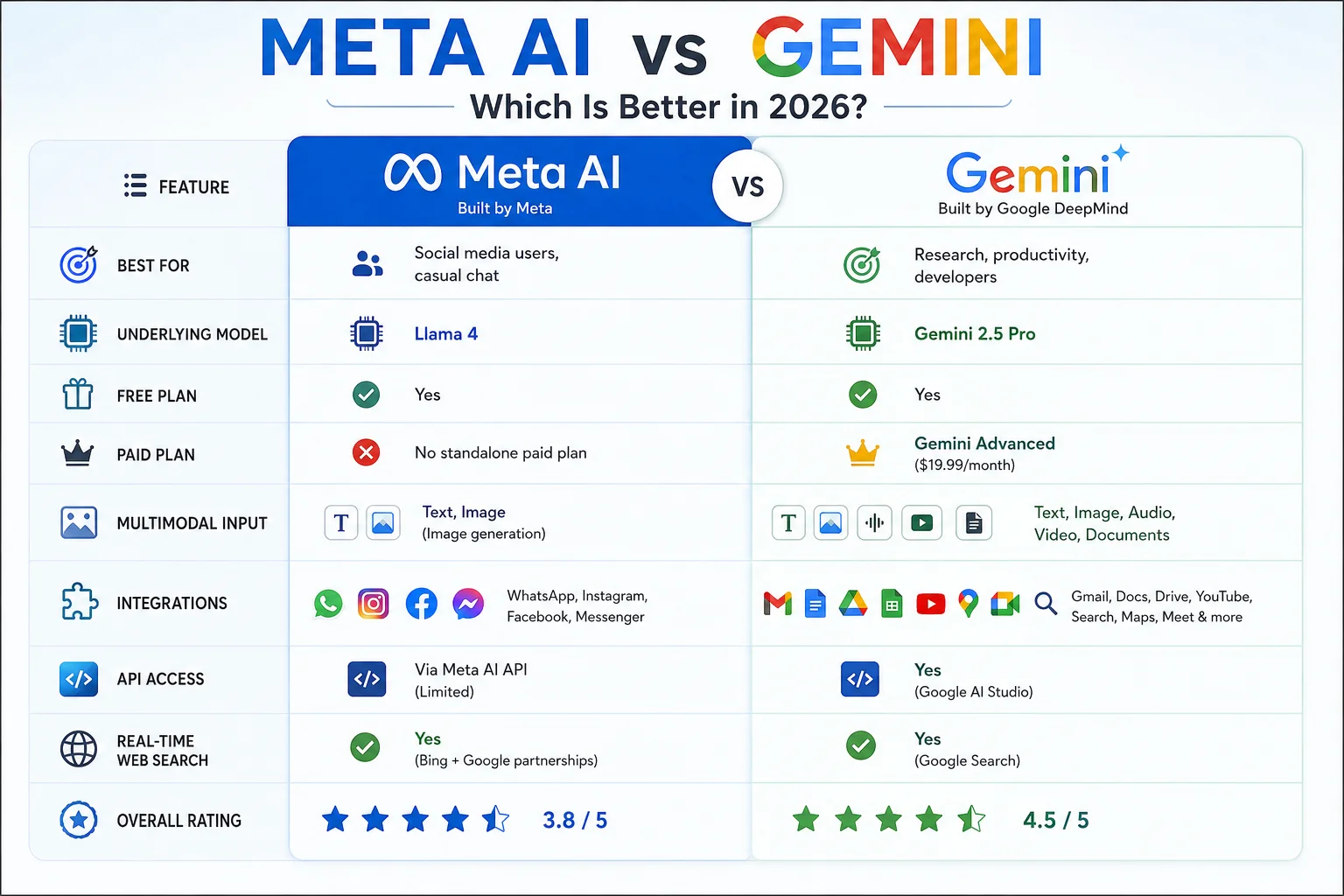
Meta AI delivers 4 core capabilities chat, image generation, social media integration, and real-time search while Gemini by Google provides 6 advanced capabilities, including deep research, multimodal reasoning, Workspace integration, Gemini Live voice mode, code generation, and API access for developers.
Meta AI, built by Meta on the Llama 4 model, and Gemini, built by Google DeepMind on the Gemini 2.5 Pro model, represent 2 of the most widely available free AI assistants in 2025. Meta AI reaches users across WhatsApp, Instagram, Facebook, and Messenger. Gemini reaches users through Google Search, Gmail, Google Docs, and Android devices.
This comparison covers features, pricing, use cases, and performance to help users choose between Meta AI and Gemini. For a broader perspective on the best AI assistants available today, the AI comparison covers 12 leading platforms side by side.
Meta AI vs Gemini: Quick Comparison
| Feature | Meta AI | Gemini |
| Best For | Social media users, casual chat | Research, productivity, developers |
| Underlying Model | Llama 4 | Gemini 2.5 Pro |
| Free Plan | Yes | Yes |
| Paid Plan | No standalone paid plan | Gemini Advanced ($19.99/month) |
| Multimodal Input | Image generation only | Text, image, audio, video, documents |
| Integrations | WhatsApp, Instagram, Facebook, Messenger | Gmail, Docs, Drive, YouTube, Search |
| API Access | Via Meta AI API (limited) | Yes Google AI Studio |
| Real-Time Web Search | Yes | Yes |
| Overall Rating | 3.8 / 5 | 4.5 / 5 |
What Is Meta AI?
Meta AI is an AI assistant developed by Meta, powered by the Llama 4 Scout and Llama 4 Maverick models, and embedded across WhatsApp, Instagram, Facebook, and Messenger.
Meta released Meta AI publicly in 2024 and expanded it across its social platforms. The assistant handles text conversations, image generation, real-time web search, and social content assistance. Llama 4 Scout operates on a 10 million token context window, making it capable of processing long documents and extended conversations.
Key Features of Meta AI
Meta AI includes 5 primary features across its platforms:
- Real-time web search powered by Bing and Google partnerships for current information
- AI image generation using Meta’s proprietary image generation models, accessible directly in WhatsApp and Instagram
- Social media integration embedded natively in 4 Meta platforms without requiring a separate app
- Conversational memory within active sessions for contextual follow-ups
- Multilingual support across 7 languages, including English, Spanish, French, and Portuguese
Best Use Cases for Meta AI
Meta AI performs best across 3 specific scenarios:
- Social media users who need quick answers, captions, or image generation without leaving WhatsApp or Instagram
- Casual users seeking a no-cost, no-signup AI assistant embedded in platforms they already use daily
- Content creators generating social post ideas, image concepts, and quick research summaries within Meta apps
What Is Gemini?
Gemini is Google’s multimodal AI assistant, built on the Gemini 2.5 Pro model, and integrated across Google Search, Gmail, Google Docs, Google Drive, Android devices, and the standalone Gemini web app.
Google DeepMind launched Gemini in December 2023 and released Gemini 2.5 Pro in 2025 as its most capable reasoning model. Gemini 2.5 Pro scores 90.0 on the MMLU benchmark, which measures knowledge across 57 academic and professional subjects. The model supports a 1 million token context window, enabling deep analysis of books, codebases, and lengthy research documents.
Key Features of Gemini
Gemini includes 6 standout capabilities:
- Gemini 2.5 Pro reasoning for complex multi-step analysis, coding, and research tasks
- Gemini Live real-time voice conversation mode available on Android and iOS
- Deep Research a feature that autonomously browses the web, synthesizes sources, and produces structured research reports
- Google Workspace integration reads and edits Gmail, Google Docs, Sheets, and Drive natively
- Multimodal input processes text, images, audio files, video, and PDF documents in a single prompt
- Google AI Studio API provides developer access to Gemini models with free tier and paid usage
Best Use Cases for Gemini
Gemini performs best across 4 distinct scenarios:
- Researchers and students using Deep Research to synthesize 10–20 sources into structured reports
- Google Workspace users automating email drafting, document editing, and spreadsheet analysis
- Developers accessing Gemini 2.5 Pro through Google AI Studio for coding assistance and API integration
- Android users using Gemini as a system-level assistant replacing Google Assistant on Pixel devices
Meta AI vs Gemini: Feature-by-Feature Comparison
Multimodal Capabilities
Gemini processes 5 input types text, images, audio, video, and documents while Meta AI processes 2 input types: text and image prompts.

Gemini 2.5 Pro analyzes uploaded PDFs, interprets screenshots, and transcribes audio files within a single conversation. Meta AI generates images from text prompts and responds to image descriptions but does not accept file uploads or audio input. For users requiring multimodal workflows, Gemini holds a clear advantage.
Reasoning and Intelligence
Gemini 2.5 Pro achieves a 90.0 score on the MMLU benchmark, while Llama 4 Maverick scores 85.5 on the same benchmark, giving Gemini a 4.5-point reasoning advantage.
Gemini 2.5 Pro uses a Chain-of-Thought reasoning system that makes its thinking process visible before producing an answer. This is particularly useful for math, logic, and multi-step research problems. Meta AI’s Llama 4 Maverick handles general conversation and moderate reasoning tasks but does not provide visible reasoning traces.
Integration Ecosystem
Gemini integrates with 8 Google services Search, Gmail, Docs, Sheets, Drive, Maps, YouTube, and Meet while Meta AI integrates with 4 Meta platforms: WhatsApp, Instagram, Facebook, and Messenger.

Gemini’s Google Workspace integration enables users to summarize long email threads, draft replies, and generate Google Sheets formulas directly from natural language prompts. Meta AI’s integration targets social communication rather than productivity workflows.
Real-Time Web Search
Both Meta AI and Gemini access real-time web information. Meta AI uses Bing and Google search partnerships to retrieve current data. Gemini uses Google Search natively, providing access to the most up-to-date indexed web content with citation links in every response.
Image Generation
Meta AI generates images faster than Gemini’s standard image generation, producing outputs in under 5 seconds within WhatsApp and Instagram interfaces.
Meta AI uses its proprietary Emu model for image generation, embedded directly in social apps. Gemini uses Imagen 3 for image generation, available in the Gemini web app and Gemini Advanced. Imagen 3 produces higher-detail photorealistic results, while Meta AI prioritizes accessibility and speed within social contexts.
For comparisons involving other AI image generators, the best AI image generators guide ranks 8 platforms by output quality and speed.
Pricing Comparison
Meta AI Pricing
Meta AI is fully free with no paid subscription tier, no usage limits disclosed publicly, and no standalone app purchase required.
Users access Meta AI through existing Meta accounts across WhatsApp, Instagram, Facebook, and Messenger. No credit card is required. Advanced features like high-resolution image generation and extended context are available on the free tier without additional cost.
Gemini Pricing
Gemini offers 2 pricing tiers: a free plan with Gemini 1.5 Flash access, and Gemini Advanced at $19.99 per month with Gemini 2.5 Pro access.
| Plan | Gemini | Meta AI |
| Free | Gemini 1.5 Flash | Full access, all platforms |
| Paid | Gemini Advanced $19.99/month | Not available |
| API | Google AI Studio pay-per-token | Meta AI API limited access |
| Enterprise | Google Workspace add-on | Not available |
Gemini Advanced includes 2 TB of Google One storage, Deep Research access, Gemini in Gmail and Docs, and priority access to new Gemini model updates. For users already paying for Google One storage, the Gemini Advanced add-on represents strong bundled value.
Which Tool Offers Better Value?
Meta AI offers greater cost value for casual users, while Gemini Advanced delivers superior feature value for professionals and Workspace users at $19.99 per month.
Use Case Comparison

Best for Research
Gemini outperforms Meta AI for research tasks, with Deep Research producing structured 2,000–5,000 word reports synthesizing 10–20 web sources automatically.
Meta AI handles quick factual lookups and summarization. Gemini’s Deep Research autonomously selects sources, cross-references data, and produces structured reports with citations a workflow Meta AI does not replicate.
Best for Social Media and Content Creation
Meta AI outperforms Gemini for social media workflows, with native integration across 4 Meta platforms and sub-5-second image generation directly inside WhatsApp and Instagram.
Users generating social captions, story ideas, and quick images benefit from Meta AI’s embedded experience. Gemini requires switching to a separate app or browser tab for the same workflow.
Best for Coding and Development
Gemini 2.5 Pro outperforms Meta AI for coding tasks, scoring first place on the SWE-bench Verified benchmark for software engineering in early 2025.
Gemini 2.5 Pro generates, debugs, and explains code across Python, JavaScript, Go, and 10 other programming languages. It also integrates with Google AI Studio for API-based development workflows. For a detailed coding tool comparison, the Claude Code vs GitHub Copilot article covers developer-specific AI tools in depth.
Best for Students
Gemini provides stronger academic support through Deep Research, Google Docs integration, and Gemini 2.5 Pro’s 90.0 MMLU benchmark score across 57 academic subjects.
Meta AI offers quick Q&A and study summaries but does not support document uploads, research report generation, or academic workflow integration.
Alternatives to Meta AI and Gemini
For users finding that neither Meta AI nor Gemini meets their specific needs, 5 strong alternatives exist:
| Alternative | Best For |
| ChatGPT | Advanced reasoning, GPT-5 access, DALL-E image generation |
| Claude | Long-document analysis, writing quality, nuanced reasoning |
| Perplexity AI | Real-time research with citations and source transparency |
| Grok | X (Twitter) integration, real-time social media data |
| Copilot | Microsoft 365 integration, Teams, Word, and Excel workflows |
The aicomparison.ai homepage lists 90+ head-to-head comparisons across all major AI tools, including coding assistants, image generators, and productivity platforms.
Readers who want a wider set of options beyond this matchup can browse the dedicated Gemini alternatives guide for more tools to compare against Google’s assistant.
Frequently Asked Questions
Is Meta AI better than Gemini?
Gemini is better than Meta AI for research, coding, and productivity tasks, while Meta AI is better for social media users accessing AI through WhatsApp, Instagram, and Facebook.
Which AI model powers Meta AI and Gemini?
Meta AI runs on Llama 4 Scout and Llama 4 Maverick, both developed by Meta. Gemini runs on Gemini 2.5 Pro, developed by Google DeepMind.
Does Meta AI have a paid plan?
Meta AI has no paid subscription plan. Full access is free across all 4 Meta platforms WhatsApp, Instagram, Facebook, and Messenger.
Which is faster Meta AI or Gemini?
Meta AI produces responses faster for simple conversational queries and image generation. Gemini 2.5 Pro takes longer on complex reasoning tasks due to its Chain-of-Thought processing, but produces more accurate and detailed outputs.
Can Gemini access Google Drive and Gmail?
Yes. Gemini Advanced integrates with Gmail, Google Drive, Google Docs, and Google Sheets, enabling document summarization, email drafting, and spreadsheet formula generation directly through natural language prompts.
Final Verdict: Meta AI vs Gemini

Gemini is the stronger AI assistant in 2025 for users who need deep research, multimodal input, Google Workspace integration, and developer API access. Meta AI is the stronger choice for users who want a free, frictionless AI assistant embedded inside WhatsApp, Instagram, and Facebook.
Choose Meta AI if:
- Social media platforms are the primary daily interface
- Free, no-setup AI access is the priority
- Quick image generation inside WhatsApp or Instagram is the main use case
- A lightweight AI assistant for casual conversation is sufficient
Choose Gemini if:
- Google Workspace tools Gmail, Docs, Drive, Sheets are part of the daily workflow
- Research tasks require synthesizing multiple sources into structured reports
- Coding assistance and API access are required
- Multimodal input images, audio, video, PDFs is part of the workflow
For users comparing more AI chatbots across different use cases, the best AI chatbot guide ranks 10 platforms by capability, pricing, and ease of use. Users evaluating AI models more broadly can explore the best AI models guide for a complete breakdown of 2025’s leading models.


