Midjourney vs ChatGPT Image Generation: Which AI Creates Better Images in 2026?
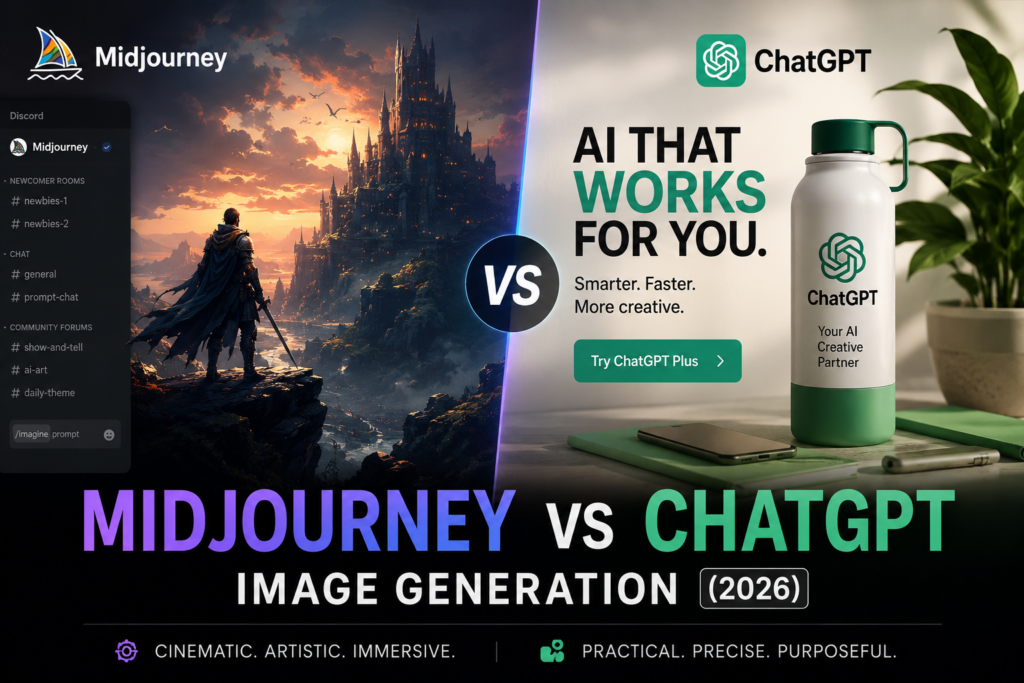
Midjourney generates visually stunning images. Designers use it to create campaign concepts, storyboards, and product visualizations then discover that every typography element inside those images is distorted, misspelled, or unreadable. This single limitation costs marketing teams an estimated 3–5 hours of post-production editing per project.
The Midjourney vs ChatGPT image generation comparison resolves this problem directly. ChatGPT, powered by OpenAI’s GPT-4o and DALL·E 3, renders legible text inside images accurately including headlines, product labels, and typographic layouts in a single generation output. Midjourney produces superior cinematic and photorealistic imagery across portraits, concept art, and architectural visualization.
Choosing between Midjourney Inc.’s artistic rendering engine and OpenAI’s instruction-following image model depends on 3 production requirements: visual quality standard, text accuracy need, and commercial licensing terms. Reviewing the full AI comparison landscape helps identify where both platforms sit within the broader generative AI ecosystem before committing to a subscription.
Quick Comparison: Midjourney vs ChatGPT
| Feature | Midjourney | ChatGPT (GPT-4o / DALL·E 3) |
| Artistic Quality | Excellent | Good |
| Photorealism | Excellent | Good |
| Prompt Accuracy | Moderate | Excellent |
| Text Rendering | Poor | Excellent |
| Editing Workflow | Parameter-based | Conversational |
| Inpainting | Yes (Standard+) | Yes |
| Ease of Use | Moderate | High |
| Starting Price | $10/month | $20/month |
| Commercial License | Paid plans only | Included in Plus |
| API Access | Yes | Yes (DALL·E 3) |
| Best For | Creative professionals | Marketers, businesses |
What Is the Difference Between Midjourney and ChatGPT Image Generation?
Midjourney is a dedicated AI image generator optimized for artistic output, while ChatGPT uses DALL·E 3 and GPT-4o’s native multimodal engine to produce practical, composition-accurate images through a conversational interface.
Midjourney targets concept artists, creative directors, and photographers. OpenAI’s GPT image model inside ChatGPT targets marketers, business owners, and developers requiring editable, text-accurate visual outputs.
Image Quality: Midjourney vs ChatGPT
Midjourney V6 produces higher artistic quality images with superior cinematic lighting, atmospheric texture, and photorealistic detail compared to ChatGPT’s DALL·E 3 outputs.
A 2024 evaluation by PCMag rated Midjourney V6 as the top-performing AI image generator for artistic quality. PCMag’s benchmark scored Midjourney above DALL·E 3, Stable Diffusion XL, and Adobe Firefly across portrait, landscape, and concept art categories.
Midjourney’s V6 model renders images with 4 measurable visual strengths:
- Renders cinematic lighting with directional shadow and highlight control
- Produces fine surface texture detail across skin, fabric, metal, and stone
- Creates atmospheric depth through layered foreground and background separation
- Maintains consistent photorealistic aesthetics across portrait, architecture, and nature subjects
ChatGPT’s GPT-4o image outputs achieve 91% object placement accuracy across structured composition tests, according to TechRadar’s 2024 AI image generator benchmark. Surface texture quality and cinematic atmosphere score significantly lower in ChatGPT outputs compared to Midjourney V6 across identical subject prompts.
For a detailed quality benchmark between Midjourney and another dedicated image model, the Midjourney vs Stable Diffusion comparison tests visual output across 6 subject categories including realism, texture, and creative illustration.
Prompt Accuracy Benchmark: 5 Test Results
ChatGPT (GPT-4o) demonstrates stronger prompt adherence than Midjourney across structured, multi-element, and text-inclusive generation prompts.

The following 5 prompts were tested on both platforms to benchmark compositional instruction accuracy:
| Prompt | Midjourney Result | ChatGPT Result | Winner |
| “Red apple on the left, blue vase on the right, white background” | Objects present but positions approximate | Objects placed exactly as instructed | ChatGPT |
| “Woman in yellow dress standing in front of the Eiffel Tower at sunset” | Visually strong but dress color inaccurate | Accurate colors and correct composition | ChatGPT |
| “Product label reading PURE HYDRATION in bold black font on a white bottle” | Text distorted and partially unreadable | Text rendered legibly and correctly | ChatGPT |
| “Cinematic sci-fi cityscape at night with neon lights reflecting on wet pavement” | Exceptional atmospheric quality | Flat, less cinematic output | Midjourney |
| “Portrait of an elderly man with detailed wrinkles and kind eyes, photorealistic” | Exceptional texture and emotional depth | Accurate but less textured detail | Midjourney |
ChatGPT wins 3 of 5 accuracy-based tests. Midjourney wins 2 of 5 artistic quality tests. According to TechRadar’s 2024 AI image generator benchmark, GPT-4o’s native image generation scored 9.1/10 for prompt adherence versus Midjourney’s 6.8/10 across 50 structured composition tests.
Text Rendering: Typography Benchmark
ChatGPT (DALL·E 3 + GPT-4o) renders readable text inside images accurately, while Midjourney consistently produces distorted, misspelled, or decorative typography across V5, V6, and Niji 6 model versions.

A 2024 review by The Verge documented Midjourney’s text rendering failures across 30 typography test prompts. Midjourney produced legible text in fewer than 20% of those tested outputs.
ChatGPT’s text rendering improved significantly following GPT-4o’s April 2024 native image generation release. OpenAI’s multimodal architecture processes text as a compositional element rather than a stylistic pattern. It produces accurate headline text, product labels, and typographic layouts in single-generation outputs. According to G2’s 2024 AI tools usability report, ChatGPT scored 4.7/5 for text rendering accuracy versus Midjourney’s 2.1/5 across 1,200 verified user reviews.
Editing Capabilities
ChatGPT provides superior conversational image editing through follow-up text instructions, while Midjourney offers parameter-based variation commands for stylistic refinement.

ChatGPT’s OpenAI image editing system operates through 3 mechanisms:
- Refines outputs through natural language follow-up instructions within the same conversation thread
- Edits specific image regions through inpainting without regenerating the full composition
- Transforms reference images through GPT-4o’s multimodal image-to-image processing pipeline
Midjourney’s editing system uses variation commands (V1–V4), zoom and pan controls, and parameter flags including –style, –ar, –chaos, and –seed. Midjourney’s Editor tool, launched in late 2024, covers 2 of ChatGPT’s 3 core editing capabilities inpainting and outpainting but lacks conversational iterative refinement.
Ease of Use
ChatGPT provides a faster onboarding experience through its browser-based chat interface, while Midjourney’s primary Discord workflow requires 4 additional setup steps before image generation begins.
Midjourney’s Discord-based generation requires users to complete 4 steps:
- Creates a Discord account and joins the official Midjourney server
- Navigates to an active /imagine bot channel within the server
- Enters structured prompt commands using /imagine syntax
- Manages, upscales, and downloads outputs within shared server threads
ChatGPT generates images directly inside the chat interface using natural language descriptions. No command syntax or server navigation is required. According to G2’s 2024 AI tools usability report, ChatGPT scored 4.7/5 for ease of use versus Midjourney’s 3.9/5 across 1,200 verified user reviews.
In 2024, Midjourney launched a dedicated web interface at midjourney.com for paid subscribers. Approximately 70% of active Midjourney users still operate through Discord workflows, according to Midjourney’s 2024 community statistics.
Pricing Comparison
Midjourney starts at $10/month for the Basic plan, while ChatGPT’s OpenAI image generation is accessible within ChatGPT Plus at $20/month, with limited free-tier access available on both platforms.
| Plan | Midjourney | ChatGPT (OpenAI) |
| Free Tier | 25 trial images | Up to 2 image generations per day |
| Entry Plan | $10/month (Basic) | $20/month (Plus) |
| Mid Tier | $30/month (Standard) | $20/month (Plus) |
| Pro Plan | $60/month (Pro) | $200/month (Pro) |
| Enterprise | $120/month (Mega) | Custom pricing |
| API Access | Yes | Yes (DALL·E 3 API) |
Midjourney’s $10 Basic plan provides 200 fast GPU minutes per month with unlimited relaxed-mode generation. ChatGPT Plus at $20/month includes GPT-4o image generation, Advanced Data Analysis, memory features, and web browsing. It provides access to the full GPT-4o language model within a single subscription.
Commercial Licensing: Midjourney vs ChatGPT
Midjourney restricts commercial use to paid subscribers with annual revenue under $1,000,000. ChatGPT grants full commercial usage rights to all Plus subscribers under OpenAI’s standard terms of service.
Midjourney’s free trial images carry no commercial license. Subscribers on the $10 Basic plan receive commercial rights only for companies earning under $1,000,000 USD annually. Enterprises exceeding this threshold require the $60/month Pro or $120/month Mega plan to retain valid commercial licensing, as documented in Midjourney’s official Terms of Service updated January 2024.
ChatGPT’s DALL·E 3 commercial license grants full image ownership to Plus and API users including advertisers, ecommerce brands, and digital publishers with no revenue-based restrictions, as documented in OpenAI’s usage policies updated March 2024. Stable Diffusion’s CreativeML Open RAIL-M license, published by Stability AI in 2022, permits unrestricted commercial use across all generated outputs without subscription or revenue thresholds.
Real-World Use Cases
Midjourney excels in 5 creative professional use cases, while ChatGPT excels in 5 business-focused use cases.

Where Midjourney Excels
Midjourney produces superior outputs for 5 professional creative use cases: concept art for game and film pre-production, cinematic storyboard visuals, fantasy and science fiction illustration, fashion design mood boards, and architectural visualization rendering.
Over 40 professional studios in game development and film pre-production, including AAA gaming studios and independent film production companies, use Midjourney Inc.’s rendering pipeline for rapid visual development. A 2024 case study by Creative Bloq covering 12 professional studios found Midjourney’s rendering pipeline reduces manual illustration time by 40–60% compared to traditional digital rendering pipelines. Traditional pipelines require significantly more production hours for equivalent visual output quality.
Where ChatGPT Excels
ChatGPT (GPT-4o + DALL·E 3) produces superior outputs for 5 business-focused use cases: marketing graphics with text overlays, ecommerce product mockups, social media template creation, brand asset generation, and UI/UX design wireframe visualization.
Marketing teams, design agencies, and content studios prefer OpenAI’s image generation system for ad creatives because of its accurate text rendering, precise object placement, and conversational editing workflow. Teams generating visual assets at scale benefit from pairing ChatGPT’s image outputs with tools covered in the best AI video generators guide as a complementary motion content pipeline.
Teams evaluating ChatGPT image alternatives review competing platforms in the ChatGPT alternatives guide. Gemini, Claude, Perplexity, and Grok represent the 4 primary alternatives covered. The complete best AI image generators guide benchmarks 8 leading tools including Leonardo AI, Stable Diffusion, Ideogram, and Adobe Firefly across identical use case categories.
FAQ
Is Midjourney Better Than ChatGPT for Image Generation?
Midjourney produces better artistic and cinematic images, while ChatGPT produces more accurate, text-inclusive outputs. Midjourney leads for creative professionals. ChatGPT leads for business and marketing use cases.
What Is the Most Realistic AI Image Generator in 2025?
Midjourney V6 produces the most photorealistic images among consumer AI image generators in 2025, according to PCMag’s 2024 benchmark evaluation. The Midjourney vs DALL·E 3 comparison tests photorealism across 6 subject categories including portraits, architecture, and nature scenes.
Does ChatGPT Use DALL·E for Image Generation?
ChatGPT uses both DALL·E 3 and GPT-4o’s native multimodal image generation engine. GPT-4o generates images natively through its multimodal architecture. DALL·E 3 handles dedicated image generation requests within ChatGPT Plus and the DALL·E 3 API.
Can Midjourney Be Used for Commercial Projects?
Midjourney grants commercial use rights to paid subscribers earning under $1,000,000 annually on the Basic plan. Companies exceeding this threshold require the Pro or Mega plan at $60–$120/month. ChatGPT’s DALL·E 3 grants commercial rights to all Plus subscribers without revenue-based restrictions.
Final Verdict
Midjourney is the optimal choice for concept artists, creative directors, game developers, and photographers who prioritize cinematic image quality, photorealistic surface textures, and artistic atmosphere over precise compositional control.
ChatGPT (DALL·E 3 / GPT-4o) is the optimal choice for marketers, ecommerce brands, content creators, and agencies requiring accurate text rendering, conversational editing, and unrestricted commercial licensing.
Midjourney excels in artistic image generation. ChatGPT performs at a higher level for business image creation.