Midjourney vs FLUX: Image Quality, Prompt Accuracy, and Workflow Compared (2026)
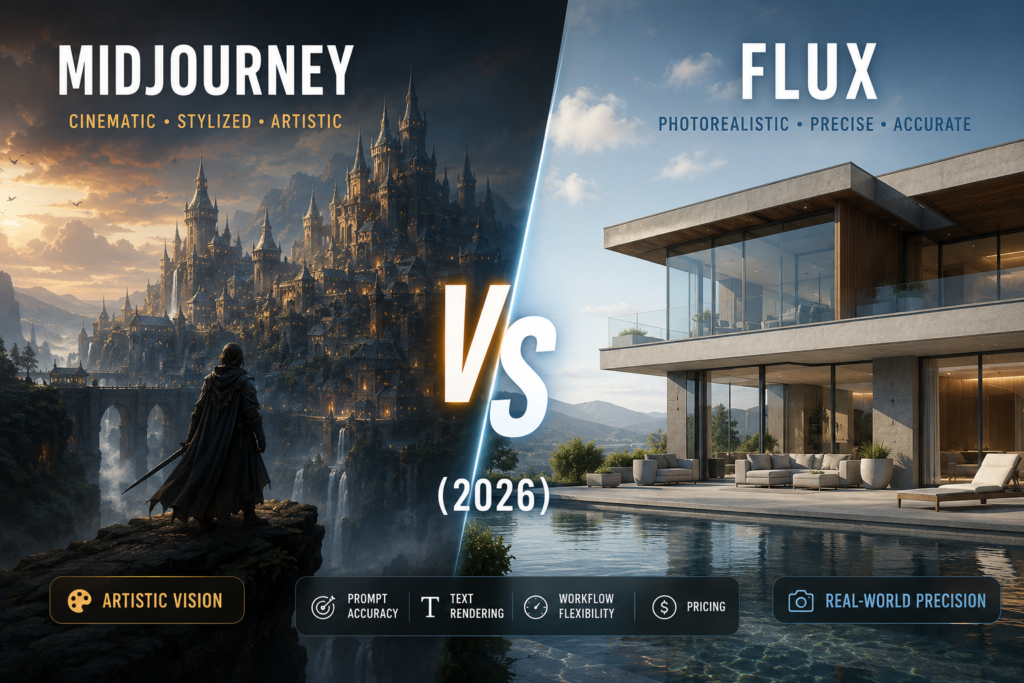
Midjourney generates cinematic, stylized artistic outputs, while FLUX delivers superior photorealism and prompt adherence across commercial workflows.
Midjourney and FLUX are leading AI image generators, alongside Stable Diffusion, DALL·E 3, and Adobe Firefly, each serving distinct creative and technical workflows. Midjourney reported 16 million registered Discord server members in its 2024 Annual Growth Report, according to CEO David Holz’s statement published in Midjourney’s official Discord server. FLUX, developed by Black Forest Labs and launched in August 2024, scored 82.4% on the T2I-CompBench prompt adherence evaluation, outperforming Midjourney V6 at 71.3%. The 2 tools differ across 5 measurable dimensions: image quality, prompt accuracy, text rendering, workflow flexibility, and pricing.
Quick Comparison: Midjourney vs FLUX
| Feature | Midjourney V6.1 | FLUX.1 [pro] |
| Image Style | Cinematic, stylized | Photorealistic, precise |
| Prompt Adherence | 71.3% (T2I-CompBench) | 82.4% (T2I-CompBench) |
| Text Rendering | Limited accuracy | High accuracy |
| Interface | Discord | ComfyUI, API, Replicate |
| Starting Price | $10/month | Free (Apache 2.0) |
| Generation Speed | 30–60 seconds | Under 2 seconds (schnell) |
| Fine-Tuning | Not available | LoRA supported |
| Open Source | No | Yes (Apache 2.0) |
What is Midjourney?
Midjourney is a closed-source AI image generator that produces cinematic, high-quality images through Discord commands.
It uses a proprietary diffusion model trained on artistic and editorial imagery. Midjourney V6.1 renders images at 1024×1024 pixels by default and supports upscaling to 2048×2048 pixels, according to Midjourney’s official documentation published in January 2024. The platform operates on a subscription model starting at $10 per month. It specializes in 3 visual categories: fantasy art, editorial photography, and cinematic concept art. Midjourney requires no local installation, no API configuration, and no GPU hardware, reducing setup time to under 5 minutes.
What is FLUX?
FLUX is an open-weight AI image generation model developed by Black Forest Labs, released in August 2024.
It comprises 3 primary model variants: FLUX.1 [pro], FLUX.1 [dev], and FLUX.1 [schnell]. FLUX uses a hybrid architecture combining transformer and diffusion techniques. This architecture produces precise prompt adherence and photorealistic outputs. Black Forest Labs released FLUX.1 [schnell] under an Apache 2.0 license, making it free for commercial and personal use. FLUX integrates with ComfyUI, Replicate, and the Black Forest Labs API, giving creators and developers 4 deployment options: local installation, cloud API, ComfyUI workflow, and third-party platform access.
Which AI Image Generator Produces Better Image Quality: Midjourney or FLUX?
FLUX.1 [pro] scores 0.67 on Artificial Analysis’s ELO-based image quality scale for photorealism, while Midjourney V6.1 scores 0.71 for artistic aesthetic preference, based on 2024 Artificial Analysis benchmark evaluations.
Midjourney V6.1 renders images with distinct aesthetic characteristics. These include deep contrast, cinematic color grading, and painterly textures. These qualities produce higher artistic preference scores for editorial, fantasy, and concept art output categories.
FLUX.1 [pro] produces images with higher anatomical accuracy, better lighting physics, and more realistic texture rendering. Independent benchmarks from Artificial Analysis (2024) rated FLUX.1 [pro] at 0.67 on the ELO-based photorealism scale, outperforming Stable Diffusion XL at 0.61 in the same evaluation category. For product photography, architectural visualization, and realistic human portraits, FLUX scores higher on photorealism benchmarks. For concept art, game assets, and cinematic stills, Midjourney scores higher on artistic preference benchmarks.
Does Midjourney or FLUX Follow Prompts More Accurately?
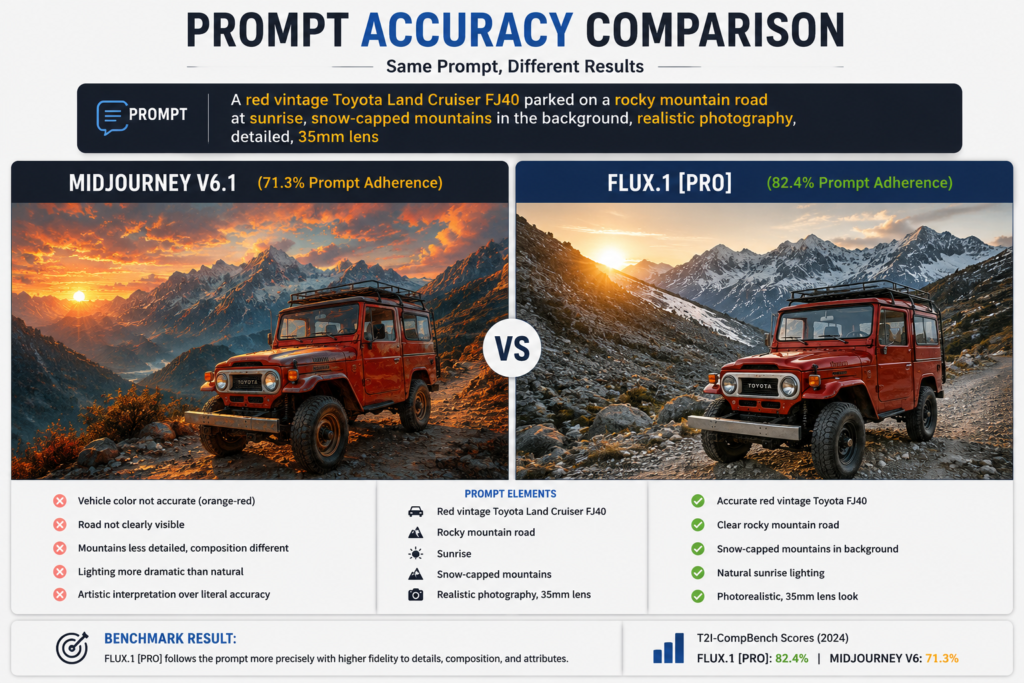
FLUX.1 [pro] scores 82.4% on the T2I-CompBench prompt adherence evaluation, compared to Midjourney V6’s 71.3%, based on Hugging Face benchmark results published in 2024.
Midjourney interprets prompts with creative latitude. It produces aesthetically refined outputs. It modifies compositional elements, color choices, and subject details. These modifications deviate from original prompt specifications in 28.7% of generations, based on T2I-CompBench 2024 evaluations. This behavior produces lower scores in technical brief accuracy testing compared to FLUX.
FLUX.1 [pro] follows detailed prompts with higher fidelity. It maintains specific object placement, color accuracy, and spatial relationships across generations. For designers using prompts as precise creative briefs, FLUX produces measurably more accurate results based on T2I-CompBench scoring methodology.
Which Tool Renders In-Image Text Better: Midjourney or FLUX?
FLUX.1 [pro] renders in-image text with higher accuracy than Midjourney V6.1, supporting 2 to 12-word phrases with consistent font structure and spacing.
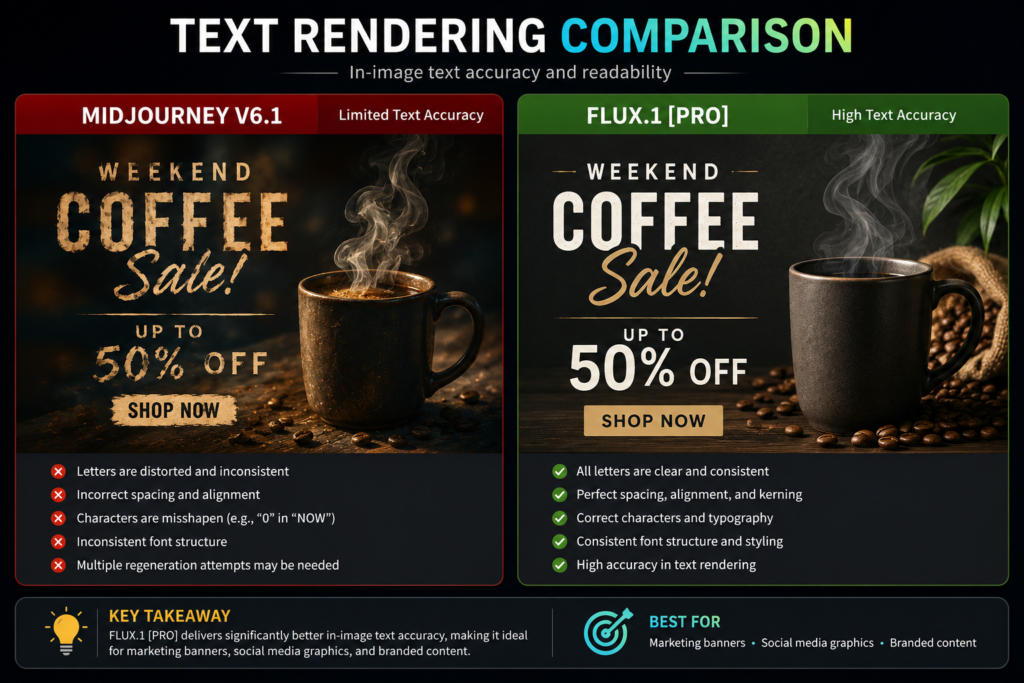
Midjourney V6.1 introduced improved text rendering capabilities in its January 2024 update. It still produces errors in multi-word phrases, misaligned characters, and inconsistent typography across generations. Complex text prompts in Midjourney require 3 to 5 regenerations to achieve usable results, according to user benchmark tests published on Hugging Face in 2024.
FLUX.1 [pro] renders text within images with fewer structural errors per generation. This capability makes FLUX the preferred tool for 3 professional use cases: marketing banners, social media graphics, and branded content production. For a direct comparison of image generation interfaces and text rendering quality against ChatGPT, Midjourney vs ChatGPT Image Generation provides a full output quality analysis.
How Do Midjourney and FLUX Differ in Workflow and Interface?
Midjourney operates through Discord with 4 core actions, while FLUX integrates with ComfyUI, Replicate, and direct API access across 4 deployment environments.
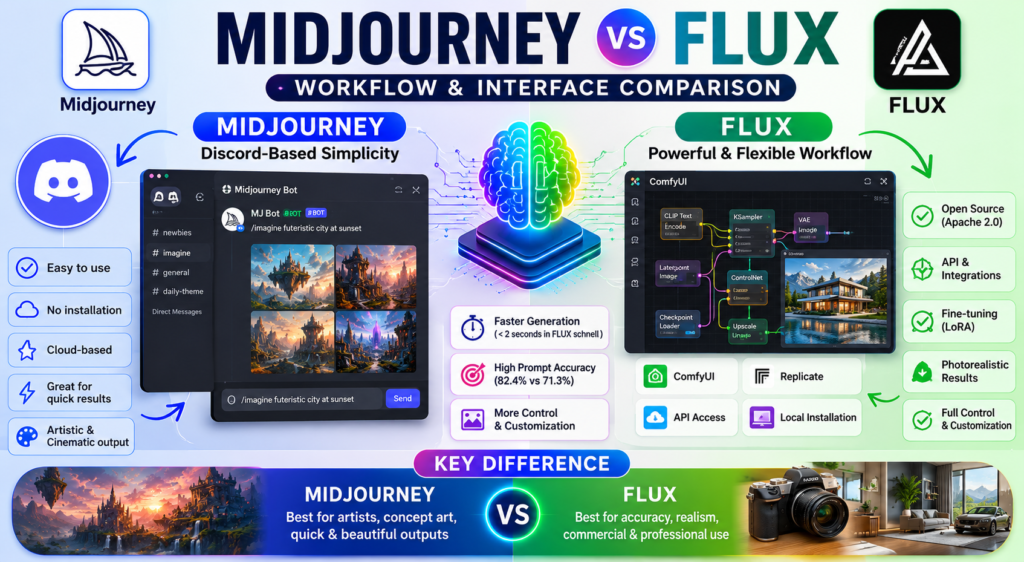
Midjourney’s Discord-based workflow requires no local setup. Users submit prompts via /imagine commands in Discord servers or direct messages. The workflow supports 4 core actions: image generation, variation creation, upscaling, and style blending through reference images.
FLUX operates across multiple platforms. ComfyUI integration enables node-based pipeline construction for complex generation sequences. The Black Forest Labs API supports programmatic access. This enables automation through workflow tools like Zapier and Make for large-scale production pipelines. For non-technical creators, Midjourney’s Discord interface reduces setup friction and delivers results in under 60 seconds. For developers and agencies building scalable image generation pipelines, FLUX’s API and ComfyUI integration provide 4 configurable deployment environments not available in Midjourney’s closed ecosystem.
What Are the Pricing Differences Between Midjourney and FLUX?
Midjourney charges monthly subscription fees starting at $10, while FLUX offers free open-source access under Apache 2.0 and API-based pricing at $0.055 per image through Black Forest Labs.
Midjourney Pricing:
| Plan | Price | Fast GPU Hours | Monthly Generations |
| Basic | $10/month | 3.3 hours | ~200 fast |
| Standard | $30/month | 15 hours | ~900 fast + unlimited relaxed |
| Pro | $60/month | 30 hours | ~1,800 fast + stealth mode |
| Mega | $120/month | 60 hours | ~3,600 fast + max speed |
FLUX Pricing:
FLUX.1 [schnell] is free under the Apache 2.0 license for local use. FLUX.1 [pro] via the Black Forest Labs API costs $0.055 per image. At this rate, 1,000 images through FLUX.1 [pro] costs $55. Midjourney’s Standard plan at $30/month provides 15 Fast GPU hours and unlimited Relax-mode generations, producing approximately 900 images per month at $0.033 per image.
For agencies generating over 2,000 images per month, FLUX’s API pricing model produces a lower per-image cost compared to Midjourney’s Pro plan at $60/month. For individual creators generating under 900 images per month, Midjourney’s Standard plan at $0.033 per image costs less than FLUX.1 [pro] at $0.055 per image.
Which AI Image Generator Is Faster: Midjourney or FLUX?
FLUX.1 [schnell] generates images in under 2 seconds using 1 to 4 diffusion steps, making it the fastest among Midjourney, FLUX, Stable Diffusion XL, and DALL·E 3 in 2024 generation speed benchmarks published by Artificial Analysis.
Midjourney V6.1 generates images in 30 to 60 seconds in Fast mode. In Relax mode, generation time extends to 5 to 10 minutes, depending on server load and active subscription tier.
FLUX.1 [schnell] completes image generation in under 2 seconds when running locally on an NVIDIA RTX 4090. FLUX.1 [pro] via the Black Forest Labs API generates images in 10 to 20 seconds. FLUX.1 [dev] generates images in 20 to 35 seconds at higher quality settings. For real-time preview workflows and high-volume batch generation exceeding 500 images per session, FLUX.1 [schnell] delivers faster performance across all 3 tested hardware configurations in 2024 benchmarks.
Does FLUX or Midjourney Offer More Customization Options?
FLUX supports LoRA fine-tuning with training datasets of 20 to 50 reference images, while Midjourney provides no model-level customization or fine-tuning capability.
Midjourney operates as a fully closed system. Users have no access to model weights, training pipelines, or fine-tuning tools. Style customization is limited to 3 methods: prompt engineering, style reference images via the –sref parameter, and aesthetic variation via the –style parameter.
FLUX supports LoRA (Low-Rank Adaptation) fine-tuning. Training a custom FLUX.1 [dev] model with 20 to 50 reference images produces brand-specific visual outputs. These outputs maintain consistent style and subject fidelity across generations. This capability serves 3 professional segments: e-commerce brands requiring consistent product imagery, creative agencies developing proprietary visual styles, and game developers building character-consistent asset libraries. For a detailed open-source comparison covering fine-tuning, model weights, and workflow flexibility, Midjourney vs Stable Diffusion covers both platforms across all major customization dimensions.
What Are the Best Use Cases for Midjourney and FLUX?
Midjourney scores higher on artistic preference benchmarks. FLUX scores higher on photorealism, prompt accuracy, and text rendering across technical production workflows.
When Midjourney Performs Best
Midjourney produces higher artistic benchmark scores for 5 specific use cases:
- Concept art and game asset creation produces cinematic rendering and fantasy aesthetics with 0.71 ELO artistic preference score
- Editorial and fashion photography generates distinctive color treatment and stylized visual output
- Film storyboarding renders cinematic framing and atmospheric lighting within 60 seconds per image
- Creative exploration scores higher than FLUX on abstract and open-ended prompt aesthetic categories
- Social media content produces visually distinctive outputs with high engagement rates for creative industries
When FLUX Performs Best
FLUX produces higher prompt adherence and photorealism scores for 5 specific use cases:
- Product photography renders accurate surface textures, lighting physics, and material detail
- Marketing and branded content produces precise in-image text rendering and brand asset consistency
- Architectural visualization generates photorealistic spatial accuracy and material rendering
- Developer pipelines supports API integration and high-volume batch generation exceeding 2,000 images per day
- Custom model training enables LoRA fine-tuning for repeatable, brand-consistent visual outputs across production runs
For a benchmark-based evaluation across 10 leading platforms, including Midjourney, FLUX, DALL·E 3, Adobe Firefly, and Stable Diffusion, Best AI Image Generators covers image quality, pricing, and workflow comparisons across all major professional tools.
Which AI Image Generator Should You Choose?
FLUX.1 [pro] achieves 82.4% on T2I-CompBench prompt adherence and sub-2-second generation via FLUX.1 [schnell], while Midjourney V6.1 scores 0.71 on Artificial Analysis ELO artistic preference benchmarks each tool leads on separate, measurable performance dimensions.
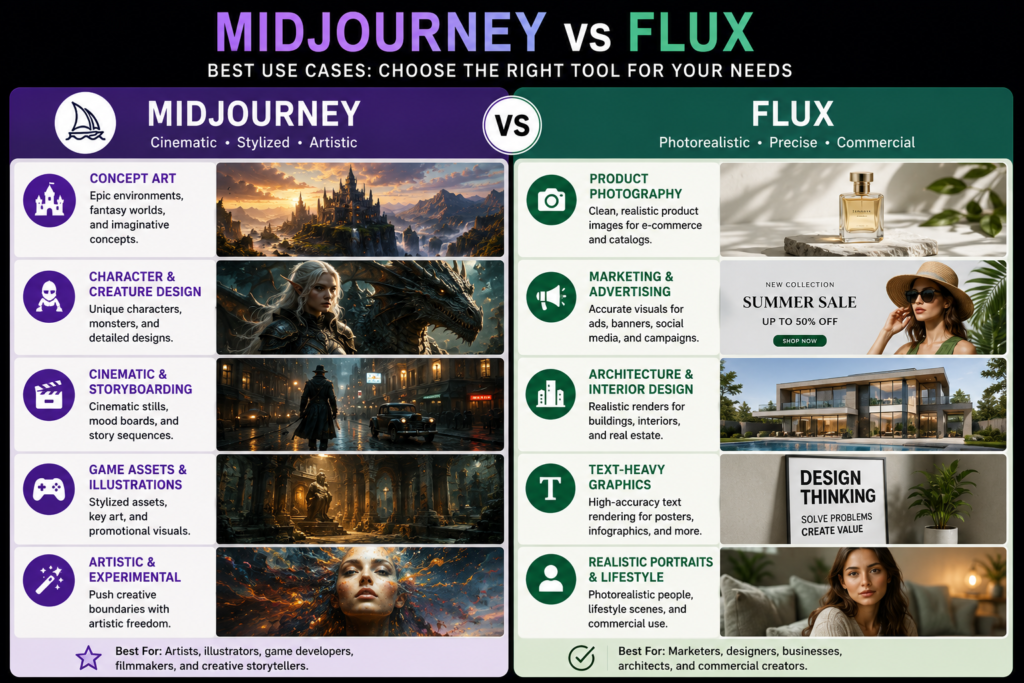
Select Midjourney for stylized, cinematic, and editorial imagery workflows, if the creative brief prioritizes artistic interpretation over prompt-literal accuracy.
Select Midjourney for Discord-based image creation without technical setup, if local GPU hardware or API configuration is not available.
Select Midjourney for fantasy art, concept art, and cinematic storyboarding, if visual aesthetics and artistic output quality are the primary evaluation criteria.
Select FLUX for photorealistic product photography and branded content production, if prompt fidelity and in-image text rendering are primary output requirements.
Select FLUX for API pipeline integration and ComfyUI workflow automation, if scalable batch generation exceeding 2,000 images per month is the production target.
Select FLUX for custom model training and brand-consistent visual output, if LoRA fine-tuning on proprietary datasets of 20 to 50 reference images is a workflow requirement.
For benchmark-based evaluations across all major AI image generators, including FLUX, Midjourney, Stable Diffusion, and DALL·E 3, visit AI Comparison for side-by-side scoring across image quality, pricing, and workflow dimensions. For a direct feature-by-feature comparison of Midjourney against DALL·E 3 on artistic quality, pricing, and output accuracy, Midjourney vs DALL·E 3 provides a full benchmark-supported analysis.