DALL-E 3 vs Stable Diffusion: Which AI Image Generator Is Better in 2026?
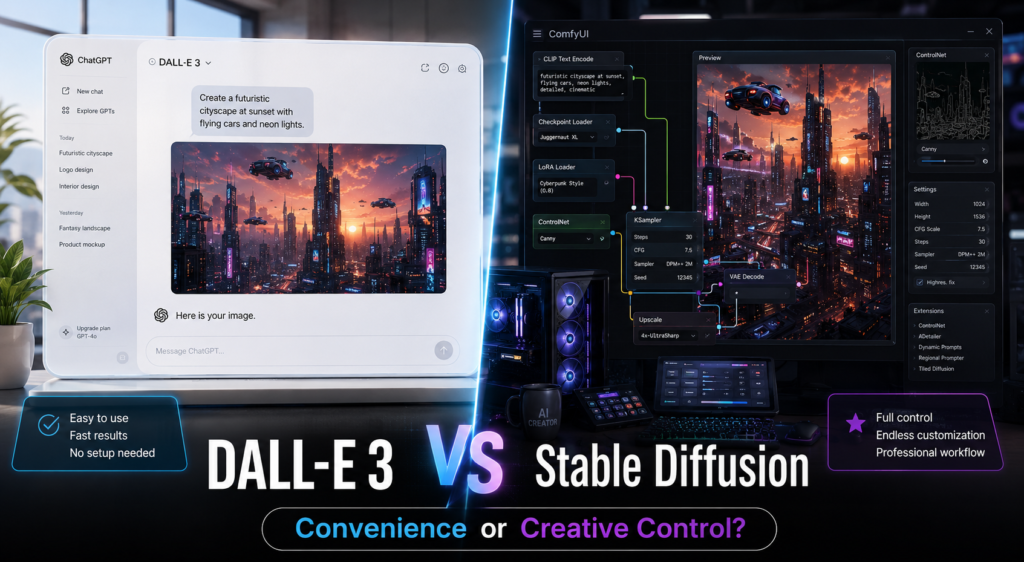
DALL-E 3 is better for prompt accuracy, text rendering, and beginner accessibility, while Stable Diffusion is better for customization, local deployment, and professional workflows. DALL-E 3 is a proprietary AI image generator developed by OpenAI and integrated into ChatGPT, while Stable Diffusion is an open-source image generation model developed by Stability AI that runs on local hardware.
The 2 models serve different user types. DALL-E 3 generates accurate images on the first attempt through natural language prompts inside ChatGPT, Bing Image Creator, and Microsoft Copilot. Stable Diffusion gives full creative control through extensions like ControlNet, LoRA, and ComfyUI, but demands a GPU with at least 8GB of VRAM.
This comparison covers 8 decision factors: prompt accuracy, image quality, text rendering, customization, hardware requirements, pricing, licensing, and ideal use cases. Both tools rank among the top performers in our guide to the Best AI Image Generators.
DALL-E 3 vs Stable Diffusion: Key Differences
There are 7 key differences between DALL-E 3 and Stable Diffusion, covering access model, prompt handling, customization, hardware, pricing, content rules, and licensing.
| Factor | DALL-E 3 | Stable Diffusion |
| Developer | OpenAI | Stability AI |
| Access model | Cloud-based (ChatGPT, Copilot) | Local installation or cloud APIs |
| Source type | Proprietary, closed | Open source (SDXL, SD 3.5) |
| Prompt accuracy | High first-attempt accuracy | Requires iterative refinement |
| Customization | None (no fine-tuning) | Full (LoRA, ControlNet, custom models) |
| Hardware requirement | None | GPU with 8GB+ VRAM |
| Cost | $20/month via ChatGPT Plus | Free model, hardware cost applies |
The core difference is convenience versus control. DALL-E 3 removes all technical barriers but locks users into OpenAI’s rules. Stable Diffusion removes all creative barriers but transfers the technical work to the user.
What Is DALL-E 3?
DALL-E 3 is a text-to-image AI model developed by OpenAI and released in October 2023. The model converts natural language prompts into images without requiring prompt engineering skills, negative prompts, or parameter tuning.
DALL-E 3 operates inside 3 platforms: ChatGPT, Microsoft Copilot, and Bing Image Creator. ChatGPT rewrites short user prompts into detailed image descriptions automatically, which raises output accuracy for casual users.
OpenAI has shifted image generation inside ChatGPT to GPT-4o native image generation since March 2025. GPT-4o produces sharper text, follows multi-object prompts more precisely, and edits existing images conversationally. Users who select an image tool today receive GPT-4o outputs in ChatGPT, with DALL-E 3 remaining active in Bing Image Creator. Our Midjourney vs ChatGPT Image Generation comparison covers GPT-4o’s image capabilities in depth.
What Is Stable Diffusion?
Stable Diffusion is an open-source latent diffusion model developed by Stability AI and first released in August 2022. The model family includes 3 major versions: SDXL, SD 3.5, and the original SD 1.5, which still powers thousands of community fine-tuned models.
Stable Diffusion runs through 2 popular local interfaces: Automatic1111 and ComfyUI. Automatic1111 offers a browser-based control panel for beginners, while ComfyUI provides node-based workflows for professionals who chain generation, upscaling, and inpainting steps.
The open-source license allows 4 actions that proprietary models block: local deployment, model fine-tuning, commercial pipeline integration, and offline private generation. Platforms like Civitai host over 100,000 community models, checkpoints, and LoRA files built on Stable Diffusion.
Prompt Accuracy: DALL-E 3 Wins
DALL-E 3 follows complex prompts more accurately than Stable Diffusion on the first attempt. OpenAI trained DALL-E 3 on highly descriptive synthetic captions, which improved its understanding of object relationships, counts, and spatial positions.
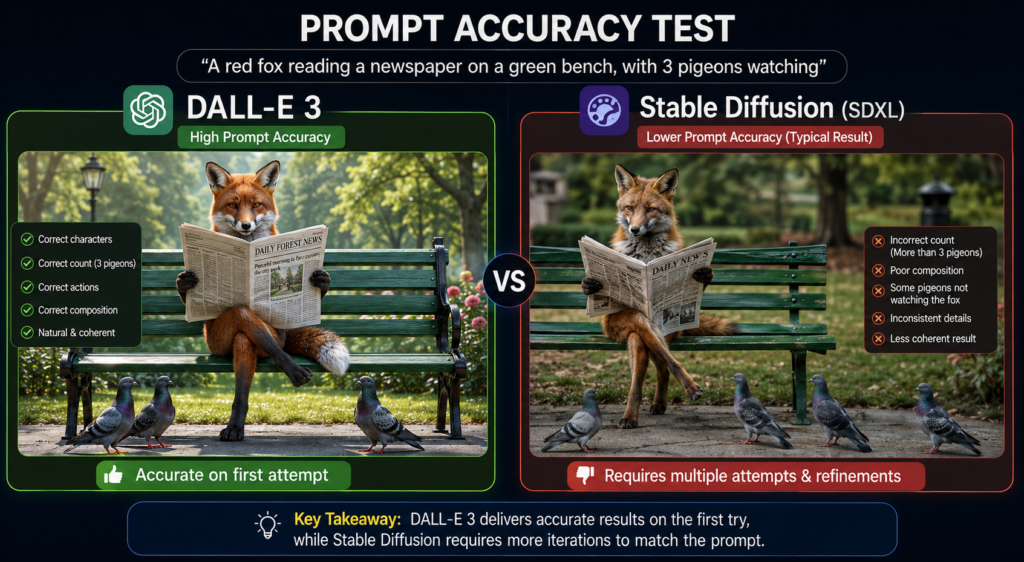
A prompt like “a red fox reading a newspaper on a green bench, with 3 pigeons watching” produces correct object counts and placement in DALL-E 3 consistently. Stable Diffusion misplaces objects, merges subjects, or ignores counts in similar tests, and reaching the intended result requires 5 to 15 generation attempts with refined prompts.
Stable Diffusion compensates through 2 mechanisms: negative prompts and ControlNet. Negative prompts exclude unwanted elements like extra fingers, blurry textures, and watermarks. ControlNet enforces exact poses, depth maps, and compositions, which delivers precision that DALL-E 3 cannot match through text alone.
Choose DALL-E 3 for first-try accuracy. Choose Stable Diffusion for repeatable, controlled precision.
Image Quality: Stable Diffusion Wins for Realism
Stable Diffusion produces more photorealistic images than DALL-E 3 when paired with community fine-tuned models. Models like Juggernaut XL, RealVisXL, and epiCRealism generate skin textures, lighting, and lens effects that exceed DALL-E 3’s default output quality.
DALL-E 3 applies a recognizable illustrative style to many outputs. The model excels at 3 image categories: digital illustrations, concept art, and stylized graphics. Photorealistic portraits from DALL-E 3 show smoother, more artificial skin compared to fine-tuned SDXL models.
Stable Diffusion also supports 4 quality-enhancement workflows that DALL-E 3 lacks: hires-fix upscaling, inpainting for targeted corrections, outpainting for canvas extension, and img2img refinement. Midjourney competes with both models on aesthetic quality, and our Midjourney vs Stable Diffusion comparison breaks down that matchup separately.
Text Rendering: DALL-E 3 Wins
DALL-E 3 renders readable text inside images more reliably than Stable Diffusion. Typography accuracy matters for 4 commercial use cases: marketing banners, product mockups, social media graphics, and event posters.
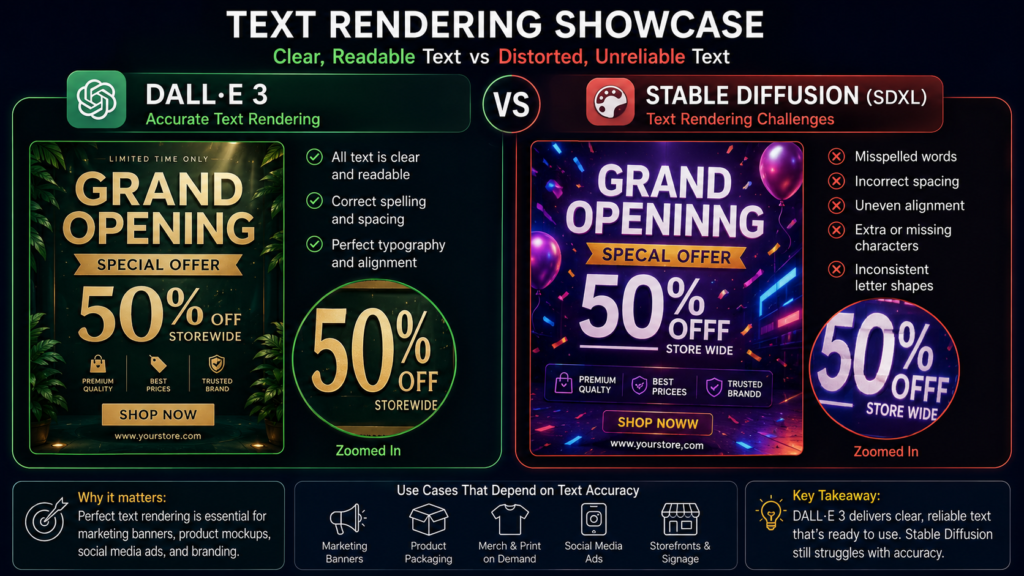
DALL-E 3 spells short phrases like “Grand Opening” or “50% Off Sale” correctly in most generations. GPT-4o image generation extends this advantage further, rendering full paragraphs, menus, and infographic labels with high accuracy.
Stable Diffusion produces garbled, misspelled text in SD 1.5 and SDXL outputs. SD 3.5 improved typography significantly, but its text accuracy still trails DALL-E 3 and GPT-4o in multi-word phrases. Designers who use Stable Diffusion add text in post-production tools like Photoshop, Canva, and GIMP instead.
Customization: Stable Diffusion Wins
Stable Diffusion offers full model customization, while DALL-E 3 offers none. The open-source ecosystem provides 4 customization layers: fine-tuned checkpoints, LoRA adapters, ControlNet guidance, and textual inversion embeddings.
LoRA training teaches Stable Diffusion a specific face, product, art style, or brand identity using 15 to 30 reference images. Businesses use this capability to generate consistent brand characters, product variations, and style-matched campaign assets at scale.
ControlNet adds 6 control methods: pose detection, depth mapping, edge detection, segmentation, normal maps, and scribble guidance. A fashion brand recreates the exact pose of a reference photo with a new model and outfit through ControlNet’s OpenPose module.
DALL-E 3 provides zero fine-tuning options. Users adjust outputs only through prompt revisions inside ChatGPT, which limits consistency across image series. Character consistency, a critical need for storyboards and brand mascots, remains unreliable in DALL-E 3.
Hardware Requirements: DALL-E 3 Wins
DALL-E 3 requires no hardware, while Stable Diffusion requires a dedicated GPU for local generation. DALL-E 3 runs entirely on OpenAI’s cloud servers and works on any device with a browser, including phones, tablets, and low-end laptops.
Stable Diffusion has 3 hardware tiers for local use. SD 1.5 runs on GPUs with 4GB VRAM like the GTX 1650. SDXL needs 8GB VRAM, with the RTX 3060 12GB serving as the popular budget choice at around $280. SD 3.5 Large performs best on 16GB+ cards like the RTX 4080.
Cloud alternatives remove the hardware barrier for Stable Diffusion users. Services like RunPod, Replicate, and Stability AI’s API charge per generation, with costs starting near $0.002 per SDXL image on rented GPUs.
Pricing: Cost Per Image Compared
Stable Diffusion costs less per image at scale, while DALL-E 3 costs less for casual, low-volume use. The pricing models differ structurally: subscription versus hardware investment.
There are 3 ways to access DALL-E 3 and GPT-4o image generation:
- Bing Image Creator offers limited free daily generations.
- ChatGPT Plus costs $20 per month with generous image limits.
- OpenAI’s API charges per image, with GPT-4o image pricing starting around $0.04 per standard image.
Stable Diffusion’s model weights cost $0. The real costs come from 2 sources: hardware and electricity. A $280 RTX 3060 generating 100 images daily amortizes to under $0.01 per image within the first year, including power costs of roughly $0.02 per hour of generation.
A marketing team producing 3,000 images monthly pays $20 on ChatGPT Plus if limits allow, or roughly $8 in electricity on owned Stable Diffusion hardware. High-volume users recover GPU costs within 3 to 6 months.
Commercial Licensing: Stable Diffusion Offers More Freedom
Stable Diffusion grants broader commercial rights than DALL-E 3 for most business sizes. Licensing terms decide whether generated images carry legal risk in client work, products, and advertising.
OpenAI grants users full ownership of DALL-E 3 outputs, including commercial rights, under its terms of use. The restriction sits in content policy: OpenAI blocks public figures, branded styles, and violent or adult content at the generation stage.
Stability AI licenses SD 3.5 under its Community License, which is free for individuals and businesses earning under $1 million in annual revenue. SDXL and SD 1.5 carry the more permissive CreativeML Open RAIL-M license. Enterprises above the revenue threshold purchase a Stability AI Enterprise license.
The 3 licensing advantages of Stable Diffusion are offline generation without usage logs, no content filter on private deployments, and full pipeline ownership. Regulated industries like healthcare and legal services value local generation because prompts never leave company servers.
Which Is Better for Beginners?
DALL-E 3 is better for beginners because it requires zero setup, zero prompt engineering, and zero hardware investment. A new user generates a usable image within 60 seconds of opening ChatGPT or Bing Image Creator.
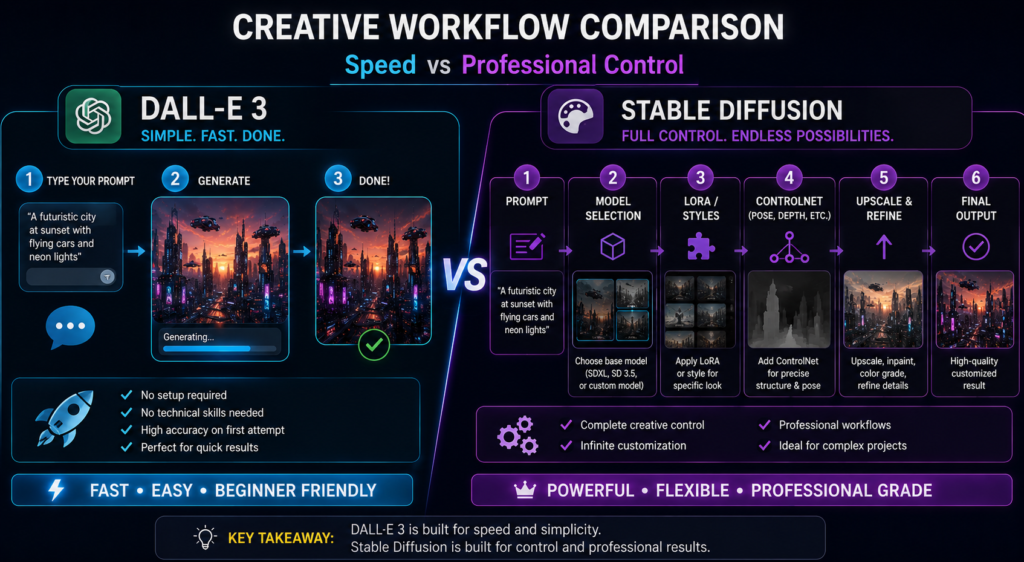
ChatGPT improves beginner results through automatic prompt expansion. A short input like “logo for a coffee shop” becomes a detailed internal prompt covering style, lighting, and composition, which raises first-attempt quality.
Stable Diffusion’s learning curve spans 4 stages: installation, model selection, prompt syntax, and parameter tuning. Beginners spend 5 to 10 hours learning samplers, CFG scales, and negative prompts before producing consistent results. Our Midjourney vs DALL-E 3 comparison evaluates a third beginner-friendly option for users still deciding.
Which Is Better for Professionals?
Stable Diffusion is better for professionals because it supports repeatable workflows, brand consistency, and pipeline automation. Professional image production demands control that cloud-only tools cannot provide.
Professional studios rely on 4 Stable Diffusion capabilities: ComfyUI workflow automation, LoRA-based character consistency, ControlNet composition control, and batch generation through APIs. A game studio generates 500 style-consistent environment concepts overnight on local hardware.
DALL-E 3 serves professionals in 3 limited scenarios: quick concept ideation, text-heavy marketing graphics, and client mockups requiring speed over consistency. Agencies often combine both tools, using DALL-E 3 for drafts and Stable Diffusion for production assets.
Final Verdict: Which Should You Choose?
Choose DALL-E 3 if you want accurate images on the first try without technical setup. It fits content marketers, social media managers, educators, and casual users who value speed, readable text rendering, and ChatGPT integration over creative control.
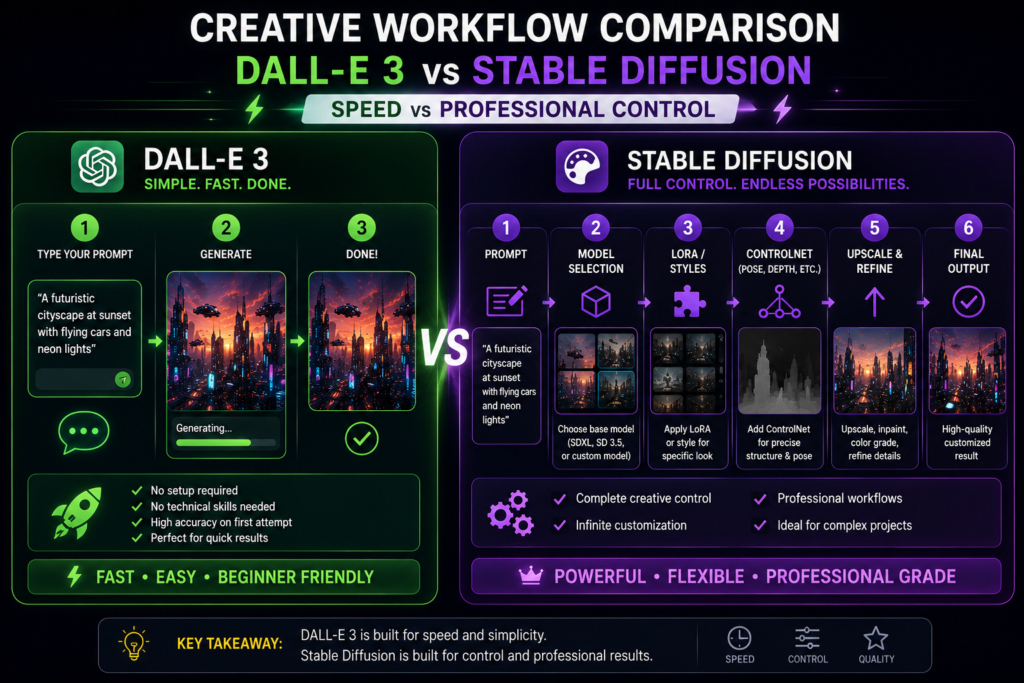
Choose Stable Diffusion if you want full creative control, customization, and the lowest cost at scale. It fits designers, game studios, agencies, and developers who need LoRA fine-tuning, ControlNet precision, private local generation, and unrestricted commercial pipelines.
Choose both if you produce images professionally. DALL-E 3 handles ideation and typography, while Stable Diffusion handles final production, consistency, and volume.
The decision reduces to 1 question: do you want the tool to do the work, or do you want to control the work? DALL-E 3 answers the first need. Stable Diffusion answers the second. For comparisons across every major AI category, explore more head-to-head guides on AI Comparison.