Best AI Marketing Tools in 2026 (Free & Paid)
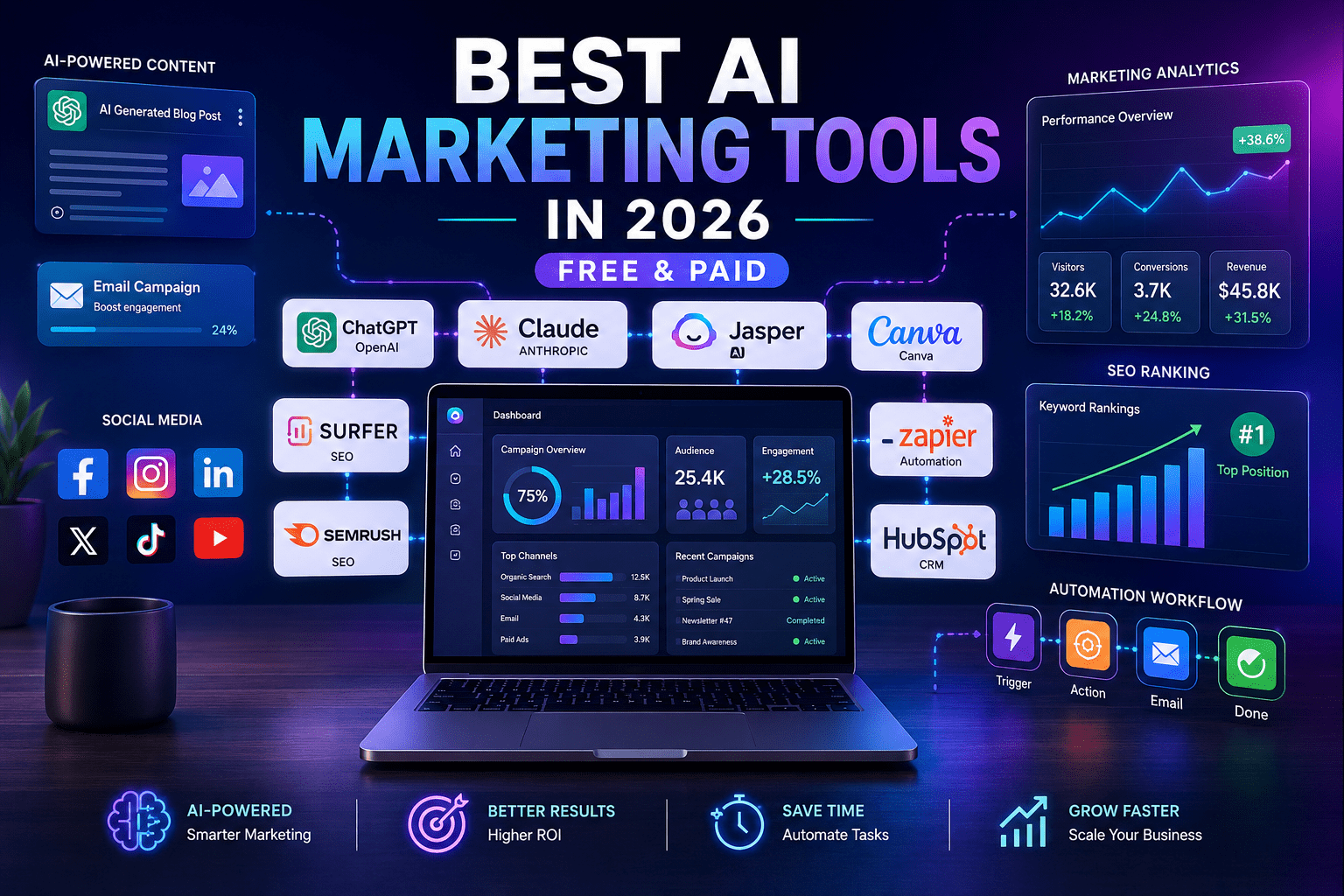
The 8 best AI marketing tools in 2026 are ChatGPT, Claude, Jasper AI, Surfer SEO, Canva, Zapier, HubSpot CRM, and Semrush. Each tool solves a different marketing problem, from content writing to workflow automation.
Marketing teams use artificial intelligence from companies like OpenAI, Anthropic, and Google to write copy, optimize content for search engines, generate visuals, manage campaigns, and automate repetitive tasks. OpenAI’s ChatGPT and Anthropic’s Claude lead the general-purpose category, Google’s Gemini competes closely behind both, and specialized platforms like Jasper AI and Surfer SEO handle narrower, deeper workflows.
This guide compares the top AI marketing tools by category, including pricing, free plans, pros and cons, and best use cases. Marketers, founders, and content teams choosing their first AI stack will find a direct, ranked answer below.
For a broader look at how leading AI assistants compare, see our AI comparison hub.
Best AI Marketing Tools at a Glance
| Tool | Best For | Free Plan | Starting Price | Category |
| ChatGPT | General marketing tasks | Yes | Paid tier available (verify current price) | Writing, research, image generation |
| Claude | Long-form content and research | Yes | Paid tier available (verify current price) | Writing, analysis, brand voice |
| Jasper AI | Brand-voice copywriting | Trial only | Paid tier available (verify current price) | Content writing |
| Surfer SEO | Content optimization | No | Paid tier available (verify current price) | SEO |
| Canva | Graphic design | Yes | Paid tier available (verify current price) | Visual content |
| Zapier | Workflow automation | Yes | Paid tier available (verify current price) | Automation |
| HubSpot CRM | AI-powered CRM | Yes | Paid tier available (verify current price) | Email, CRM |
| Semrush | SEO and competitor tracking | No | Paid tier available (verify current price) | SEO, AI visibility |
What Are AI Marketing Tools?
AI marketing tools are software platforms that use artificial intelligence to automate, optimize, or generate marketing tasks. These tasks include writing copy, designing graphics, scheduling social posts, analyzing search rankings, and managing customer relationships.
Most AI marketing tools fall into 2 categories. General-purpose AI assistants such as ChatGPT, Claude, and Gemini handle a wide range of tasks. Specialized platforms such as Jasper AI, Surfer SEO, and Canva focus on a single marketing function.
How Marketers Use AI Tools

Marketing teams apply AI across 6 core functions:
- Content writing drafting blog posts, ad copy, and email campaigns
- SEO optimization scoring content against top-ranking pages
- Visual design generating images, graphics, and video assets
- Workflow automation connecting apps to eliminate manual steps
- Customer relationship management scoring leads and personalizing outreach
- AI visibility tracking monitoring brand mentions inside ChatGPT, Gemini, and Perplexity answers
Each function below maps to specific tools, ranked by use case.
Best AI Marketing Tools for Content Writing and Copy
ChatGPT and Claude are the top AI marketing tools for content writing in 2026. Both handle blog posts, ad copy, and brand messaging, while Jasper AI and Copy.ai serve teams that need built-in brand-voice training.
ChatGPT
ChatGPT, built by OpenAI, generates blog drafts, email copy, and social captions from a single prompt. GPT-5 powers ChatGPT’s reasoning and writing capabilities on paid plans, producing more structured long-form drafts than the free tier.
Pros:
- Generates drafts, images, and research summaries in one interface
- Free plan available for testing before upgrading
- Wide plugin and integration ecosystem through Zapier
Cons:
- Long-form output sometimes needs heavier editing for brand voice
- Image generation offers less fine-grained control than dedicated design tools
- Usage caps apply even on paid tiers during high-demand periods
Claude
Claude, built by Anthropic, produces more natural long-form writing with less editing required than most general-purpose chatbots. Claude Sonnet handles everyday marketing writing, while Claude Opus manages more complex reasoning and research tasks.
Claude’s Projects feature stores brand voice instructions and uploaded files, so marketers do not re-explain context in every conversation. For a full breakdown of how Claude compares to OpenAI’s chatbot, read Claude vs ChatGPT.
Pros:
- Natural writing tone requires less post-editing
- Projects feature retains brand voice and context across sessions
- Strong performance on research-heavy and analytical writing tasks
Cons:
- Usage limits can be restrictive on complex, multi-step tasks
- Smaller third-party plugin ecosystem compared to ChatGPT
- Image generation is not a core feature
Jasper AI
Jasper AI specializes in brand-voice copywriting for marketing teams that publish at scale. The platform trains on uploaded writing samples to match a company’s tone across email, ad copy, and product descriptions.
See how it stacks up against a direct competitor in Jasper vs Copy.ai, or explore Jasper AI alternatives for budget options.
Pros:
- Strong brand-voice training across large content teams
- Simple, intuitive dashboard for non-technical users
- Built specifically for marketing copy, not general-purpose tasks
Cons:
- No permanent free plan, only a trial
- Output often needs human polishing before publishing
- Higher cost than general-purpose AI assistants
Writesonic
Writesonic positions itself as a lower-cost alternative to Jasper AI for brand-voice copywriting. The platform covers similar core use cases, including blog posts, product descriptions, and ad copy, but targets smaller marketing teams with tighter budgets.
Pros:
- Lower starting price than Jasper AI
- Covers similar core copywriting use cases
- Simple onboarding for teams new to AI copywriting tools
Cons:
- Smaller feature set than Jasper AI for enterprise teams
- Less established brand-voice training depth
- Fewer third-party integrations than larger copywriting platforms
Best AI Marketing Tools for SEO and Content Optimization
Surfer SEO and Semrush lead AI marketing tools for SEO in 2026. Surfer SEO scores content against top-ranking pages in real time, while Semrush combines content optimization with full-site competitor tracking.
Surfer SEO
Surfer SEO analyzes the top-ranking pages for a target keyword and generates a content score based on keyword density, structure, and readability. The score updates as a marketer edits the draft inside Surfer’s built-in editor.
Surfer SEO integrates with Google Docs and WordPress for direct publishing. Compare it directly against competitors in Surfer SEO vs Ahrefs, Surfer SEO vs Semrush, and Surfer SEO vs Clearscope.
Pros:
- Real-time content scoring against live SERP data
- Direct integrations with Google Docs and WordPress
- Clear, actionable optimization suggestions
Cons:
- No free plan available
- Pricing scales quickly for agencies managing multiple sites
- Limited usefulness without an existing SEO content strategy
Clearscope
Clearscope provides detailed content briefs that include recommended keywords, reader questions, and competitor content gaps. Marketers share these briefs directly with freelance writers or internal teams to standardize content quality before drafting begins.
Pros:
- Highly detailed, shareable content briefs
- Strong for managing external freelance writers
- Clear competitor gap analysis built into every brief
Cons:
- Priced higher than most comparable alternatives
- Less flexible editor than Surfer SEO
- Fewer platform integrations than larger SEO suites
Semrush
Semrush combines keyword research, rank tracking, site audits, and competitor analysis in a single platform. Semrush’s AI Toolkit tracks how brands appear in answers from ChatGPT, Google AI, Gemini, and Perplexity, drawing on a large internal prompt database described in Semrush’s own product documentation.
For an alternative SEO suite, see Semrush alternatives or the direct matchup in Ahrefs vs Semrush.
Pros:
- Combines SEO, competitor tracking, and AI visibility in one platform
- Large feature set covers most marketing research needs
- AI Toolkit tracks brand mentions across multiple AI assistants
Cons:
- Feature density creates a steep learning curve
- No free plan
- Can be more than smaller teams need
Best AI Marketing Tools for Visual and Creative Content
Canva and ChatGPT lead AI marketing tools for visual content in 2026. Canva offers a template-driven design editor, while ChatGPT generates original images directly inside chat.
Canva
Canva includes more than 1.6 million templates and AI-powered design tools under its Magic Design suite.
Pros:
- Massive template library covers most marketing formats
- Free plan includes usable AI features
- Minimal learning curve for non-designers
Cons:
- Some AI features remain locked behind paid plans even when visible on the free tier
- Less precise control than professional editing tools like Photoshop
ChatGPT (Image Generation)
ChatGPT generates original images from text prompts using its built-in image model. Marketers use this for blog illustrations, ad concepts, and social assets that avoid generic stock photography.
Pros:
- Generates images without leaving an existing chat workflow
- Fast iteration on prompt variations
Cons:
- Less fine-grained editing control than dedicated image tools
- Brand consistency across multiple images can be harder to maintain
Midjourney
Midjourney specializes in high-fidelity AI-generated artwork, often used for campaign concept art rather than quick social graphics. Marketers rely on Midjourney when a campaign needs a distinct visual style that templates cannot replicate, such as illustrated brand worlds or stylized product renders. Compare Midjourney’s output style against competitors in Midjourney vs DALL-E 3 and Midjourney vs Flux.
Pros:
- High visual fidelity and artistic range
- Strong community and prompt-sharing resources
- Distinct aesthetic options not easily replicated in template tools
Cons:
- Steeper learning curve for prompt engineering
- Interface less intuitive than Canva or ChatGPT for quick edits
- No native background-removal or layout editing tools
Adobe Photoshop
Adobe Photoshop combines traditional editing control with AI features for object removal and background extension.
Pros:
- Full professional editing control alongside AI shortcuts
- Industry-standard tool with broad team familiarity
Cons:
- Steep learning curve for new users
- Higher cost than template-based design tools
Best AI Marketing Tools for Video Generation
Runway and Synthesia lead AI marketing tools for video in 2026. Runway generates original video from text prompts, while Synthesia converts scripts into avatar-led videos without filming.
Runway
Runway generates video clips from text prompts and includes background removal, frame interpolation, and subtitle generation.
Pros:
- Generates original video without a camera or studio
- Wide toolset for editing beyond text-to-video
Cons:
- Steep learning curve for new users
- Free-tier credits are one-time, not renewing
Synthesia
Synthesia converts text scripts into videos using AI avatars, with more than 230 avatar options available. Marketers use Synthesia for internal training videos, onboarding content, and social clips without hiring a film crew.
Pros:
- Large avatar library covers diverse brand needs
- No filming or production equipment required
Cons:
- Avatar delivery can feel less authentic than human-presented video
- Free plan caps annual video minutes tightly
Kling AI
Kling AI functions as a full AI creative studio for video ad production, often paired with Claude for scriptwriting and ElevenLabs for voiceover. Compare its output against a direct competitor in Kling AI vs Runway.
Pros:
- Full creative studio for end-to-end AI video ads
- Strong performance reputation among performance marketers
Cons:
- Less beginner-friendly than template-driven alternatives
- Best results require pairing with other AI tools
Best AI Marketing Tools for Email Marketing and CRM
HubSpot CRM and ActiveCampaign lead AI marketing tools for email and customer relationship management in 2026. HubSpot combines a free CRM with AI workflow tools, while ActiveCampaign focuses on AI-generated email campaigns and predictive send timing.
HubSpot CRM
HubSpot’s AI toolkit, called Breeze AI, includes a Copilot assistant for drafting follow-up emails and summarizing deals, plus autonomous Breeze Agents for prospecting and content tasks. HubSpot’s free plan includes unlimited CRM contacts and basic AI features.
HubSpot integrates with Claude and ChatGPT through Zapier, allowing marketers to pull CRM data directly into chat-based workflows.
Pros:
- Generous free plan with unlimited contacts
- AI tools embedded directly in the CRM workflow
- Scales across marketing, sales, and service hubs
Cons:
- Full value requires committing to HubSpot’s broader ecosystem
- Pricing can climb quickly when mixing multiple hubs
ActiveCampaign
ActiveCampaign drafts full email campaigns, including subject lines and starter automations, from a plain-language description. Its predictive send-timing feature learns each contact’s open behavior individually rather than scheduling at a single fixed time.
Pros:
- AI drafts complete campaigns, not just subject lines
- Predictive send timing personalizes delivery per contact
Cons:
- Pricing scales quickly as contact lists grow
- Less intuitive interface than HubSpot for CRM-first teams
Best AI Marketing Tools for Social Media Management
FeedHive leads AI marketing tools for social media management in 2026, offering AI-powered content recycling and conditional posting based on engagement performance.
FeedHive
FeedHive’s AI features include content recycling, which repurposes existing posts without duplication, and conditional posting, which triggers follow-up actions based on real-time engagement.
Pros:
- Conditional posting automates engagement-based actions
- Content recycling reduces repetitive manual work
Cons:
- AI hashtag and performance-prediction features are limited on lower-tier plans
- Smaller integration ecosystem than larger platforms
Buffer and Hootsuite
Buffer is best for teams that want simple AI caption generation without a steep learning curve. Hootsuite’s OwlyWriter is best for larger teams already using Hootsuite’s broader scheduling and analytics suite, since the AI writer sits inside an existing workflow rather than requiring a separate platform.
Pros:
- Lower cost than FeedHive for smaller teams
- Familiar, established platforms with broad integration support
- Easier onboarding for teams new to AI-assisted social management
Cons:
- AI features are less advanced than FeedHive’s conditional posting
- Less differentiated feature set compared to dedicated AI-first tools
- Content recycling and performance prediction are more limited
Best AI Marketing Tools for Workflow Automation
Zapier is the leading AI marketing tool for workflow automation in 2026, connecting more than 9,000 apps without requiring code.
Zapier
Zapier links marketing tools into automated workflows, called Zaps. A marketer can trigger an action in Slack, HubSpot, or Google Sheets whenever a lead fills out a form, without manual data entry.
Zapier Copilot builds workflows from a plain-language description, and Zapier MCP connects AI assistants like Claude and ChatGPT directly to the rest of a marketing stack.
Pros:
- Connects more than 9,000 apps without coding
- Zapier Copilot builds workflows from plain language
- Free plan supports unlimited two-step Zaps
Cons:
- Multi-step workflows require a paid plan
- Complex branching logic can be harder to debug than custom code
n8n and Make
n8n is best for technical marketing teams that want open-source control over automation logic, including self-hosting for data privacy requirements. Make is best for teams that want visual workflow building with more flexibility than Zapier’s linear Zaps, particularly for workflows with multiple branching conditions. Compare these platforms directly in n8n vs Zapier and Make vs Zapier, or explore n8n alternatives and Zapier alternatives.
Pros:
- Often lower cost than Zapier at scale
- More flexible logic building, especially Make’s visual canvas
- n8n supports self-hosting for teams with strict data requirements
Cons:
- Steeper learning curve than Zapier, especially for n8n
- Smaller app integration libraries than Zapier’s 9,000+
- Less beginner-friendly documentation and community support
Best AI Marketing Tools for AI Visibility and Brand Tracking
Semrush and Similarweb lead AI marketing tools for AI visibility tracking in 2026. Both platforms monitor whether ChatGPT, Gemini, and Perplexity recommend a brand when users ask category-related questions.
Semrush AI Toolkit
Semrush’s AI Toolkit tracks brand mentions across AI-generated answers and pairs that data with a site audit focused on AI readiness. This lets marketing teams already using Semrush for keyword tracking extend the same dashboard to monitor citations inside ChatGPT, Gemini, and Perplexity responses.
Pros:
- Combines AI visibility tracking with existing SEO data
- No separate platform needed for teams already using Semrush
- Site audit flags technical issues affecting AI readability
Cons:
- Adds to an already feature-dense platform
- Requires a Semrush subscription as a prerequisite
- AI visibility data is newer and less battle-tested than core SEO features
Similarweb
Similarweb’s AI Brand Visibility tool reports which keywords and prompts drive AI-referred traffic, alongside a channel-by-channel breakdown of which AI assistant sends the most visitors. The broader Similarweb platform also covers competitor benchmarking, audience intelligence, and paid search analysis beyond AI visibility alone.
Pros:
- Detailed traffic-source breakdown by AI assistant
- Strong broader market and competitor intelligence data
- Useful for teams already tracking competitor traffic patterns
Cons:
- AI visibility features lack brand sentiment analysis
- Pricing for AI features is request-based, not published upfront
- Broader platform may exceed what teams need for AI tracking alone
AI visibility tracking is a newer marketing function, growing as AI assistants increasingly serve as a discovery channel alongside traditional search engines like Google.
Best Free AI Marketing Tools
ChatGPT, Claude, Canva, Zapier, and HubSpot CRM offer the strongest free plans among AI marketing tools in 2026. Each provides functional AI features without a credit card, though usage limits apply.
- ChatGPT free plan includes limited GPT-5 access and image generation
- Claude free plan includes Claude Sonnet access with daily usage limits
- Canva free plan includes 1.6 million+ templates and basic Magic Design tools
- Zapier free plan supports unlimited two-step automations
- HubSpot CRM free plan includes unlimited contacts and basic Breeze AI tools
- Google Labs multiple free experimental tools, including Pomelli for on-brand ad generation
Free plans work well for solo marketers and early-stage startups testing a single use case before committing to a paid tier. For more on no-cost options across categories, see ChatGPT alternatives and Claude alternatives.
How to Choose an AI Marketing Tool
Choosing an AI marketing tool depends on 4 factors: team size, budget, primary use case, and existing tech stack.
Solo marketers and small teams benefit most from general-purpose assistants like ChatGPT and Claude, which cover writing, research, and brainstorming in one subscription. Larger teams with dedicated SEO, design, or email functions get more value from specialized tools like Surfer SEO, Canva, or ActiveCampaign when workflows center on a single repeated task.
Budget-conscious teams should start with free plans across ChatGPT, Claude, Canva, and Zapier before upgrading any single tool. Teams already using HubSpot or Salesforce should prioritize AI tools with native integrations to avoid duplicate data entry.
Existing tech stack often matters more than feature lists alone. A marketing team running campaigns through HubSpot benefits more from HubSpot’s built-in Breeze AI than from a standalone tool requiring manual data transfer between platforms. Teams already paying for Semrush gain more immediate value from its AI Toolkit than from purchasing Similarweb separately for the same AI visibility function.
Frequently Asked Questions
What is the best AI tool for marketing?
ChatGPT and Claude rank as the best overall AI tools for marketing in 2026, covering content writing, research, and brainstorming in a single platform. Specialized needs, like SEO scoring or video generation, require dedicated tools such as Surfer SEO or Runway.
What is the best free AI marketing tool?
ChatGPT’s free plan offers the most functional no-cost AI marketing tool in 2026, including limited GPT-5 access for writing and image generation. Claude and Canva also offer strong free tiers for writing and design tasks.
Can AI replace a marketing team?
AI marketing tools automate individual tasks, including drafting, designing, and scheduling, but do not replace strategic decision-making. Marketing teams use tools like ChatGPT and Surfer SEO to execute faster, not to eliminate human oversight of campaigns.
Which AI tool is best for small businesses?
Zapier and HubSpot CRM suit small businesses best, since both offer functional free plans that scale with team growth. Small teams can pair either platform with ChatGPT or Claude for content creation without exceeding a marketing budget.
How much do AI marketing tools cost?
AI marketing tool pricing ranges from free plans to specialized platforms priced well above $100/month, such as Surfer SEO or Semrush. Confirm exact current pricing on each provider’s official pricing page, since rates change frequently.
Explore more comparisons: Jasper AI vs ChatGPT.
Final Verdict
ChatGPT is the best overall AI marketing tool in 2026 for teams that need one platform covering writing, research, and image generation. Claude is the best choice for long-form content and brand-voice consistency, particularly for teams producing detailed blog or research content.
Zapier is the best free AI marketing tool for teams that need to connect existing apps without a development budget. Semrush is the best enterprise AI marketing tool, combining SEO, competitor tracking, and AI visibility monitoring in one subscription.
Most marketing teams end up running 3 to 5 AI tools simultaneously rather than relying on a single platform. A typical stack pairs a general-purpose assistant like ChatGPT or Claude for drafting, a specialized SEO tool like Surfer SEO for optimization, and an automation layer like Zapier to connect everything to the team’s existing CRM and project management software.
Choose ChatGPT If:
- A single tool needs to cover writing, research, and image generation
- Team members already pay for ChatGPT Plus for general productivity
- Budget favors one general-purpose subscription over multiple specialized tools
Choose Claude If:
- Content quality and natural writing tone matter more than speed
- The team needs Projects to store brand voice and reference files long-term
- Workflows involve research-heavy tasks like competitor analysis or campaign reporting
Choose Jasper AI or Surfer SEO If:
- The team publishes content at scale and needs dedicated brand-voice training
- SEO performance is the primary success metric, not just content volume
- Budget supports a specialized subscription on top of a general AI assistant
Choose Zapier If:
- Marketing tools need to talk to each other without manual data transfer
- The team has no developer resources for custom integrations
- Free-tier automation (two-step Zaps) covers current workflow needs
For more AI tool comparisons across writing, coding, and design, explore related guides including best AI chatbot, best AI coding assistant, and best AI image generators.
