Claude vs Mistral: Which AI Model Is Better in 2026?
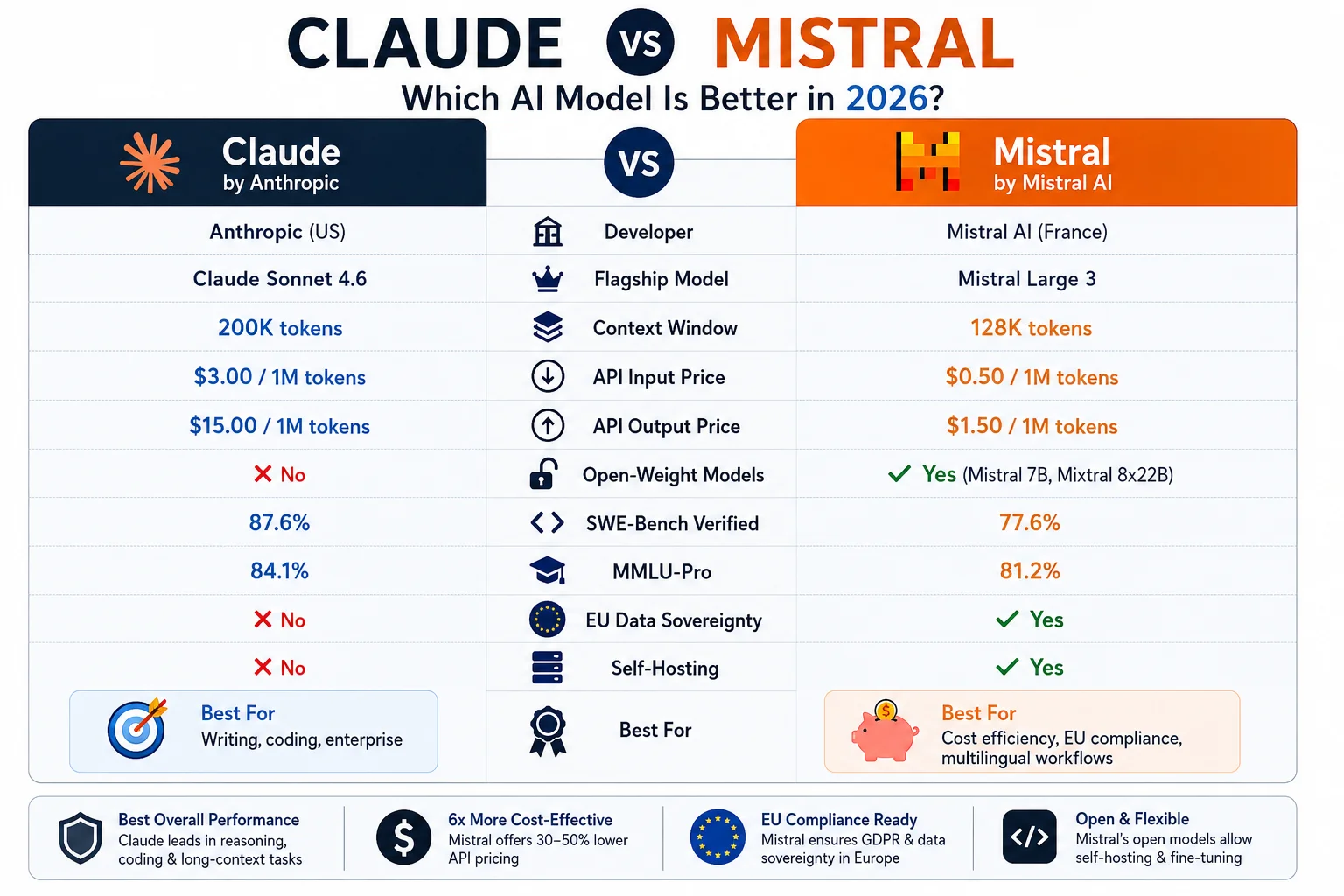
Claude, developed by Anthropic, and Mistral, developed by Paris-based Mistral AI, represent two distinct approaches to large language model design. Claude delivers superior reasoning, coding accuracy, and long-context processing with a 200K token context window. Mistral delivers 30–50% lower API pricing, EU data sovereignty, and open-weight models for self-hosting. Claude is better for complex writing, coding, and enterprise reasoning. Mistral is better for cost-sensitive deployments, European compliance requirements, and multilingual workflows.
Claude vs Mistral: Quick Comparison
| Feature | Claude | Mistral |
| Developer | Anthropic (US) | Mistral AI (France) |
| Flagship Model | Claude Sonnet 4.6 | Mistral Large 3 |
| Context Window | 200K tokens | 128K tokens |
| API Input Price | $3.00/M tokens | $0.50/M tokens |
| API Output Price | $15.00/M tokens | $1.50/M tokens |
| Open-Weight Models | No | Yes (Mistral 7B, Mixtral 8x22B) |
| SWE-Bench Verified | 87.6% | 77.6% |
| MMLU-Pro | 84.1% | 81.2% |
| EU Data Sovereignty | No | Yes |
| Self-Hosting | No | Yes |
| Best For | Writing, coding, enterprise | Cost efficiency, EU compliance |
What Is Claude?
Claude is a proprietary large language model developed by Anthropic, a US-based AI safety company. Claude uses Constitutional AI training to reduce hallucination rates and improve output alignment. Stanford HAI’s 2025 AI Index Report recorded Claude’s hallucination rate at 2.1% on factual QA the lowest rate among commercial models tested.
Claude is available through Anthropic’s API, Amazon Bedrock, and Google Cloud Vertex AI. The model lineup includes 3 tiers: Claude Opus 4.6 for flagship reasoning, Claude Sonnet 4.6 for balanced performance, and Claude Haiku for fast lightweight tasks.
Key Features of Claude
Claude delivers 4 core capabilities that define its competitive position:
- 200K token context window processes entire codebases, regulatory documents, and long-form research in a single session
- Constitutional AI alignment produces fewer harmful outputs and lower hallucination rates than competing commercial models
- Claude Code an autonomous coding agent that achieves 72.7% on SWE-bench, navigating multi-file codebases with minimal human intervention
- Extended thinking breaks complex problems into visible reasoning chains for legal analysis, financial modeling, and strategic document review
For a broader comparison of Claude against OpenAI’s models, see Claude vs ChatGPT.
What Is Mistral?
Mistral is an open-weight and commercial large language model developed by Mistral AI, a French company founded in 2023 by former Google DeepMind and Meta researchers. In March 2026, Mistral raised $830 million for a dedicated Paris data center, signaling a permanent infrastructure commitment to European AI sovereignty.
Mistral’s flagship Mistral Large 3 uses a Mixture-of-Experts (MoE) architecture with 41 billion active parameters drawn from 675 billion total parameters. Le Chat is Mistral’s free consumer chatbot interface. La Plateforme is its API service for developers and enterprise teams.
Key Features of Mistral
Mistral delivers 4 distinct advantages that differentiate it from US-based providers:
- Open-weight models Mistral 7B and Mixtral 8x22B are downloadable under Apache 2.0 license for self-hosting and fine-tuning
- EU data sovereignty all data processing occurs within European infrastructure, satisfying GDPR and sector-specific data residency requirements
- Competitive API pricing Mistral Large 3 at $0.50/$1.50 per million tokens delivers a 6x cost advantage over Claude Sonnet 4.6 at $3.00/$15.00
- Multilingual capability Mistral processes French, German, and Spanish with higher fluency than any US-based competitor
For a direct comparison of Mistral against Meta’s open-source models, see Llama vs Mistral.
Claude vs Mistral: Performance and Benchmarks

Claude Opus 4.6 outperforms Mistral Large 3 on 4 of 5 standard benchmarks used to evaluate frontier language models.
| Benchmark | Claude Opus 4.6 | Mistral Large 3 | What It Measures |
| SWE-Bench Verified | 87.6% | ~45% | Real-world GitHub issue resolution |
| MMLU-Pro | 84.1% | 81.2% | Multi-domain academic knowledge |
| GPQA Diamond | 74.9% | ~58% | PhD-level scientific reasoning |
| HumanEval | 92.0% | 84.0% | Python code generation |
| Multilingual Fluency | Moderate | High | European language performance |
Mistral Large 3 now handles 85–90% of tasks at Claude Sonnet quality for standard use cases, according to Artificial Analysis LLM Performance Rankings from February 2026. The performance gap narrows on routine tasks and widens on multi-step analytical work requiring nuanced judgment.
Claude vs Mistral: Coding
Claude is the stronger coding model across complex and multi-file engineering tasks. Claude Sonnet 4.6 scores 79.6% on SWE-Bench Verified, compared to Mistral Medium 3.5’s 77.6% on the same benchmark, according to BenchLM.ai’s July 2026 leaderboard. Claude Code achieves 72.7% on SWE-bench for autonomous multi-file coding a score no other autonomous coding agent matches.
Mistral’s Codestral model handles structured code generation and completion tasks effectively. Codestral suits API work, code scaffolding, and high-volume batch processing where cost efficiency outweighs reasoning depth. Mistral Medium 3.5 holds a narrow edge over Claude Sonnet 4.6 on Terminal-Bench Hard, which tests command-line-specific coding scenarios.
Choose Claude for complex architecture decisions, multi-file changes, and production-grade debugging. Choose Codestral for high-volume structured code generation where token cost is the primary constraint.
For a wider view of top-performing coding tools, see best AI coding assistant and Claude Code vs Cursor.
Claude vs Mistral: Writing Quality
Claude produces more natural, human-sounding long-form writing than Mistral across all standard English-language content types. Claude maintains consistent tone across long-form articles, technical documentation, investor communications, and UX copy without robotic phrasing. This advantage stems from instruction-following precision Claude interprets style constraints with fewer editing cycles.
Mistral writes competently. Mistral Large 3 handles multilingual content production better than Claude, particularly for French, German, and Spanish outputs. European teams producing content across multiple languages gain a significant operational advantage with Mistral’s multilingual fluency.
For English-language writing marketing copy, long-form content, and professional communications Claude delivers higher quality with less post-editing required. For multilingual content in French, German, and Spanish, Mistral outperforms Claude on fluency and cultural accuracy.
Claude vs Mistral: Pricing

Mistral is significantly cheaper than Claude at every model tier.
| Tier | Claude | Mistral | Input Cost Difference |
| Flagship Input | $3.00/M (Sonnet 4.6) | $0.50/M (Large 3) | 6x cheaper |
| Flagship Output | $15.00/M | $1.50/M | 10x cheaper |
| Lightweight Input | $0.25/M (Haiku) | $0.10/M (Small) | 2.5x cheaper |
| Consumer Interface | Claude.ai Free (rate-limited) | Le Chat Free (unlimited) | Mistral more generous |
A development team processing 10 million tokens per month pays $30,000 for Claude Sonnet 4.6 input versus $5,000 for Mistral Large 3 a $25,000 monthly difference at scale. A Gartner TCO analysis found Mistral reduces AI platform costs by 35–45% versus equivalent US-based provider setups for European enterprises.
Choose Claude on pricing only if the quality improvement on complex reasoning justifies the 6–10x premium which it does for legal analysis, financial modeling, and production-grade code review. Choose Mistral for high-volume inference pipelines, content automation, and tasks where output volume is high and complexity is moderate.
Claude vs Mistral: Open Source and Self-Hosting
Mistral offers 3 open-weight models Mistral 7B, Mixtral 8x7B, and Mixtral 8x22B all downloadable under Apache 2.0 license. Organizations run these on their own GPU servers, private cloud, or air-gapped environments without any data leaving their infrastructure.
Claude has no open-weight or open-source models. Claude deploys exclusively via Anthropic’s managed cloud API, Amazon Bedrock, or Google Cloud Vertex AI. Organizations requiring full infrastructure control, custom fine-tuning on proprietary data, or air-gapped deployment have no path to Claude.
Important distinction: Mistral Large 3 and Codestral are commercial models not open-weight. Open-weight access applies to Mistral 7B, Mixtral 8x7B, and Mixtral 8x22B only. “Open-weight” means downloadable model weights; training data and full training pipelines are not published.
For teams evaluating open-source alternatives to both models, see DeepSeek vs Claude and Claude alternatives.
Claude vs Mistral: Privacy and GDPR Compliance
Mistral AI processes all data within European infrastructure under French and EU jurisdiction. This satisfies GDPR requirements and sector-specific data residency rules applicable to healthcare, finance, and public sector organizations across the EU. Mistral’s $830 million Paris data center investment in March 2026 reinforces this commitment as a long-term infrastructure position.

Anthropic is a US-based company. Claude data processing operates under US data law jurisdiction. The EU AI Act does not mandate EU-based providers, but sector-specific data residency requirements in healthcare, defense, and financial services effectively require EU-based processing for affected organizations.
European enterprises using Claude face 2 compliance risks: US data jurisdiction creates potential conflicts with GDPR data residency requirements, and future regulatory tightening under the EU AI Act may impose stricter processing restrictions on US-based AI services for EU citizen data.
For a compliance comparison involving similar considerations, see ChatGPT vs Mistral.
Which Should You Choose?

Choose Claude if:
- The workflow involves complex multi-step reasoning such as legal analysis, financial modeling, or technical documentation
- Long-context document processing exceeding 128K tokens is required
- English-language writing quality and instruction-following precision are the primary output criteria
- Claude Code’s autonomous coding agent capability is relevant to the development stack
- Enterprise-grade safety, structured outputs, and alignment guarantees are required
Choose Mistral if:
- EU data sovereignty and GDPR-compliant processing are non-negotiable requirements
- High-volume API usage makes Claude’s 6–10x pricing premium operationally unsustainable
- Self-hosting or fine-tuning on proprietary data requires open-weight model access
- Multilingual content production in French, German, or Spanish is a core workflow
- Development teams need flexible deployment across private cloud, on-premise, or air-gapped environments
For a wider view of top-performing language models in 2026, see best AI models.
Frequently Asked Questions
Is Claude better than Mistral?
Claude delivers stronger performance on reasoning, coding, and English writing, scoring 84.1% on MMLU-Pro compared to Mistral’s 81.2%. Mistral is better for EU data compliance, multilingual content, and high-volume API use where cost efficiency is the primary requirement.
Which is cheaper Claude or Mistral?
Mistral is 6–10x cheaper than Claude at the flagship model tier. Mistral Large 3 costs $0.50/M input tokens versus Claude Sonnet 4.6 at $3.00/M. Teams processing 10M tokens per month save over $25,000 monthly by choosing Mistral at the flagship input tier.
Is Mistral open source?
Mistral offers 3 open-weight models Mistral 7B, Mixtral 8x7B, and Mixtral 8x22B under Apache 2.0 license. Mistral Large 3 and Codestral are commercial API-only models. Open-weight means downloadable model weights, not a full open-source training pipeline.
Does Mistral comply with GDPR?
Yes. Mistral AI processes all data within European infrastructure under French and EU jurisdiction, satisfying GDPR and sector-specific data residency rules for healthcare, finance, and public sector organizations operating in the EU.
Which model is better for coding?
Claude is better for complex coding tasks. Claude Sonnet 4.6 scores 79.6% on SWE-Bench Verified, and Claude Code achieves 72.7% on SWE-bench for autonomous multi-file coding. Mistral Codestral performs effectively on structured code generation tasks where cost efficiency is the priority.

