Qwen vs DeepSeek: Which Chinese AI Model Wins in 2026?
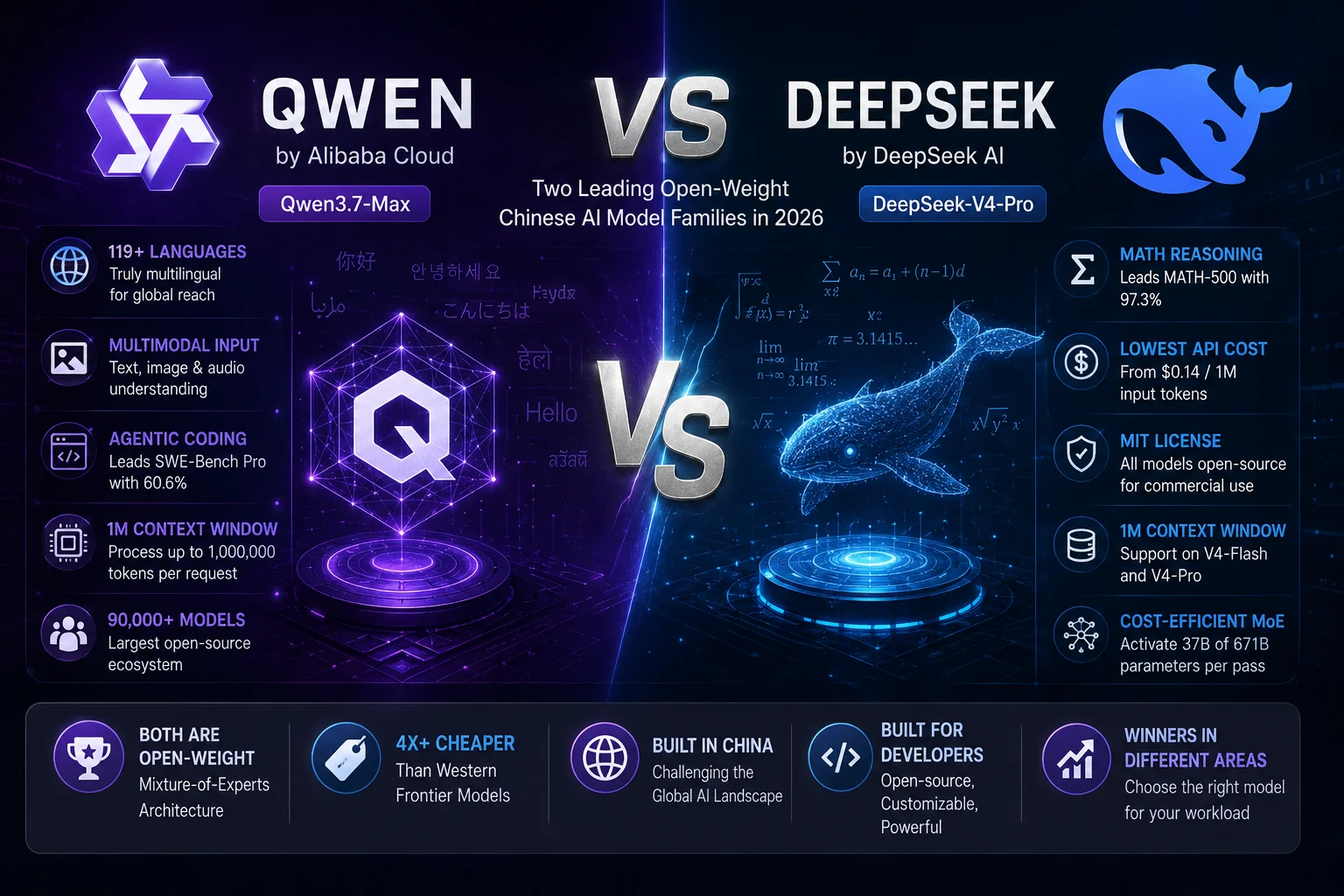
Qwen and DeepSeek are the 2 most capable open-weight Chinese AI model families in 2026. Choosing between them is difficult. Both use Mixture-of-Experts architecture. Both release open weights. Both undercut Western frontier model pricing by 4x or more.
The problem: each model family wins on different benchmarks. Qwen3-235B-A22B leads on 17 of 23 independent benchmarks, including agentic coding and STEM reasoning. DeepSeek-R1 leads on MATH-500 with 97.3% 7.1 points ahead of Qwen. Picking the wrong model costs development time and API budget.
This comparison covers 6 independent benchmarks, 4 pricing tiers, 4 use cases, and 8 verified limitations to identify the correct model for each workload.
Qwen vs DeepSeek: At a Glance
Qwen and DeepSeek differ across 8 key dimensions: developer origin, flagship model, context window, multimodal support, licensing, API cost, language coverage, and ecosystem size.
| Feature | Qwen | DeepSeek |
| Developer | Alibaba Cloud | DeepSeek AI |
| Flagship Model | Qwen3.7-Max | DeepSeek-V4-Pro |
| Context Window | 1,000,000 tokens | 128,000 tokens |
| Multimodal Input | Text, image, audio | Text only |
| Open-Weight License | Apache 2.0 (≤35B) | MIT (all models) |
| Flagship API Cost | $2.50 / 1M input tokens | $0.55 / 1M input tokens |
| Cheapest API Tier | $0.15 / 1M (Qwen3.6-35B) | $0.14 / 1M (V4 Flash) |
| Languages Supported | 119+ | Limited multilingual |
| HuggingFace Derivatives | 90,000+ models | Smaller ecosystem |
| Best For | Coding agents, multilingual, multimodal | Math, reasoning, low-cost API |
What Is Qwen?
Qwen is a family of open-weight large language models built by Alibaba Cloud, using a Mixture-of-Experts (MoE) architecture with Hybrid Gated DeltaNet attention. The Qwen3 family ranges from 0.5B to 235B parameters. It supports context windows up to 1,000,000 tokens via the Qwen3.7-Max API.
Qwen delivers 5 standout capabilities across multilingual, multimodal, and agentic coding tasks:
- Supports 119 languages, including Arabic, Hindi, Japanese, and Korean
- Processes 1,000,000 tokens per call through the Qwen3.7-Max API endpoint
- Accepts text, image, and audio input through Qwen-VL and Qwen-Audio specialized models
- Hosts 90,000+ derivative models on HuggingFace and ModelScope surpassing Meta Llama’s community count as of February 2025
- Runs on a single NVIDIA RTX 4090 for Qwen3.6-35B-A3B at INT4 quantization via Ollama
The Qwen model family includes 3 active deployment tiers: Qwen3.7-Max (proprietary hosted API), Qwen3.6-35B-A3B (open-weight Apache 2.0), and Qwen3-VL (vision-language multimodal model).
What Is DeepSeek?
DeepSeek is a family of open-weight AI models developed by DeepSeek AI, a Chinese research lab specializing in cost-efficient frontier model architecture. DeepSeek-R1 and DeepSeek-V4 use a Mixture-of-Experts design with Multi-Head Latent Attention (MLA). MLA compresses KV-cache memory to reduce inference cost at scale.
DeepSeek delivers 5 standout capabilities across mathematical reasoning, coding, and low-cost API deployment:
- Achieves 97.3% on MATH-500 the highest score among open-weight models as of May 2026 (Hendrycks et al., 2021)
- Prices DeepSeek-V4-Flash at $0.14 per 1M input tokens the lowest hosted API rate in its performance tier
- Releases all models under MIT license, permitting commercial use with no monthly active user threshold
- Supports 1,000,000 token context on both V4-Flash and V4-Pro API endpoints
- Activates 37B of 671B total parameters per forward pass, reducing inference compute cost versus comparable dense models
The DeepSeek model family includes 3 active deployment tiers: DeepSeek-V4-Pro (frontier API), DeepSeek-V4-Flash (low-cost API), and DeepSeek-R1 (open-weight reasoning model, MIT license).
How Do Qwen and DeepSeek Perform on Independent Benchmarks?

Qwen leads on 17 of 23 independent benchmarks as of May 2026. DeepSeek leads on 6 benchmarks concentrated in pure mathematical reasoning and structured symbolic derivation.
| Benchmark | Qwen | DeepSeek-R1 | Winner |
| SWE-Bench Pro (agentic coding) | 60.6% | 59.0% | Qwen |
| MATH-500 (math reasoning) | 90.2% | 97.3% | DeepSeek |
| LiveCodeBench (coding contests) | 70.7% | 65.9% | Qwen |
| GPQA Diamond (STEM reasoning) | 92.4% | 71.5% | Qwen |
| CodeForces ELO (competitive coding) | 2,056 | 2,029 | Qwen |
| Terminal-Bench 2.0 (agent tasks) | 69.7% | 67.9% | Qwen |
Sources: SWE-Bench Pro leaderboard (Jimenez et al., 2023), Artificial Analysis Intelligence Index May 2026
Which Model Wins on Agentic Coding?
Qwen3.7-Max achieves 60.6% on SWE-Bench Pro, resolving real GitHub issues from 2,294 production open-source projects. DeepSeek-V4-Pro achieves 59.0% on the same leaderboard. At the open-weight tier, Qwen3.6-35B-A3B scores 49.5% versus DeepSeek-R1’s 49.2%.
Which Model Leads on Mathematical Reasoning?
DeepSeek-R1 achieves 97.3% on MATH-500, outperforming Qwen3-235B-A22B’s 90.2% by 7.1 percentage points (Hendrycks et al., 2021). MATH-500 evaluates competition-level mathematics across 5 domains: algebra, geometry, number theory, counting, and probability. DeepSeek-R1 delivers the strongest open-weight math performance for STEM-heavy workflows requiring symbolic derivation.
Which Model Performs Better on STEM Reasoning?
Qwen3-235B-A22B achieves 92.4% on GPQA Diamond, compared to DeepSeek-R1’s 71.5% a 20.9-point advantage (Rein et al., 2023). GPQA Diamond evaluates PhD-level science questions across biology, chemistry, and physics. Qwen delivers a 20.9-point structural lead on general scientific reasoning beyond pure mathematics.
How Do Qwen and DeepSeek Compare on Pricing?

Qwen and DeepSeek pricing splits across 4 tiers: Qwen3.7-Max (proprietary), DeepSeek-R1, Qwen3.6-35B-A3B (open-weight), and DeepSeek-V4-Flash (low-cost).
| Model | Input ($/1M tokens) | Output ($/1M tokens) | Context | License |
| Qwen3.7-Max | $2.50 | $7.50 | 1M tokens | Proprietary |
| DeepSeek-R1 | $0.55 | $2.19 | 128K tokens | MIT |
| Qwen3.6-35B-A3B | $0.15 | $1.00 | 262K tokens | Apache 2.0 |
| DeepSeek-V4-Flash | $0.14 | $0.28 | 1M tokens | MIT |
Sources: Alibaba Cloud Model Studio, DeepSeek official API pricing page July 2026
At the frontier tier, DeepSeek-R1 ($0.55/1M input) costs 4.5x less than Qwen3.7-Max ($2.50/1M). At the open-weight tier, Qwen3.6-35B-A3B ($0.15/1M) costs 3.7x less than DeepSeek-R1. DeepSeek-V4-Flash at $0.14/1M delivers the lowest input token rate across both families.
What Does Self-Hosting Cost?
Qwen3.6-35B-A3B fits on a single NVIDIA RTX 4090 at 24GB VRAM using INT4 quantization. DeepSeek-R1 (671B total parameters) requires a multi-GPU server with 140GB+ VRAM at INT4 quantization. Choose Qwen3.6-35B-A3B for local deployment, if single-GPU consumer hardware is the infrastructure constraint.
How Do Qwen and DeepSeek Compare Feature by Feature?
Qwen and DeepSeek differ across 4 core technical capabilities: coding performance, multilingual support, multimodal input, and licensing structure.
Which Is Better for Coding: Qwen or DeepSeek?
Qwen3-Coder-32B achieves 88.4% on HumanEval, compared to DeepSeek-Coder-V2-Lite’s 83.5% on the same benchmark. DeepSeek-Coder leads on repository-level analysis and fill-in-the-middle (FIM) autocomplete tasks. Qwen3.7-Max’s 1,000,000-token window enables full repository analysis in a single API call. DeepSeek-R1’s 128K limit prevents this for large codebases.
Best AI Coding Assistant covers AI coding tools, including Cursor, Copilot, and Claude Code. DeepSeek vs GitHub Copilot compares DeepSeek against GitHub Copilot for developer workflows.
Which Has Better Multilingual Support?
Qwen3-235B supports 119 languages, including Chinese, Arabic, Hindi, Japanese, and Korean. DeepSeek-R1 delivers stronger output quality in English and Mandarin Chinese than in other Asian or European languages. Qwen’s broader training data delivers higher output accuracy across Middle Eastern and Southeast Asian languages than DeepSeek-R1.
Which Model Supports More Input Types?
Qwen-VL accepts text, image, and audio input through 3 specialized model variants: Qwen3-VL for vision-language tasks, Qwen-Audio for speech understanding, and Qwen-VL-Max for enterprise multimodal inference. DeepSeek-R1 accepts text input only. Qwen-VL provides multimodal coverage for diagram parsing, screenshot analysis, and product image captioning coverage DeepSeek-R1 lacks entirely.
How Do Qwen and DeepSeek Licensing Terms Compare?
Qwen applies Apache 2.0 licensing to all models at 35B parameters or below, including Qwen3.6-35B-A3B. Models above 35B parameters use the Tongyi Qianwen License. This license requires a separate commercial agreement with Alibaba Cloud for products exceeding 100M monthly active users. DeepSeek applies MIT licensing across all model tiers with no MAU threshold and no additional agreement at any scale.
Which Model Suits Each Use Case?
Qwen and DeepSeek serve 3 distinct user groups differently: developers, enterprise teams, and students.
Qwen vs DeepSeek for Developers
Qwen3.6-35B-A3B at $0.15/1M tokens combines open-weight access, Apache 2.0 licensing, single-GPU deployment, and 49.5% SWE-Bench Pro accuracy for individual developers. DeepSeek-R1 suits developers building mathematical reasoning pipelines and scientific computing applications. MIT licensing and 97.3% MATH-500 accuracy provide the strongest foundation for these use cases.
DeepSeek vs GitHub Copilot compares DeepSeek directly against GitHub Copilot for developer workflows.
Qwen vs DeepSeek for Enterprise
Qwen3.7-Max delivers 4 enterprise capabilities in a single hosted API: 1,000,000-token context for long document processing, 119-language multilingual support, image and audio multimodal input, and Alibaba Cloud infrastructure integration. DeepSeek-R1 provides simpler MIT licensing, a 4.5x lower API cost at the frontier tier, and stronger mathematical reasoning for STEM-heavy enterprise workflows. EU GDPR-regulated enterprises and US government deployments face data residency constraints with both APIs. Both Alibaba Cloud and DeepSeek route API requests through Asian data centers by default.
Qwen vs DeepSeek for Students
DeepSeek-R1 at $0.55/1M input tokens delivers 97.3% MATH-500 accuracy for mathematics homework, competitive problem sets, and exam preparation at the lowest frontier-class cost. According to Aydin et al. (2025, arXiv preprint), DeepSeek V3 and Qwen 2.5 Max perform competitively in academic writing tasks. Qwen demonstrates stronger multilingual essay output. DeepSeek demonstrates stronger logical argument structure in English-language writing.
What Are the Key Limitations of Qwen and DeepSeek?
Qwen and DeepSeek each carry 4 verified limitations that affect production deployment decisions.
4 Verified Limitations of Qwen
Qwen’s 4 verified limitations affect cost, licensing, data residency, and open-weight access:
- Qwen3.7-Max costs $2.50/1M input tokens at the frontier tier, making it 4.5x more expensive than DeepSeek-R1
- Models above 35B parameters require a separate commercial agreement with Alibaba Cloud for products exceeding 100M monthly active users
- The primary API endpoint routes through Alibaba Cloud’s Singapore data center, creating residency constraints for EU GDPR and US government deployments
- Qwen3.7-Max weights remain closed and unpublished, restricting deployment to the hosted API with no local inference option
4 Verified Limitations of DeepSeek
DeepSeek’s 4 verified limitations affect context length, multimodal capability, self-hosting hardware, and community ecosystem:
- DeepSeek-R1’s context window caps at 128,000 tokens, preventing full-repository code analysis and long-session agent state management
- DeepSeek-R1 accepts text input only, with no image, audio, or video processing across any current model tier
- DeepSeek-R1 requires 140GB+ VRAM at INT4 quantization for local inference, exceeding all consumer and prosumer GPU configurations
- DeepSeek’s derivative model ecosystem contains significantly fewer community fine-tunes than Qwen’s 90,000+ HuggingFace and ModelScope models
Qwen vs DeepSeek: Which Should You Choose?

The choice between Qwen and DeepSeek depends on 4 factors: context window requirement, primary workload type, licensing terms, and hardware constraints.
Choose Qwen If:
- Context windows longer than 128K tokens are required for the task
- Multilingual support across 3+ languages including Arabic, Hindi, Japanese, or Korean is a core requirement
- Image or audio input processing is part of the pipeline
- Local deployment on a single NVIDIA RTX 4090 is the hardware constraint
- A large pre-built community of fine-tuned model variants accelerates development
- Agentic coding pipelines require long-session state management beyond 128K tokens
Choose DeepSeek If:
- Pure mathematical reasoning, symbolic derivation, or STEM problem-solving is the primary workload
- The lowest frontier-class API cost at $0.55/1M input tokens is the operational priority
- MIT licensing with no MAU threshold is a legal or contractual requirement
- All task context fits within 128K tokens and MLA-compressed inference reduces cost
- A lean, predictable 2-tier model family structure simplifies product architecture decisions
Best AI Models covers the top-performing AI models across every capability tier. Best AI Tools covers the broader AI software landscape.
What Are the Best Alternatives to Qwen and DeepSeek?
Qwen and DeepSeek have 6 relevant alternatives, each optimized for distinct use cases across open-weight models, reasoning tools, and general-purpose AI:
| Alternative | Best For |
| DeepSeek vs ChatGPT | Comparing DeepSeek against GPT-5 for general use |
| DeepSeek vs Claude | Math reasoning vs. long-form writing balance |
| DeepSeek vs Gemini | Open-weight vs. Google’s multimodal frontier model |
| Grok vs DeepSeek | Real-time data access vs. open-weight cost efficiency |
| Llama vs ChatGPT | Meta’s open-weight alternative for flexible fine-tuning |
| DeepSeek Alternatives | Full list of open-weight alternatives to DeepSeek |
Frequently Asked Questions
Is Qwen Better Than DeepSeek?
Qwen leads on 17 of 23 independent benchmarks including SWE-Bench Pro agentic coding (60.6% vs 59.0%), GPQA Diamond STEM reasoning (92.4% vs 71.5%), and LiveCodeBench (70.7% vs 65.9%). DeepSeek leads on 6 benchmarks concentrated in pure mathematical reasoning. DeepSeek holds a 7.1-point MATH-500 advantage (97.3% vs 90.2%). The correct choice depends on the specific workload type.
Which Is Cheaper Qwen or DeepSeek?
DeepSeek-V4-Flash at $0.14/1M input tokens is the cheapest hosted API across both families. At the frontier tier, DeepSeek-R1 ($0.55/1M) costs 4.5x less than Qwen3.7-Max ($2.50/1M). At the open-weight tier, Qwen3.6-35B-A3B ($0.15/1M) costs 3.7x less than DeepSeek-R1. The cost winner changes based on which model tier is compared.
Is DeepSeek Better Than Qwen for Coding?
Qwen3-Coder-32B achieves 88.4% on HumanEval, compared to DeepSeek-Coder-V2-Lite’s 83.5%. DeepSeek-Coder leads on repository-level tasks and fill-in-the-middle autocomplete. Qwen3.7-Max’s 1M context window provides a structural advantage DeepSeek-R1 cannot replicate within its 128K limit. Best AI Coding Assistant provides a full coding AI comparison.
Which Has Better Open-Weight Models?
Qwen’s open-weight ecosystem contains 90,000+ derivative models on HuggingFace and ModelScope, surpassing Meta Llama’s community derivative count as of February 2025. DeepSeek-R1’s MIT license imposes no MAU threshold. Qwen’s ecosystem is broader. DeepSeek’s open-weight license is simpler.
What Is the Context Window Difference Between Qwen and DeepSeek?
Qwen3.7-Max supports 1,000,000 tokens per API call. Qwen3 open-weight models support 262,000 tokens natively via YaRN RoPE scaling. DeepSeek-R1 supports 128,000 tokens. The 7.8x context window difference results from architectural divergence. Qwen uses Hybrid Gated DeltaNet, applying linear attention in 3 of every 4 layers. This design enables longer context without quadratic memory growth. DeepSeek’s MLA architecture caps at 128K due to its KV-cache compression design.
Which Is Better for Multilingual Tasks?
Qwen3-235B delivers stronger multilingual performance, supporting 119 languages, including Arabic, Hindi, Japanese, Korean, and French. DeepSeek-R1 produces higher-quality output in English and Mandarin Chinese than in other languages. Qwen provides broader and more accurate language coverage for multilingual content workflows, translation pipelines, and global product deployments.

