DeepSeek vs Mistral (2026): Which Open-Source LLM Is Better?
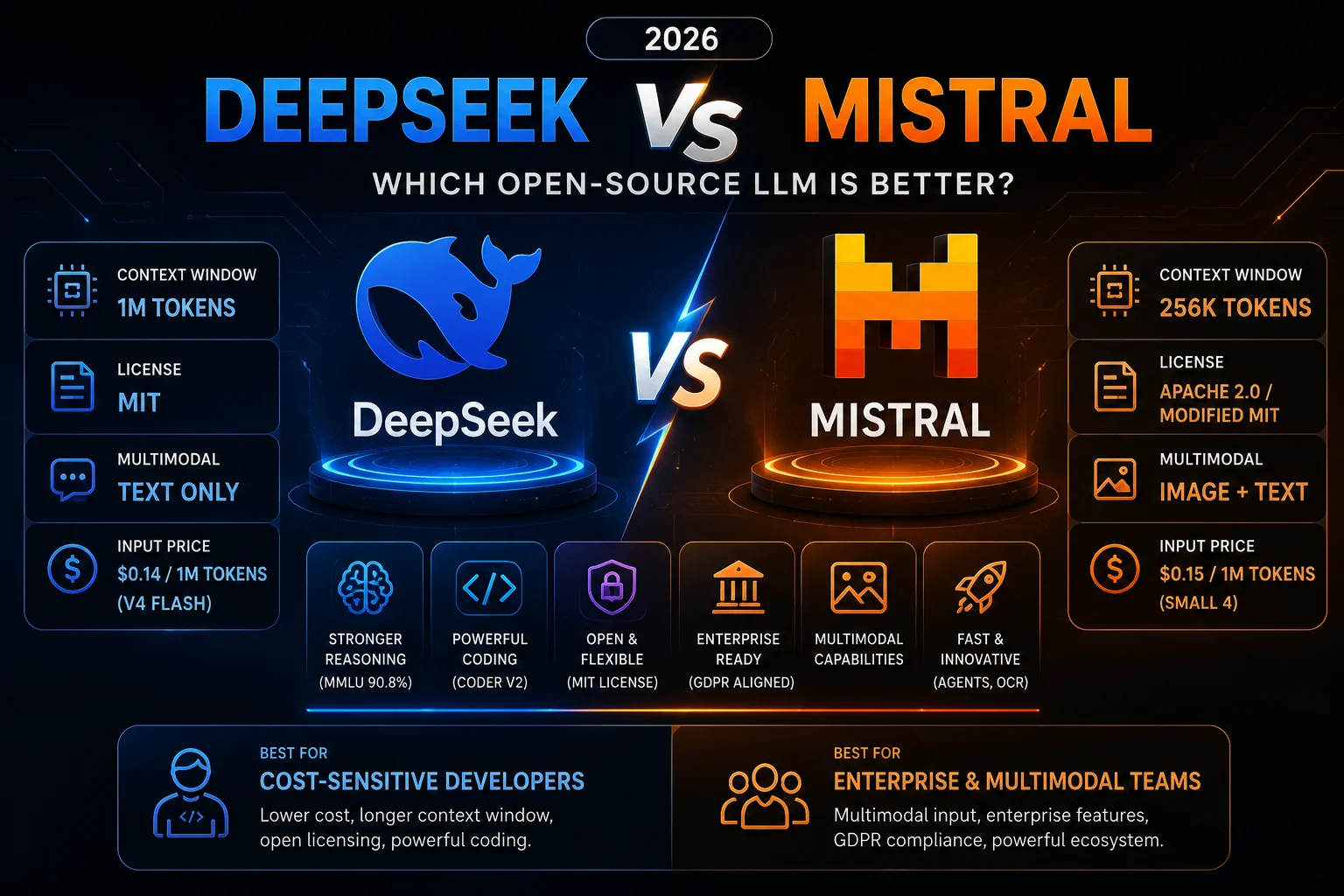
DeepSeek and Mistral are the 2 most competitive open-source large language model providers in 2026. DeepSeek AI was founded in 2023 by Liang Wenfeng in Hangzhou, China. It delivers frontier-level reasoning at 2% of competing model API costs. Mistral AI was co-founded in 2023 by Arthur Mensch, Guillaume Lample, and Timothée Lacroix in Paris. It builds GDPR-aligned models with enterprise-grade multimodal and agent tooling.
8 critical dimensions separate these platforms: pricing, benchmark performance, coding, privacy, licensing, context window, multimodal support, and deployment. The 5 primary user groups evaluating DeepSeek and Mistral include developers, enterprise buyers, AI researchers, open-source contributors, and product teams. The Best AI Models guide ranks 10 leading LLMs across all these use cases. Teams choosing a conversational AI interface also benefit from the Best AI Chatbot guide, which compares 10 platforms on accuracy, pricing, and interface quality.
DeepSeek vs Mistral: Quick Comparison
DeepSeek leads on API cost, context window size, and reasoning benchmark scores. Mistral leads on multimodal input support, enterprise compliance documentation, and product breadth.
| Feature | DeepSeek | Mistral |
| Best For | Cost-sensitive developers | Enterprise and multimodal teams |
| Flagship API Model | DeepSeek V4 Pro | Mistral Large 3 |
| Input Cost (per 1M Tokens) | $0.14 V4 Flash | $0.15 Small 4 |
| Context Window | 1M tokens | 256K tokens |
| Multimodal Support | No text only | Yes image + text |
| License | MIT | Apache 2.0 / Modified MIT |
| GDPR Compliance | PRC server storage | EU GDPR-aligned DPA |
| Coding Model | DeepSeek Coder V2 | Codestral / Devstral |
| MMLU Score | 90.8% R1 | 81.2% Large |
| Overall Rating | 4.5/5 | 4.4/5 |
What Is DeepSeek?
DeepSeek is an open-source LLM platform built by a Chinese AI research company, offering 4 production models: DeepSeek V4 Flash, DeepSeek V4 Pro, DeepSeek R1, and DeepSeek Coder V2. DeepSeek V3 and R1 achieved frontier-level performance in late 2024 and January 2025. The DeepSeek V3 GitHub repository holds 97,600 stars and 15,900 forks. DeepSeek R1 holds 48.7 million downloads on Ollama the most-deployed open-weight reasoning model for local inference in 2026.
How DeepSeek measures against OpenAI’s GPT-5 on reasoning, speed, and API cost is covered in the DeepSeek vs ChatGPT comparison. Teams evaluating DeepSeek against Grok 4 on benchmark scores and open-source availability benefit from the Grok vs DeepSeek analysis.
Key Features of DeepSeek
DeepSeek delivers 6 primary capabilities for developers and research teams:
- 1M-token context window across V4 Flash and V4 Pro
- MIT license permitting unrestricted commercial use and model distillation
- Mixture of Experts (MoE) architecture V4 Pro activates 49B of 1.6T total parameters per forward pass
- OpenAI-compatible and Anthropic-compatible API enabling direct SDK migration without code rewrites
- Thinking and non-thinking modes for adjustable reasoning depth per request
- DeepSeek Coder V2 supporting 338 programming languages on a 236B MoE architecture
Pros and Cons of DeepSeek
3 major advantages of DeepSeek include the lowest API pricing among frontier models, a 1M-token context window, and MIT licensing for full commercial deployment.
3 notable limitations of DeepSeek include the absence of image input in V4 models, Chinese server data storage on the official API, and large model sizes that increase self-hosting infrastructure complexity.
What Is Mistral?
Mistral is an open-source and enterprise LLM platform developed by Mistral AI, offering 5 primary models: Mistral Small 4, Mistral Large 3, Mistral Medium 3.5, Magistral Medium, and Codestral. Mistral AI raised $3.18B in total funding. Mistral CEO Arthur Mensch publicly described DeepSeek as “the Mistral of China,” citing parallel open-source strategies between both companies.
Mixtral 8x22B Mistral’s earlier open-weight model under Apache 2.0 established Mistral’s reputation for competitive open-source performance. Mistral models are available on HuggingFace and via cloud vendors including AWS, Google Cloud, and Azure.
The ChatGPT vs Mistral comparison covers how Mistral measures against OpenAI’s GPT-5 on pricing, writing quality, and API features. The Llama vs Mistral guide covers architecture, licensing, and benchmark differences between Mistral and Meta’s Llama 4 models developed by overlapping research teams. Teams comparing Mistral to Anthropic’s Claude on enterprise controls and writing quality benefit from the Claude vs Mistral breakdown.
Key Features of Mistral
Mistral delivers 7 primary capabilities across La Plateforme:
- Multimodal input Mistral Medium 3.5, Large 3, and Small 4 accept image and text inputs
- GDPR-aligned data controls with a published Data Processing Addendum under EU law
- Le Chat a consumer interface streaming tokens up to 10× faster via the Flash Answers pipeline
- Mistral Agents API for multi-step agentic workflows with persistent memory and tool connectors
- Document AI and OCR processing 2,000 pages per minute at 99% accuracy across 11 languages
- 50% batch processing discount and 90% cached input token discount on La Plateforme
- Mistral Code an enterprise IDE assistant for JetBrains and VSCode built on the Continue open-source project
Pros and Cons of Mistral
4 key advantages of Mistral include multimodal input across 3 model tiers, GDPR-compliant data handling with a published DPA, a broader 5-model portfolio, and a complete agent and OCR ecosystem.
3 notable limitations of Mistral include higher token pricing on frontier models, a 256K context window versus DeepSeek’s 1M, and complex model selection across its lineup that requires evaluation before deployment.
DeepSeek vs Mistral: Pricing Comparison
DeepSeek V4 Flash is the lowest-cost production-grade LLM API in 2026, priced at $0.14 per million input tokens and $0.28 per million output tokens. Mistral Small 4 charges $0.15 per million input tokens. It charges $0.60 per million output tokens more than double DeepSeek Flash’s output rate.
| Model | Input / 1M Tokens | Output / 1M Tokens | Context |
| DeepSeek V4 Flash | $0.14 | $0.28 | 1M |
| DeepSeek V4 Pro | $0.435 | $0.87 | 1M |
| Mistral Small 4 | $0.15 | $0.60 | 256K |
| Mistral Large 3 | $0.50 | $1.50 | 256K |
| Mistral Medium 3.5 | $1.50 | $7.50 | 256K |
| Mistral Magistral Medium | $2.00 | $5.00 | 40K |
| Mistral Codestral | $0.30 | $0.90 | Model-specific |
Source: DeepSeek API Documentation (api-docs.deepseek.com); Mistral Pricing Page (mistral.ai/pricing). Verified July 2026.
At 10 million input tokens and 2 million output tokens, DeepSeek V4 Flash costs $1.96. Mistral Small 4 costs $2.70 for the same workload. At 10 million output tokens, DeepSeek Flash costs $2.80. Mistral Small 4 costs $6.00 for identical output volume.
Mistral’s 90% cached input discount reduces costs for applications with repetitive system prompts. These include document analysis pipelines, customer support agents, and RAG-based research assistants. DeepSeek cache-hit pricing drops significantly below the standard $0.14 input rate.
How DeepSeek’s API token costs compare to Anthropic Claude Sonnet rates across identical workloads is detailed in the DeepSeek vs Claude pricing breakdown. A full cross-platform cost analysis across 12 AI platforms appears in the Best AI Tools guide.
DeepSeek wins the pricing comparison for text and code generation workloads at scale.
DeepSeek vs Mistral: Performance and Benchmarks

DeepSeek R1 scores 90.8% on MMLU, compared to Mistral Large at 81.2% on the same benchmark. On AIME-24, DeepSeek R1-0528 achieves 91.4% versus Mistral Magistral Medium at 73.6%. On GSM8K, DeepSeek V2.5 scores 95.1% versus Mistral Large 2 at 93.0%.
DeepSeek R1 vs Mistral Large: Model-Level Benchmark
DeepSeek R1 outperforms Mistral Large on 4 of 5 major benchmarks: MMLU, AIME-24, AIME-25, and GSM8K. Mistral Devstral Small 24B outperforms DeepSeek Coder V2 on HumanEval coding benchmarks, scoring 90.1% versus 85.6%. Mistral Medium 3.5 achieves 77.6% on SWE-Bench Verified measuring agentic software engineering task completion.
| Benchmark | DeepSeek Model | Score | Mistral Model | Score |
| MMLU | DeepSeek R1 | 90.8% | Mistral Large | 81.2% |
| AIME-24 | DeepSeek R1-0528 | 91.4% | Magistral Medium | 73.6% |
| AIME-25 | DeepSeek R1-0528 | 87.5% | — | — |
| GSM8K | DeepSeek V2.5 | 95.1% | Mistral Large 2 | 93.0% |
| HumanEval | DeepSeek Coder V2 | 85.6% | Devstral Small 24B | 90.1% |
| SWE-Bench Verified | — | — | Mistral Medium 3.5 | 77.6% |
Sources: DeepSeek R1 Technical Report (arxiv.org/abs/2501.12948); Mistral AI model cards (mistral.ai); LMSYS Chatbot Arena Leaderboard (lmarena.ai). Verified July 2026.
DeepSeek leads on 4 reasoning and mathematics benchmarks. Mistral Devstral leads on agentic coding benchmarks. Real-world performance varies based on task type, prompt structure, context length, and tool integration.
DeepSeek vs Mistral: Coding Comparison
DeepSeek Coder V2 supports 338 programming languages, scores 85.6% on HumanEval, and processes full-project generation on a 236B MoE architecture. Mistral’s coding ecosystem includes 3 dedicated products: Codestral, Devstral, and Mistral Code. Devstral Small 24B scores 90.1% on HumanEval. It leads on agentic multi-file task benchmarks through the Mistral Vibe remote agent workflow.
DeepSeek Coder V2 excels at long-context code generation. Specific strengths include reading 100,000-token repositories, generating full multi-file implementations, and producing cross-file patches. Mistral Devstral excels at multi-step agentic tasks, including test fixing, dependency resolution, and pull request generation with minimal human correction.
Mistral Code provides direct IDE support for JetBrains and VSCode with enterprise compliance controls. DeepSeek Coder V2 provides stronger value for teams running a custom agent harness at high output volume.
The Best AI Coding Assistant guide ranks 8 leading coding tools across benchmark scores, IDE integration, and pricing. How DeepSeek Coder V2 measures against Microsoft’s GitHub Copilot on real-world developer tasks is covered in the DeepSeek vs GitHub Copilot comparison.
DeepSeek Coder V2 wins on context and cost per generated token. Mistral Devstral wins on packaged agentic tooling and HumanEval score.
DeepSeek vs Mistral: Privacy, Security, and Licensing
DeepSeek’s official API stores prompts, outputs, IP addresses, and keystroke metadata on PRC servers, with data shared with advertising partners under Chinese law. Mistral documents GDPR-aligned data controls, a published Data Processing Addendum, zero-data-retention options, and training opt-out settings for paid API tiers.
Enterprise buyers in finance, healthcare, and government organizations evaluate Mistral against 3 documented criteria: DPA terms, zero-data-retention configuration, and subprocessor disclosure.
| Model Tier | License | Commercial Use | Distillation |
| DeepSeek R1 / V4 | MIT | ✅ Permitted | ✅ Permitted |
| Mistral 7B / Mixtral 8x22B | Apache 2.0 | ✅ Permitted | ✅ Permitted |
| Mistral Medium 3.5 | Modified MIT | ✅ Permitted | Review required |
| Mistral Large 3 | Apache 2.0 | ✅ Permitted | ✅ Permitted |
DeepSeek’s MIT license permits unrestricted commercial deployment, fine-tuning, and model distillation. This applies to self-hosted deployments via tools like vLLM and Ollama. A 4-bit quantized DeepSeek R1 runs on a single Nvidia RTX 4090 with 24 GB of VRAM. Mistral 7B runs on mid-range consumer hardware via Ollama or LM Studio, requiring less VRAM at equivalent quantization.
Qwen developed by Alibaba is the other major Chinese open-weight model family using MIT licensing. The Qwen vs DeepSeek comparison covers data sovereignty differences, architecture, and benchmark scores between both Chinese open-source providers.
Mistral wins on enterprise compliance documentation. DeepSeek wins on license permissiveness for self-hosted deployment.
DeepSeek vs Mistral: Context Window and Multimodal Support
DeepSeek V4 Flash and V4 Pro support a 1M-token context window 4 times larger than Mistral’s 256K across Medium 3.5, Large 3, and Small 4. This advantage improves performance on tasks involving large codebases, full legal contracts, and extended research papers requiring complete document ingestion in a single pass.
Mistral leads on multimodal capability. Mistral Medium 3.5, Large 3, and Small 4 accept image and text inputs. DeepSeek V4 processes text only. Mistral’s OCR 4 API processes 2,000 pages per minute at 99% accuracy across 11 languages, including Arabic, Chinese, Japanese, French, and German.
Other multimodal AI platforms with image and text support include Gemini 2.5 Pro (Google DeepMind), GPT-5 (OpenAI), and Claude Sonnet (Anthropic). The DeepSeek vs Gemini comparison covers how Google’s multimodal model measures against DeepSeek V4 on reasoning, image understanding, and API pricing.
DeepSeek wins on context window size. Mistral wins on multimodal and document processing capability.
DeepSeek vs Mistral: Which One to Choose?

DeepSeek V4 is the stronger choice for cost-sensitive text, reasoning, and code generation at scale. Mistral is the stronger choice for multimodal input, enterprise compliance requirements, and teams using packaged agent infrastructure.
Choose DeepSeek If:
- API token cost is a primary operational constraint
- Workloads exceed 256K tokens, including legal contract review, full codebase analysis, and multi-document summarization
- Deployment runs self-hosted under MIT license terms using vLLM or Ollama
- Coding tasks involve large repositories, patch generation, and high output volume
- No image or document input is involved
Choose Mistral If:
- Workflows include image, PDF, or visual document inputs
- Data processing operates under GDPR-compliant EU data controls
- Enterprise agent tooling comes packaged out of the box via Mistral Vibe or La Plateforme
- Smaller open-weight model options fit edge deployment workloads, including Ministral 3B and Mistral Small 4
- OCR, embeddings, and speech APIs consolidate into one provider
Teams building long-document RAG systems, customer support automation, or coding agents benefit from testing both platforms. Cost per successful task not cost per token is the accurate evaluation metric for production deployment.
The DeepSeek Alternatives guide covers 8 open-source and proprietary models for teams where DeepSeek does not fully meet requirements. How Perplexity AI’s search-augmented approach differs from DeepSeek’s reasoning-first LLM is detailed in the Perplexity vs DeepSeek comparison.
Frequently Asked Questions
Is DeepSeek Better Than Mistral?
DeepSeek is better for cost-sensitive reasoning, text generation, and long-context tasks. Mistral is better for multimodal input, enterprise compliance documentation, and agentic workflow tooling. DeepSeek R1 scores 90.8% on MMLU versus Mistral Large at 81.2%. Mistral Devstral Small scores 90.1% on HumanEval versus DeepSeek Coder V2 at 85.6%.
Which Is Cheaper DeepSeek or Mistral?
DeepSeek V4 Flash costs $0.14 per million input tokens and $0.28 per million output tokens cheaper than Mistral Medium 3.5 at $1.50 input and $7.50 output per million tokens. Mistral Small 4 at $0.15 input is comparable to DeepSeek Flash for input-heavy workloads only.
Is DeepSeek Open Source?
DeepSeek V4 model weights and code are distributed under the MIT license, permitting unrestricted commercial deployment, fine-tuning, and model distillation without fees or attribution requirements.
Is Mistral GDPR Compliant?
Mistral publishes a GDPR-aligned Data Processing Addendum, training opt-out controls, and zero-data-retention documentation for paid API tiers. Enterprise buyers verify Labs model exceptions and subprocessor disclosures before processing regulated personal data.
What Are the Alternatives to DeepSeek and Mistral?
4 primary alternatives include ChatGPT (OpenAI GPT-5), Claude Sonnet (Anthropic), Llama 4 (Meta), and Gemini 2.5 Pro (Google DeepMind). The DeepSeek Alternatives guide covers 8 competing models with pricing and benchmark comparisons. Teams evaluating OpenAI replacements benefit from the ChatGPT Alternatives guide covering 10 platforms on accuracy, pricing, and feature depth.
Can DeepSeek Run Locally?
A 4-bit quantized DeepSeek R1 runs on a single Nvidia RTX 4090 with 24 GB of VRAM. Mistral 7B runs on mid-range consumer hardware via Ollama or LM Studio. It requires less VRAM than DeepSeek R1 at equivalent quantization levels. Both models support production inference via vLLM.
Which Is Better for Enterprise Use?
Mistral is the better choice for managed enterprise API deployments, providing training controls, zero-data-retention options, a published DPA, and EU data residency. DeepSeek is the better choice for enterprise teams deploying self-hosted models under MIT license terms, where data sovereignty is controlled at the infrastructure level. Teams evaluating AI tools for enterprise productivity workflows also benefit from the Best AI Productivity Tools guide, which covers 10 platforms across automation, writing, and communication.
Final Verdict

DeepSeek and Mistral are the 2 strongest open-source LLM platforms in 2026. DeepSeek R1 leads Mistral on MMLU (90.8% vs 81.2%) and AIME-24 (91.4% vs 73.6%). DeepSeek V4 Flash costs $0.14 per million input tokens with a 1M-token context window under MIT licensing. Mistral delivers the strongest enterprise platform among open-weight providers. It offers multimodal support across 3 model tiers, GDPR-aligned data controls, and a complete agent, OCR, and speech ecosystem.
Choose DeepSeek V4 Flash for cost-optimized text and code generation at scale. Choose Mistral Medium 3.5 for multimodal, compliance-sensitive, and agent-heavy production workloads. Both platforms merit evaluation against 3 primary criteria: cost per successful task, data residency requirements, and multimodal necessity.

