Claude Opus 4.7 Launch Reshapes AI Model Competition in 2026
The artificial intelligence race intensified this week as Anthropic unveiled its latest flagship model, Claude Opus 4.7, positioning it as a direct competitor to GPT-5 and Gemini 3.1 Pro. Early benchmark results suggest the new model could significantly impact how developers and enterprises choose AI tools in 2026.
Claude Opus 4.7 Sets New Coding Benchmark
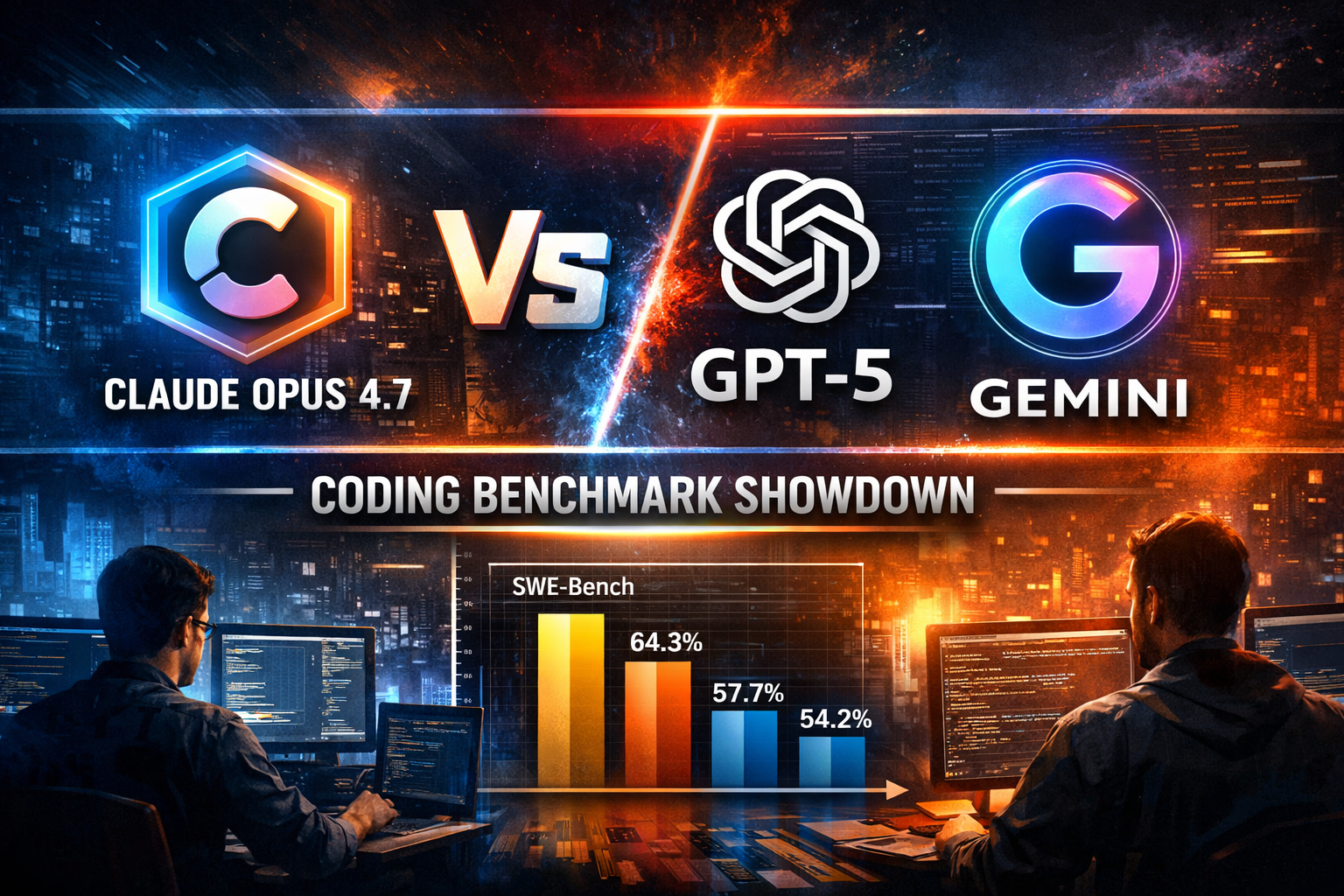
Claude Opus 4.7 is already drawing attention for its performance in software engineering tasks. According to early benchmark data, the model scored 64.3% on SWE-bench Pro, outperforming GPT-5.4 and Gemini 3.1 Pro in real-world coding scenarios.
SWE-bench is considered one of the most practical evaluations because it measures how effectively AI models can fix bugs and complete coding tasks in real repositories.
The improvements reflect a broader trend toward agent-style AI systems that can:
- Debug complex applications
- Handle multi-step development workflows
- Assist in production-level coding environments
This gives Claude a clear edge among developers looking for reliability rather than just speed.
General AI Performance Reaches Near Parity
While Claude leads in coding, the overall intelligence gap between top AI models is narrowing. Recent comparisons show that Claude Opus 4.7, GPT-5.4 Pro, and Gemini 3.1 Pro all score around 94% in general reasoning benchmarks, indicating near-equal capabilities.
This signals a shift in the AI industry. Instead of competing purely on intelligence scores, companies are now focusing on:
- Specialized capabilities
- Ecosystem integration
- Real-world reliability
Each model is carving out its own strength:
- Claude focuses on structured reasoning and coding
- GPT-5 emphasizes versatility across tasks
- Gemini integrates deeply with productivity and search tools
Strategic Shift Toward Enterprise and Developers
With this release, Anthropic appears to be doubling down on enterprise use cases. Claude Opus 4.7 is designed to handle complex workflows, making it attractive for engineering teams and businesses building AI-powered products.
This move aligns with a broader industry trend where AI models are becoming:
- Embedded into development pipelines
- Used for automation and agent-based tasks
- Critical tools for productivity rather than optional assistants
The competition is no longer about who has the smartest chatbot, but who delivers the most practical value in real-world scenarios.
AI Model Competition Enters a New Phase
The launch of Claude Opus 4.7 highlights how the AI landscape is evolving in 2026. Benchmarks still matter, but they are no longer the sole deciding factor.
Instead, users are evaluating models based on:
- Workflow compatibility
- Performance in specific tasks
- Consistency and reliability
For developers, Claude’s latest release may offer a compelling advantage. For general users, GPT-5 and Gemini remain strong all-around options.
Final Outlook
Claude Opus 4.7 does not completely replace GPT-5 or Gemini, but it strengthens Anthropic’s position in a critical area: software development.
As AI models continue to mature, the real competition is shifting from who is better overall to who is better for your specific use case.
And with this launch, Claude has made a strong case for being the top choice in coding-focused AI workflows.