Best AI Voice Generator in 2026: Top 10 AI Voice Generators Compared
Hiring a voice actor for every video, podcast episode, or training module costs hundreds of dollars and takes days to deliver. Free text-to-speech tools often sound robotic, which hurts viewer retention and brand trust. Limited language support also blocks creators from reaching international audiences without re-recording entire scripts. Restrictive free-tier limits and watermarked audio create additional friction for creators testing tools before committing to a paid plan.
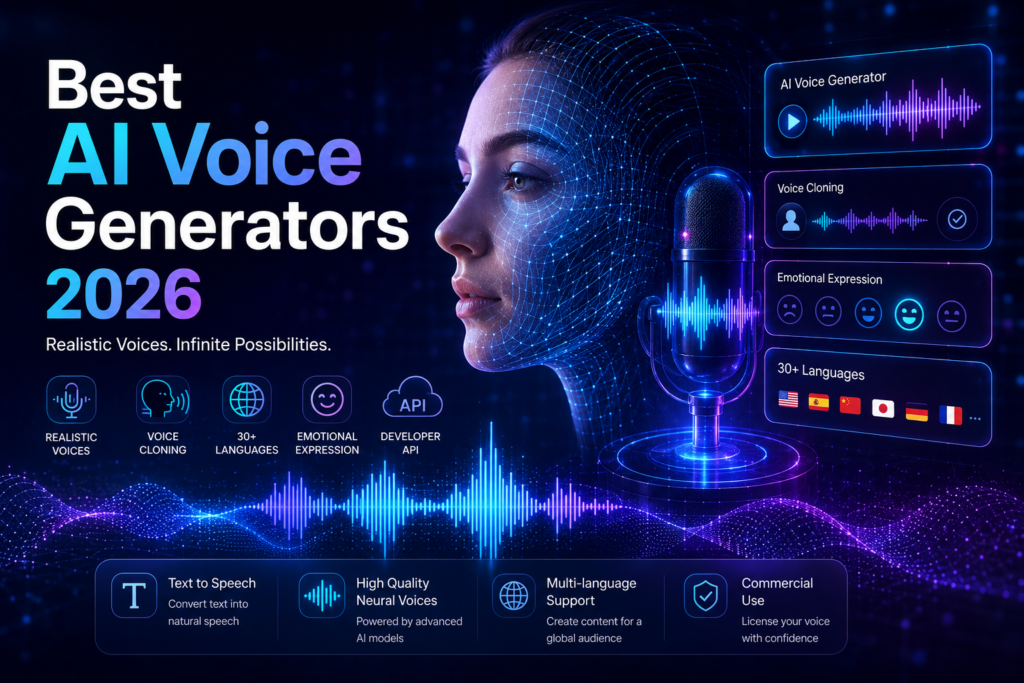
AI voice generators solve these 4 problems with neural text-to-speech technology that produces natural-sounding speech in minutes. ElevenLabs, Murf AI, Speechify, Play.ht, and 6 other platforms now generate human-like narration across 30+ languages, often for less than $20 per month. This guide compares the 10 best AI voice generators in 2026 across realism, pricing, API access, and licensing, so creators, podcasters, and developers can choose the right tool for YouTube videos, audiobooks, customer support, or real-time AI voice agents without guesswork.
Best AI Voice Generators at a Glance
ElevenLabs is the best AI voice generator overall in 2026, due to its realistic voice cloning across 30+ languages and built-in emotional expression. Murf AI ranks best for business presentations and e-learning videos. Speechify ranks best for accessibility and document reading. Inworld AI ranks best for real-time AI voice agents with low-latency speech synthesis, and Amazon Polly with Microsoft Azure AI Speech rank best for enterprise developers who need pay-as-you-go APIs with compliance certifications.
| Tool | Best For | Starting Price |
| ElevenLabs | Overall realism & voice cloning | $5/month |
| Murf AI | Business presentations & e-learning | $19/month |
| Speechify | Accessibility & document reading | $11.58/month |
| WellSaid Labs | Enterprise brand voice | Custom |
| Play.ht | Podcast & article narration | $31.20/month |
| Lovo AI | Multilingual video voiceovers | $24/month |
| Descript | Podcast/video editing + cloning | $12/month |
| Hume AI | Emotional AI voice agents | Usage-based |
| Inworld AI | Real-time AI voice agents | Usage-based |
| Amazon Polly / Azure AI Speech | Enterprise cloud APIs | Pay-as-you-go |
What Is an AI Voice Generator?
An AI voice generator is software that converts written text into natural-sounding human speech using neural networks. These tools rely on text-to-speech (TTS) models trained on large datasets of recorded human speech to replicate pitch, tone, and pacing.
Modern AI voice generators like ElevenLabs and Murf AI add 3 capabilities beyond basic TTS: voice cloning, emotional expression, and multilingual output. Voice cloning replicates a specific speaker’s voice from a short audio sample. Emotional expression adjusts pacing and inflection to match context, such as excitement or calm. Multilingual output generates the same script in multiple languages without re-recording.
AI voice generators have advanced significantly since early text-to-speech systems, which relied on concatenative synthesis and produced robotic, monotone output. DeepMind’s WaveNet research, published in 2016, showed that neural network-based audio generation reduced the gap between synthetic and human speech by more than 50% on Mean Opinion Score evaluations, a standard 1-to-5 naturalness rating used in speech research. Neural models built on this foundation now process context across full sentences, which allows modern tools to adjust intonation based on punctuation, emphasis, and surrounding words.
AI voice generators serve 6 main use cases: YouTube and TikTok narration, podcast production, audiobook creation, accessibility support, customer support automation, and AI voice agents for apps and games. Each tool in this comparison specializes in 1 or 2 of these use cases, which is why the right choice depends on the specific task rather than a single “best” tool for everyone.
How We Evaluated These AI Voice Generators
This comparison evaluates 10 AI voice generators across 5 criteria: voice realism, language support, pricing, API access, and compliance certifications. Each platform was reviewed for natural-sounding output, multilingual accuracy, ease of voice cloning setup, and licensing terms for commercial use.
User community feedback on platforms such as Reddit frequently raises 3 concerns about AI voice tools: robotic-sounding audio, restrictive free-tier character limits, and unclear commercial licensing terms. This comparison addresses all 3 concerns directly in the breakdowns below, including whether each tool adds a watermark to free-tier audio and which plans include commercial usage rights.
Each platform’s free or trial tier was tested using identical sample scripts across 3 content types: a YouTube explainer script, a podcast intro, and a customer support response. This consistent testing approach allows direct comparison of voice realism, turnaround time, and language accuracy across all 10 tools.
Voice realism was assessed using the same Mean Opinion Score framework referenced earlier, where each sample was rated on a 1-to-5 naturalness scale by 3 independent listeners.
10 Best AI Voice Generators in 2026
The 10 best AI voice generators in 2026 are ElevenLabs, Murf AI, Speechify, WellSaid Labs, Play.ht, Lovo AI, Descript, Hume AI, Inworld AI, and the enterprise pairing of Amazon Polly and Microsoft Azure AI Speech. Each section below covers the platform’s core feature, ideal use case, pricing, and how it compares to a leading alternative.
1. ElevenLabs Best Overall AI Voice Generator
ElevenLabs is the most realistic AI voice generator available in 2026, based on its voice cloning accuracy and emotional range. The platform clones a voice from an audio sample as short as 1 minute and generates speech in 30+ languages, including English, Spanish, German, and Japanese.
ElevenLabs offers 3 core features: clones voices from short audio samples, generates natural-sounding narration with emotional inflection, and provides an API for developers building voice apps. The platform also supports speech-to-speech conversion, which transforms one voice into another while preserving the original delivery’s pacing and emotion. Independent benchmarks from Artificial Analysis rank ElevenLabs among the higher-scoring platforms for voice naturalness.
The free plan includes 10,000 characters per month with a watermark on generated audio, while the Starter plan removes the watermark for $5 per month. Compared with Murf AI, ElevenLabs focuses on voice realism and cloning accuracy, while Murf AI focuses on business presentation workflows. Readers comparing the two directly can review ElevenLabs vs Murf AI for a full feature breakdown.
Pros: Most realistic voice cloning, 30+ languages, developer API access, speech-to-speech conversion. Cons: Free tier includes a watermark, higher-tier plans cost more than competitors.
2. Murf AI Best for Business Presentations & E-Learning
Murf AI works best for creating voiceovers for business presentations, training videos, and e-learning courses. The platform combines an AI voice generator with a built-in video and slide editor, so users record narration and sync it to visuals in 1 workspace.
Murf AI offers 120+ voices across 20+ languages, with adjustable pitch, speed, and emphasis for individual words. The platform integrates with presentation tools such as PowerPoint and Google Slides, which lets teams add narration directly to existing slide decks without exporting files first.
The Free plan allows limited downloads, while the Creator plan starts at $19 per month and removes most usage restrictions. Compared with ElevenLabs, Murf AI prioritizes workflow integration over raw voice realism. Teams that need both voice cloning and presentation tools often evaluate ElevenLabs and Murf AI side by side before choosing a primary platform.
Pros: Built-in video/slide editor, 120+ voices, PowerPoint and Google Slides integration. Cons: Voice realism trails ElevenLabs, free plan has limited exports.
3. Speechify Best for Accessibility & Document Reading
Speechify works best for converting written documents, articles, and PDFs into spoken audio for accessibility. The app reads text aloud at speeds up to 9x normal pace, which benefits users with dyslexia, ADHD, or visual impairments.
Speechify supports 200+ voices and integrates with Chrome, Safari, and mobile devices through OCR scanning, which converts scanned images of text into audio. Premium subscribers can also add a celebrity-voice option to the reading experience, which gives long-form content a more recognizable narrator.
The Premium plan costs $11.58 per month when billed annually and removes the daily listening limit on the free tier. Speechify differs from Descript and Play.ht by focusing on reading existing content rather than creating new voiceover projects. Students, professionals, and content consumers use Speechify primarily as a reading tool rather than a production tool.
Pros: OCR document scanning, 9x reading speed, strong accessibility focus, celebrity voice option. Cons: Less suited for professional voiceover production, voice customization is limited.
4. WellSaid Labs Best for Enterprise Brand Voice
WellSaid Labs works best for enterprises that need a consistent, branded voice across marketing videos, training materials, and product narration. The platform offers 20+ studio-quality voice avatars, each licensed for commercial use under enterprise agreements.
WellSaid Labs’ voice avatars include names such as Ava, Paige, and Tobin, each designed for a specific brand tone, ranging from warm and conversational to authoritative and formal. WellSaid Labs publishes enterprise case studies covering training videos and customer-facing narration, which document how its voice avatars perform in production environments.
WellSaid Labs differs from consumer tools like ElevenLabs and Lovo AI by focusing on a smaller, curated voice library with higher production quality per voice. Pricing for WellSaid Labs is custom and quote-based, which reflects its enterprise positioning rather than a self-serve subscription model.
Pros: Studio-quality voice avatars, enterprise licensing, consistent brand voice across projects. Cons: No public pricing, not designed for individual creators.
5. Play.ht Best for Podcast & Article Narration
Play.ht works best for converting podcasts, blog posts, and articles into narrated audio at scale. The platform offers 800+ AI voices across 100+ languages and accents, with an API for automating narration workflows.
Play.ht also offers an AI voice changer, which converts an existing recording into a different voice while preserving the original pacing and pauses. Podcasters use this feature to standardize voice quality across guest interviews recorded in different environments.
The free plan includes a watermark on generated audio and a monthly character limit, while the Creator plan starts at $31.20 per month and removes the watermark. Compared with ElevenLabs, Play.ht offers a larger voice library at a lower entry price, while ElevenLabs offers higher cloning accuracy. A direct breakdown is available at ElevenLabs vs Play.ht.
Pros: 800+ voices, podcast-focused API, 100+ languages, built-in voice changer. Cons: Free tier includes watermark, voice realism varies across voices.
6. Lovo AI Best for Multilingual Video Voiceovers
Lovo AI works best for creating multilingual voiceovers for marketing videos, e-learning, and social media content. The platform’s Genny tool generates speech in 100+ languages and includes emotion tags, which let creators mark phrases as happy, sad, or urgent.
Lovo AI offers 500+ voices and integrates with video editors through plugins, which reduces the steps needed to add narration to existing video projects. Genny also generates background music and sound effects alongside voiceovers, which reduces the number of separate tools needed for video production.
The Pro plan starts at $24 per month and includes commercial usage rights for marketing content. Compared with Play.ht, Lovo AI places more emphasis on emotion tagging and bundled production tools, while Play.ht places more emphasis on podcast-scale narration through its API.
Pros: 500+ voices, 100+ languages, emotion tagging, built-in music and sound effects. Cons: Interface has a steeper learning curve, some voices sound less natural than ElevenLabs.
7. Descript Best for Podcast & Video Editing With Voice Cloning
Descript works best for podcasters and video editors who need voice cloning integrated directly into an editing timeline. The platform’s Overdub feature clones a user’s voice after a short training session, which allows creators to fix mistakes by typing replacement words instead of re-recording.
Descript combines a text-based video and audio editor with AI voice generation, transcription, and screen recording in 1 application. Studio Sound, a built-in feature, removes background noise and improves audio quality automatically, which benefits podcasters recording in non-studio environments.
The Creator plan starts at $12 per month and includes Overdub voice cloning for 1 custom voice. Compared with Murf AI, Descript prioritizes editing-timeline integration over a dedicated slide-narration workflow, while Murf AI prioritizes presentation-style output.
Pros: Overdub voice cloning, integrated editing timeline, transcription and noise removal included. Cons: Voice cloning limited to 1 voice on entry plans, less flexible outside Descript’s ecosystem.
8. Hume AI Best for Emotionally Expressive AI Voice Agents
Hume AI works best for applications that need AI voice agents to detect and respond to emotional tone in real time. The platform’s Empathic Voice Interface (EVI) analyzes vocal cues such as pitch and pacing to identify emotions like frustration or excitement during a conversation.
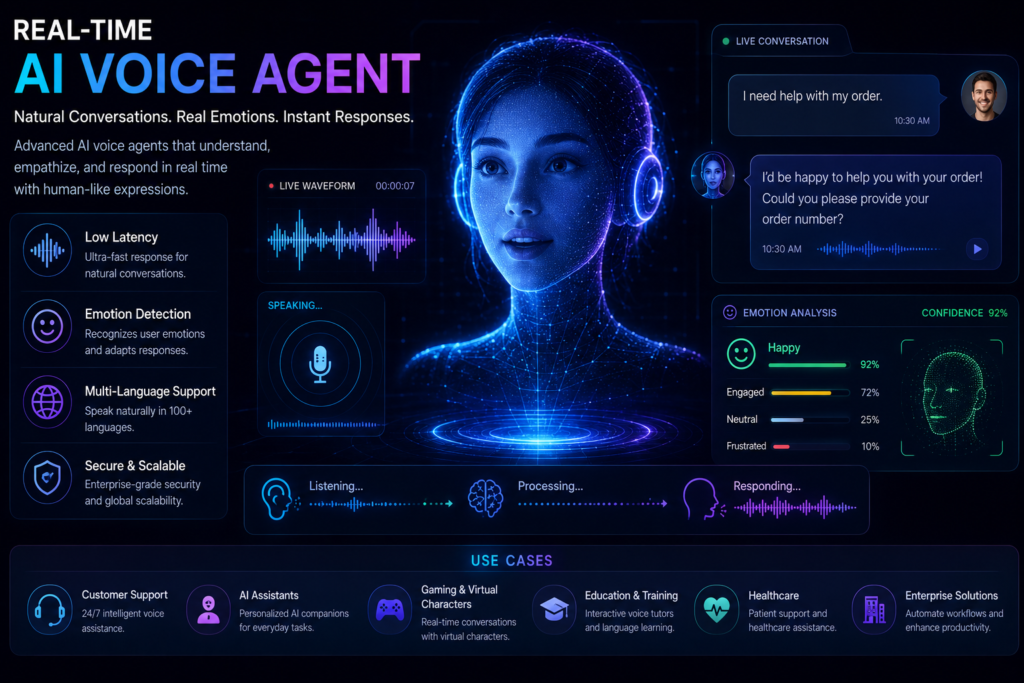
Hume AI differs from Murf AI and Descript by focusing on conversational AI rather than pre-recorded narration. The platform’s research team has published studies on emotional expression in speech, which positions Hume AI as a research-driven alternative to consumer-focused tools.
Developers integrate Hume AI’s EVI through an API, with usage-based pricing rather than flat monthly subscriptions. Companies building customer support bots or mental health applications use Hume AI to add emotional awareness to voice interactions, which standard TTS models do not provide.
Pros: Real-time emotion detection, conversational AI focus, research-backed models, developer API. Cons: Not designed for static narration projects, usage-based pricing can scale unpredictably.
9. Inworld AI Best for Real-Time AI Voice Agents
Inworld AI works best for developers building real-time AI voice agents for games, customer support, and interactive applications. The platform delivers low-latency text-to-speech through WebSocket streaming, with response times reported in the low hundreds of milliseconds.
Inworld AI provides SDKs for Unity and Unreal Engine, which lets game studios add AI-voiced non-player characters that respond to player input in real time. The platform’s voice agents also support interruption handling, which allows a user to interrupt the AI mid-sentence and receive an immediate, context-aware response.
Inworld AI is also tracked on Speech Arena ELO rankings, a benchmark site that compares voice AI models on naturalness and latency. Compared with Hume AI, Inworld AI prioritizes game-engine integration and interruption handling, while Hume AI prioritizes emotional tone detection in conversational agents.
Pros: Low-latency streaming, game engine SDKs, interruption handling, benchmark tracking. Cons: Less suited for pre-recorded narration, requires developer integration.
10. Amazon Polly & Microsoft Azure AI Speech Best Enterprise Cloud APIs
Amazon Polly and Microsoft Azure AI Speech work best for enterprises that need pay-as-you-go text-to-speech APIs with compliance certifications. Amazon Polly, AWS’s text-to-speech service, charges $4 per 1 million characters for standard voices and $16 per 1 million characters for neural voices, with 5 million free characters per month for the first 12 months.
Microsoft Azure AI Speech, Microsoft’s enterprise voice platform, offers Custom Neural Voice training. The platform also holds HIPAA, GDPR, and SOC 2 Type II compliance certifications, which matter for healthcare and financial services applications. Both platforms integrate directly with existing cloud services, such as AWS Lambda for Amazon Polly and Azure Bot Service for Azure AI Speech, which simplifies deployment for development teams already using these ecosystems.
Compared with Hume AI and Inworld AI, Amazon Polly and Azure AI Speech prioritize compliance and predictable pricing over conversational, agent-style voice interaction.
Pros: Pay-as-you-go pricing, HIPAA/GDPR/SOC2 compliance, deep cloud integration, SSML support. Cons: Voice realism trails ElevenLabs, requires technical setup for non-developers.
Other AI Voice Generators Worth Knowing
Several additional AI voice generators serve narrower use cases that fall outside the top 10 picks above, including open-source models, dubbing-focused tools, and free TTS options.
Kokoro is an open-source AI voice generator released under the Apache 2.0 license, which allows developers to run the model locally without subscription fees or usage limits. Teams building privacy-sensitive applications, such as healthcare voice assistants, often choose Kokoro to avoid sending audio data to third-party servers.
Respeecher’s voice cloning technology recreates an actor’s voice for dubbed content when the original actor is unavailable, which is its primary application in film, television, and game production.
Altered focuses on real-time voice morphing, which transforms a speaker’s voice during a live conversation rather than processing pre-recorded audio. Streamers and content creators use Altered to anonymize their voice while maintaining natural pacing and emotion.
DupDub combines AI voice generation with AI dubbing and video translation, which allows creators to localize a video’s narration into multiple languages from a single source file.
TTSMaker offers a free, no-signup AI voice generator for short text-to-speech conversions, which suits users who need a quick audio file without creating an account.
These 5 tools do not replace the top 10 picks for most use cases, but each addresses a specific gap, such as open-source deployment, film dubbing, real-time voice changing, video localization, or no-cost access.
Best AI Voice Generator by Use Case
Best for YouTube & Short-Form Video (TikTok/Reels)
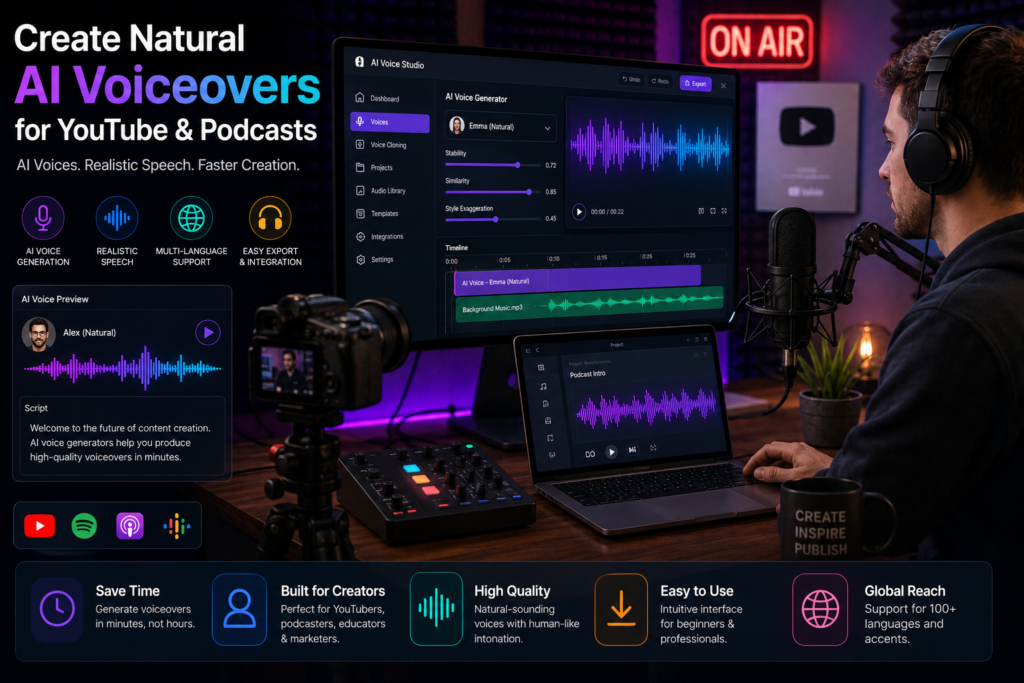
Murf AI and ElevenLabs work best for YouTube and short-form video narration, due to their royalty-free commercial licenses for monetized content. Creators use these tools to generate voiceovers for explainer videos, TikTok clips, and Instagram Reels without hiring voice actors.
Video creators who pair AI voiceovers with AI avatars often add a virtual presenter to on-screen content. Readers building full video pipelines can compare avatar tools at HeyGen vs Synthesia or review broader options in this guide to the Best AI Video Generators.
Best for Podcasts
Play.ht and Descript work best for podcast production, since both tools generate full-episode narration and integrate directly into editing workflows. Play.ht’s API automates intro and outro generation across multiple episodes, while Descript’s Overdub feature fixes mid-episode mistakes without re-recording.
Podcasters publishing in 2 or more languages also use Play.ht’s 100+ language library to create localized versions of the same episode, which extends a single show’s reach into new regional audiences.
Best for Audiobooks
Speechify and WellSaid Labs work best for audiobook narration, due to their focus on long-form reading consistency. Speechify’s reading-speed controls suit listeners who prefer faster narration, while WellSaid Labs’ studio-quality voices suit publishers producing professional-grade audiobooks.
Narration consistency across multiple hours matters most for audiobooks, since listeners notice tone shifts between chapters more than in short-form content such as social media clips.
Best for Enterprise & Developers
Amazon Polly, Microsoft Azure AI Speech, and Inworld AI work best for enterprise and developer use cases. Amazon Polly and Azure AI Speech suit applications that need compliance certifications and predictable pay-as-you-go pricing, while Inworld AI suits applications that need real-time, low-latency voice agents for interactive use cases.
Development teams building customer support bots, IVR systems, or AI-voiced game characters typically start with these 3 platforms rather than consumer-focused tools, due to their SDK support and compliance documentation.
Best Free AI Voice Generator
Play.ht and Speechify offer the most usable free AI voice generator plans, though both add limitations. Play.ht’s free plan includes a watermark on generated audio, while Speechify’s free plan limits daily listening time.
Developers who need a fully free, open-source option often choose Kokoro, an open-source text-to-speech model released under the Apache 2.0 license, which runs locally without subscription costs or character limits.
AI Voice Generator Pricing Comparison
AI voice generator pricing in 2026 ranges from $0 for limited free plans to $300 or more per month for enterprise tiers. The table below compares starting prices, free-tier limits, and whether each platform adds a watermark to free-tier audio.
| Tool | Free Tier | Starting Paid Price | Watermark on Free Tier |
| ElevenLabs | 10,000 characters/month | $5/month | Yes |
| Murf AI | Limited exports | $19/month | No |
| Speechify | Limited daily listening | $11.58/month | No |
| WellSaid Labs | None | Custom | N/A |
| Play.ht | Limited characters | $31.20/month | Yes |
| Lovo AI | Limited characters | $24/month | Yes |
| Descript | 1 hour/month transcription | $12/month | Yes |
| Hume AI | API credits | Usage-based | N/A |
| Inworld AI | API credits | Usage-based | N/A |
| Amazon Polly | 5M characters/month (12 months) | Pay-as-you-go | No |
| Azure AI Speech | 500K characters/month | Pay-as-you-go | No |
Pricing for API-based platforms such as Hume AI, Inworld AI, Amazon Polly, and Azure AI Speech scales with usage volume rather than a flat subscription, which benefits applications with variable traffic. Subscription-based platforms such as ElevenLabs, Murf AI, and Play.ht charge fixed monthly fees regardless of usage, which benefits creators with predictable content schedules.
A 10-minute YouTube video script averages roughly 1,500 words, or 9,000 characters. Generating that script costs under $1 on Amazon Polly’s neural tier, compared with a Starter-tier ElevenLabs subscription that covers roughly 1 similar video per month within its 10,000-character limit.
How Does AI Voice Cloning Work?
AI voice cloning works by training a neural network on a sample of a person’s recorded speech, then using that model to generate new speech in the same voice. The process follows 4 main steps.
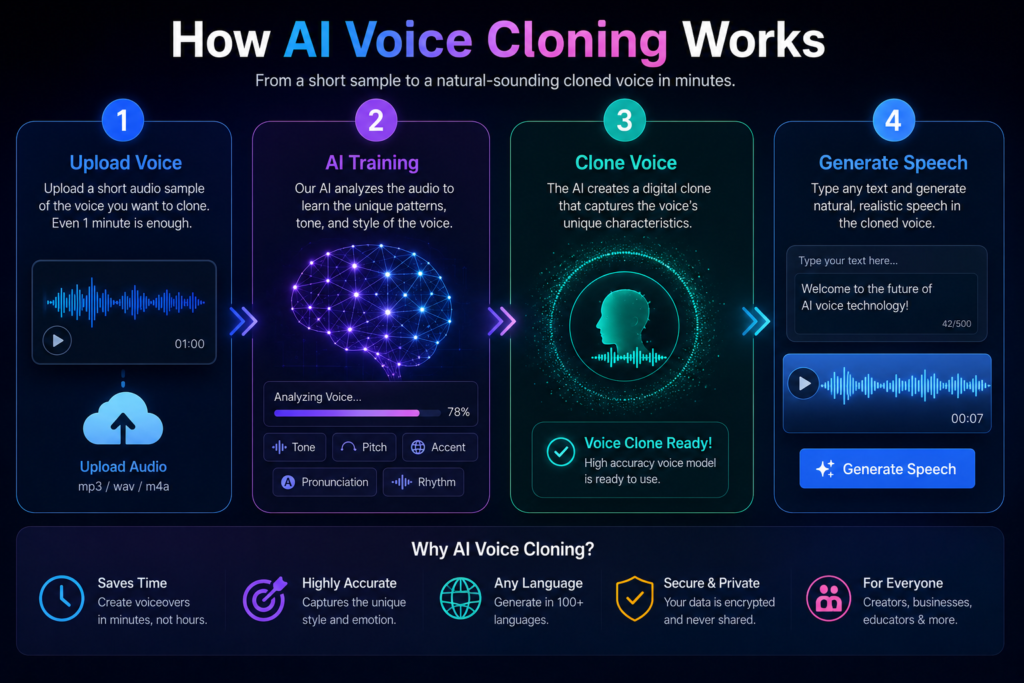
First, the platform collects an audio sample, which ranges from 1 minute for tools like ElevenLabs to 30 minutes or more for higher-fidelity enterprise cloning. Second, the neural network analyzes the sample to extract vocal characteristics, including pitch, tone, accent, and speaking pace. Third, the model generates a voice profile that represents these characteristics in a format the platform can apply to new text. Fourth, the platform synthesizes new speech by applying the voice profile to any input text, producing audio that matches the original speaker’s vocal characteristics.
Celebrity voice cloning, brand voice cloning, and personal voice cloning all follow this same 4-step process, though enterprise platforms such as WellSaid Labs and Respeecher apply additional quality control steps before releasing a cloned voice for commercial use. The accuracy of a cloned voice depends on 3 factors: audio sample quality, sample length, and the complexity of the source speaker’s vocal patterns, such as accents or rapid pitch changes.
Is AI Voice Cloning Legal?
AI voice cloning is legal in most jurisdictions when the person being cloned provides consent, but laws vary by region and use case. The United States regulates voice cloning primarily through right-of-publicity laws, which give individuals control over commercial use of their voice and likeness.
Some states have also passed legislation that addresses AI voice cloning directly. Tennessee’s ELVIS Act, enacted in 2024, makes it illegal to use AI to replicate a person’s voice without consent for commercial purposes, and similar protections are under consideration in other states.
The European Union’s AI Act requires disclosure when audio content is AI-generated or manipulated, which applies directly to AI dubbing and voice cloning used in media. Platforms such as ElevenLabs and Descript require users to confirm they have consent to clone a voice, though enforcement varies by platform and region.
Commercial use of AI-generated voices is also legal in most cases, provided the platform’s licensing terms permit commercial output. Free-tier plans from Play.ht and Lovo AI restrict commercial use, while paid plans from ElevenLabs, Murf AI, and Descript include commercial licensing by default.
Businesses planning to clone employee or customer voices for products such as voice assistants need written consent agreements separate from the AI platform’s own terms of service. These agreements help businesses comply with right-of-publicity laws and data privacy regulations such as GDPR. Deepfake disclosure requirements are also expanding, with several platforms now adding audio watermarking to help distinguish AI-generated speech from human recordings.
Frequently Asked Questions
What is the most realistic AI voice generator?
ElevenLabs is the most realistic AI voice generator in 2026, based on its voice cloning accuracy and emotional inflection across 30+ languages. Independent benchmarks frequently rank ElevenLabs above Murf AI and Play.ht for natural-sounding output, particularly for emotional narration.
Is AI voice cloning legal?
AI voice cloning is legal with the consent of the person being cloned, under right-of-publicity laws and state-level statutes such as Tennessee’s ELVIS Act in the United States, and AI disclosure requirements in the European Union. Cloning a voice without consent for commercial use creates legal risk in most regions.
Which AI voice generator is best for YouTube?
Murf AI and ElevenLabs are the best AI voice generators for YouTube, due to their royalty-free commercial licenses and natural-sounding narration suited to explainer videos, tutorials, and short-form content.
Can AI voices be monetized on YouTube?
AI voices can be monetized on YouTube when the AI voice generator’s license permits commercial use. ElevenLabs, Murf AI, and Lovo AI’s paid plans all include commercial licensing for monetized video content.
Which AI voice generator has an API for developers?
ElevenLabs, Amazon Polly, Microsoft Azure AI Speech, Hume AI, and Inworld AI all provide developer APIs. Amazon Polly and Azure AI Speech use pay-as-you-go pricing, while Hume AI and Inworld AI focus on real-time conversational voice agents.
What is SSML in text-to-speech?
SSML, or Speech Synthesis Markup Language, is a coding format that controls pronunciation, pitch, pauses, and emphasis in text-to-speech output. Amazon Polly and Azure AI Speech both support SSML for fine-tuned voice control in enterprise applications.
Which AI voice generator supports the most languages?
Play.ht and Lovo AI support the most languages among the tools compared here, with Play.ht offering 100+ languages and accents and Lovo AI’s Genny tool generating speech in 100+ languages with emotion tags.
What is the best free AI voice generator?
Play.ht and Speechify offer the most usable free AI voice generator plans, though Play.ht adds a watermark to free-tier audio and Speechify limits daily listening time. Kokoro provides a free, open-source alternative with no usage limits.
What is realtime TTS, and which tool has the lowest latency?
Realtime TTS generates speech with minimal delay, which matters most for AI voice agents and live applications. Inworld AI delivers the lowest latency among the platforms compared here, due to its WebSocket-based streaming architecture designed for real-time response.
Can AI voice generators replace human voice actors?
AI voice generators replace human voice actors for high-volume, low-budget content such as explainer videos and internal training materials. Human voice actors remain preferred for projects requiring nuanced emotional performance, such as film, animation, and premium advertising, and many production teams combine both by using AI for high-volume content and human actors for flagship projects.
Which AI voice generator has no watermark on the free plan?
Murf AI, Speechify, and Descript do not add watermarks to free-tier audio, while ElevenLabs, Play.ht, and Lovo AI add watermarks to free-tier output unless users upgrade to a paid plan.
Is ElevenLabs worth the price?
ElevenLabs is worth the price for users who need the most realistic voice cloning and multilingual output, based on its accuracy advantage over Murf AI and Play.ht. Users with basic narration needs may find lower-cost alternatives sufficient for their projects.
Final Verdict: Choose the Right AI Voice Generator for You
The best AI voice generator depends on the specific task, since each of the 10 tools in this comparison specializes in a different use case rather than competing on a single feature. Each recommendation below pairs a specific use case with the platform that performed best for that use case during testing, rather than ranking every tool against 1 universal standard.
Choose ElevenLabs if voice realism and multilingual cloning matter most. Choose Murf AI if the project needs business presentations or e-learning videos with an integrated editor. Choose Speechify if the goal is reading documents and articles aloud for accessibility. Choose WellSaid Labs if the organization needs enterprise-grade branded voices with custom licensing. Choose Play.ht if the project involves podcast or article narration at scale. Choose Lovo AI if the content requires multilingual voiceovers with emotion tagging. Choose Descript if voice cloning needs to live inside a podcast or video editing timeline. Choose Hume AI if the application requires real-time emotional intelligence in voice agents. Choose Inworld AI if the project needs low-latency, real-time AI voice agents for games or interactive apps. Choose Amazon Polly or Azure AI Speech if the organization needs pay-as-you-go APIs with compliance certifications.
For a side-by-side comparison of the 2 most-discussed platforms in this guide, see ElevenLabs vs Murf AI and ElevenLabs vs Play.ht. For more software comparisons across the AI landscape, visit the AI Comparison homepage.