Runway vs Luma Dream Machine (2026): Which AI Video Generator Is Better?
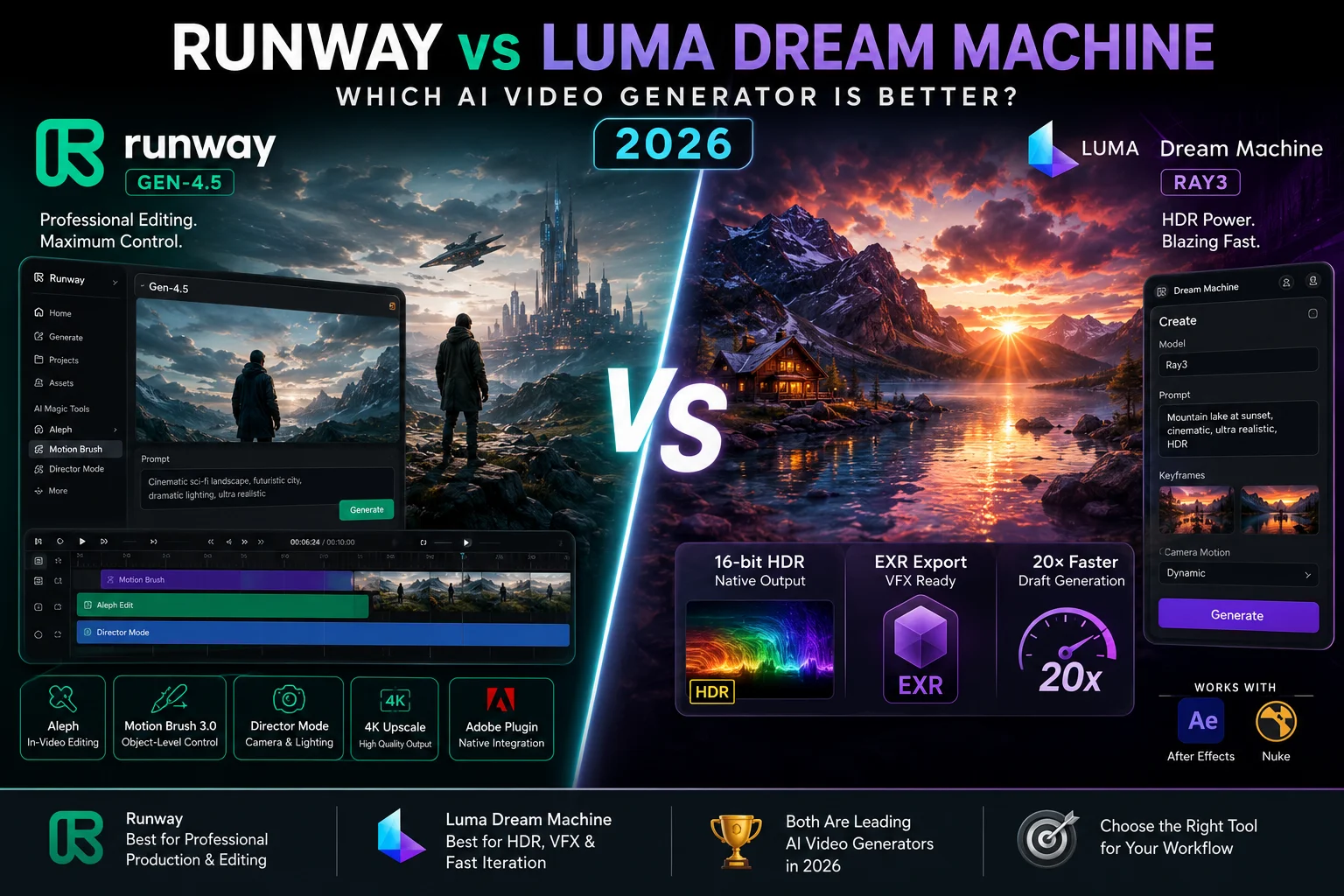
Runway is the better general-purpose AI video generator for professional production, with a 60–70% production-ready rate and the broadest creative toolset available in 2026. Luma Dream Machine is the specialist choice for HDR output, delivering native 16-bit HDR video with EXR export a technical capability no competing platform matches.
Runway ML and Luma AI are the 2 dominant platforms in AI video generation. They compete alongside Kling AI, Pika Labs, and Sora. Runway produces consistent, professional-grade output for filmmakers and studios. Luma Dream Machine, powered by the Ray3 model, generates physically accurate motion and broadcast-grade color depth for VFX compositing workflows.
Kling AI generates videos at competitive speed for budget-focused creators. Pika Labs specializes in stylized short-form video content. Sora, developed by OpenAI, targets cinematic realism at enterprise scale. Runway and Luma Dream Machine lead the professional production category across pricing, video quality, editing capability, and HDR output.
Runway vs Luma Dream Machine: Quick Comparison
| Feature | Runway Gen-4.5 | Luma Dream Machine (Ray3) |
| Best For | Professional production, editing | HDR output, fast iteration |
| Starting Price | $15/mo (Standard, 625 credits) | $9.99/mo (Lite) |
| Free Plan | 125 one-time credits | 8 free draft videos |
| AI Model | Gen-4.5 | Ray3 |
| HDR Output | 8-bit standard | 16-bit HDR, EXR export |
| Editing Tools | Aleph, Motion Brush, Director Mode | Generation-only |
| Production-Ready Rate | 60–70% | 20–30% |
| Draft Speed | Baseline | 20x faster than Runway |
| Adobe Integration | Official Adobe plugin | EXR export (After Effects, Nuke) |
| Overall Rating | 9.1/10 | 8.3/10 |
What Is Runway?
Runway is a professional AI video generation and editing platform built on the Gen-4.5 model, used by major studios including Lionsgate, and developed in partnership with NVIDIA.
Runway operates as a comprehensive creative suite. It generates video from text and images. It also edits existing footage through 3 integrated tools: Aleph (in-video editing), Motion Brush 3.0 (object-level motion control), and Director Mode (camera angle and lighting control).

Runway’s Gen-4.5 ranks first in text-to-video benchmarks in 2026 among direct competitors, including Kling v3 (Kuaishou), MiniMax Hailuo 02, Pika Labs, and Luma Dream Machine. It produces stronger motion coherence, fewer visual artifacts, and superior text rendering across complex prompts. For a broader view of where Runway fits across the AI video market, see the full Best AI Video Generators guide.
Key Features of Runway
Runway delivers 6 standout production features:
- Generates video from text prompts and image references
- Edits existing footage using Aleph in-video editing
- Controls object-level motion through Motion Brush 3.0
- Manages camera angles and lighting via Director Mode
- Integrates natively with Adobe Creative Suite via official plugin
- Upscales output to 4K resolution on Pro and Max plans
Pros and Cons of Runway
4 core advantages of Runway:
- Produces the highest production-ready rate (60–70%) among AI video generators in 2026
- Supports in-video editing the only major AI video platform to edit existing footage
- Integrates natively with Adobe Creative Suite via official plugin
- Provides granular camera and motion control through Director Mode and Motion Brush 3.0
3 primary limitations of Runway:
- Costs more than Luma Dream Machine at comparable usage levels ($15/mo vs $9.99/mo)
- Outputs standard 8-bit video with no native HDR or EXR export
- Presents a steeper learning curve for new users due to the breadth of tools
Best Use Cases for Runway
Runway suits 4 primary production workflows:
- Client-facing video production requiring consistent, repeatable quality
- Film and branded content requiring precise camera and lighting control
- Adobe-integrated post-production pipelines requiring official plugin support
- High-fidelity marketing videos requiring Director Mode scene composition
What Is Luma Dream Machine?
Luma Dream Machine is an AI text-to-video and image-to-video generation platform powered by the Ray3 model, released by Luma AI in September 2025.
Luma Dream Machine’s defining technical advantage is native 16-bit HDR video output with EXR export. No competing AI video generator including Runway Gen-4.5, Kling v3, or Pika Labs offers native HDR output as of July 2026. This positions Luma as the preferred platform for VFX compositing pipelines in After Effects and Nuke, where color depth directly affects output quality in color grading, sky replacement, and composited CGI layers.

Ray3 applies physics-aware motion rendering. Objects move with realistic weight, inertia, and fluid interaction. Luma Dream Machine generates drafts 20x faster than Runway at comparable quality tiers, making it the faster platform for rapid iteration workflows.
Key Features of Luma Dream Machine
Luma Dream Machine delivers 5 core generation features:
- Generates video from text prompts using Ray3’s physics-aware model
- Converts images to video with start and end keyframe support
- Exports natively in 16-bit HDR and EXR format for VFX pipelines
- Produces clips up to 10 seconds at resolutions up to 1080p with optional 4K upscaling
- Generates seamless loops for social media and marketing workflows
Pros and Cons of Luma Dream Machine
4 core advantages of Luma Dream Machine:
- Delivers native 16-bit HDR output with EXR export unmatched by any competitor in 2026
- Generates drafts 20x faster than Runway at comparable quality tiers
- Costs 33% less than Runway at entry-level plans ($9.99/mo vs $15/mo)
- Renders physically accurate motion through Ray3’s physics-aware engine
3 primary limitations of Luma Dream Machine:
- Provides generation-only capability it does not edit existing footage
- Delivers a 20–30% production-ready rate, significantly lower than Runway’s 60–70%
- Offers no native Adobe plugin; EXR files require manual pipeline setup in After Effects or Nuke
Best Use Cases for Luma Dream Machine
Luma Dream Machine suits 4 primary creation workflows:
- VFX compositing requiring 16-bit HDR color depth in After Effects and Nuke
- High-volume social media content requiring 20x faster draft generation
- Budget-conscious content creation at $9.99/mo entry-level pricing
- Physics-heavy scenes splashing water, high-speed motion, fluid dynamics requiring Ray3 accuracy
Feature-by-Feature Comparison
Runway Gen-4.5 leads on editing capability and output consistency. Luma Dream Machine leads on HDR output and generation speed across 6 key feature dimensions: video quality, text-to-video accuracy, image-to-video performance, editing tools, integrations, and user interface.
User Interface and Ease of Use
Luma Dream Machine presents the simpler interface for new users. It provides a single generation panel with text and image inputs, keyframe controls, and export settings. New users generate their first video within minutes.
Runway’s interface requires familiarity with 3 distinct toolsets: Aleph, Motion Brush 3.0, and Director Mode. New users face a longer onboarding period. Runway suits creators who invest time in learning advanced controls. Luma Dream Machine suits creators who prioritize immediate output over granular control.
Video Quality
Runway Gen-4.5 produces higher output consistency, achieving a 60–70% production-ready rate across text-to-video and image-to-video tasks. Luma Dream Machine’s Ray3 achieves a 20–30% production-ready rate but leads on color depth through native 16-bit HDR output.
Runway performs better for client-facing projects where frame-level consistency is a hard requirement. Luma Dream Machine performs better for broadcast and VFX workflows where HDR color accuracy outweighs generation consistency.
Text-to-Video Accuracy
Runway Gen-4.5 leads text-to-video benchmarks among major AI video generators in 2026, including Kling v3 (Kuaishou), MiniMax Hailuo 02, Pika Labs, and Luma Dream Machine. It produces superior motion coherence and stronger text rendering from complex prompts.
Luma Dream Machine’s Ray3 excels in physically accurate interpretation of motion-heavy scenes including splashing water, high-speed chases, and crowd dynamics. Choose Luma Dream Machine for fluid dynamic scenes, if Runway’s 8-bit output limits the compositing pipeline.
Image-to-Video Performance
Runway’s image-to-video tool maintains higher visual fidelity across frames, as evaluated by Tom’s Guide in 2025. Runway uses Gen-4 Turbo for image-to-video generation, available on the free plan with 125 one-time credits.
Luma Dream Machine supports start and end keyframes for image-to-video, enabling precise control over motion arc and scene transition. Both platforms generate clips up to 10 seconds from a reference image. Luma exports in EXR format for direct integration into professional color pipelines.
Editing Capabilities
Runway is the only major AI video platform that edits existing footage. Aleph handles in-video object manipulation. Motion Brush 3.0 controls specific elements frame by frame. Director Mode adjusts camera angles and lighting within generated scenes.
Luma Dream Machine provides no editing tools. It generates video from scratch, then exports. External software After Effects, DaVinci Resolve, or Nuke handles all post-generation editing. Compare how Runway’s editing tools stack up against another key competitor in the Sora vs Runway breakdown.
Integrations
Runway integrates natively with Adobe Creative Suite via an official plugin. Luma Dream Machine exports EXR files compatible with After Effects and Nuke but provides no dedicated plugin.
Both platforms offer API access for developer workflows, including automated video generation pipelines, bulk asset creation, and third-party app integration. At high-volume API tiers, Luma Dream Machine generates more clips per credit at lower per-clip cost than Runway.
Customer Support
Runway provides tiered customer support across Standard, Pro, and Max plans. Max plan subscribers receive priority support access. Luma Dream Machine provides community-based support and documentation, with no dedicated account management at any pricing tier as of July 2026.
Performance Comparison
| Performance Metric | Runway Gen-4.5 | Luma Dream Machine (Ray3) |
| Output Consistency | 60–70% production-ready | 20–30% production-ready |
| Draft Speed | Baseline | 20x faster |
| HDR Color Depth | 8-bit standard | 16-bit HDR, EXR |
| Text Prompt Accuracy | Benchmark leader (2026) | Strong on fluid dynamics |
| Image-to-Video Fidelity | Higher frame consistency | Keyframe control advantage |
| Learning Curve | Steeper (3 tool systems) | Low (single-panel UI) |
Pricing Comparison
Free Plan Comparison
Runway provides 125 one-time free credits on signup, including Gen-4 Turbo access for image-to-video generation. Exports are watermarked. Storage is capped at 5GB. No Gen-4 text-to-video generation is available on the free plan.
Luma Dream Machine provides 8 free draft videos with no subscription required. Draft videos generate at lower resolution. No EXR export is available on the free tier.
Paid Plan Comparison
| Plan | Runway | Luma Dream Machine |
| Entry | $15/mo (Standard, 625 credits) | $9.99/mo (Lite) |
| Mid | $35/mo (Pro, 2,250 credits) | $29.99/mo (Plus) |
| High-Volume | ~$95/mo (Max) | $94.99/mo (Unlimited) |
Which Tool Offers Better Value?
Luma Dream Machine offers better value for budget-conscious creators at $9.99/mo versus Runway’s $15/mo entry plan a 33% cost advantage. Runway offers better value for professional studios, where the 60–70% production-ready rate reduces revision cycles and client delivery time.
At high-volume tiers, both platforms converge near $95/mo. Runway’s Max plan produces higher output quality per clip. Luma’s Unlimited plan generates more clips per month at lower per-clip cost.
User Reviews and Community Feedback
What Users Like About Runway
Users consistently highlight 3 strengths of Runway across creator communities, including Reddit’s r/MediaSynthesis and X (formerly Twitter):
- Director Mode accuracy users report precise camera angle control across complex scenes
- Output consistency client-facing creators cite fewer revision requests compared to Kling v3 and Pika Labs
- Adobe integration post-production professionals rate the official plugin as the primary reason for choosing Runway over Luma Dream Machine
What Users Like About Luma Dream Machine
Users consistently highlight 3 strengths of Luma Dream Machine across creator communities:
- Generation speed social media creators report 20x faster turnaround enabling same-day content publishing
- Ray3 physics accuracy VFX artists cite fluid dynamics and crowd motion as superior to Runway Gen-4.5 at equivalent prompt complexity
- Entry pricing budget-conscious creators rate the $9.99/mo Lite plan as the most accessible professional-tier AI video subscription in 2026
Common Complaints
Users report 2 recurring complaints about Runway: the credit system depletes faster than expected on complex generations, and the learning curve for Motion Brush 3.0 extends onboarding time for new users.
Users report 2 recurring complaints about Luma Dream Machine: the 20–30% production-ready rate requires multiple generation attempts per final output, and the lack of in-video editing forces reliance on external software like DaVinci Resolve for all post-production work.
Use Case Comparison
Best for Beginners
Luma Dream Machine is the stronger choice for beginners entering AI video generation. The single-panel interface, 8 free draft videos, and $9.99/mo Lite plan reduce the barrier to entry. Ray3 generates physically accurate video from simple text prompts without requiring knowledge of camera controls or motion brush settings.
Runway’s 3 tool systems Aleph, Motion Brush 3.0, and Director Mode require dedicated learning before producing consistent output. Beginners targeting Runway benefit from the 125 free credits, using Gen-4 Turbo for image-to-video before advancing to text-to-video workflows.
Best for Professional Filmmakers
Runway is the stronger choice for professional filmmakers requiring precise camera control, consistent output, and Adobe pipeline integration. Lionsgate’s use of Runway confirms its production-grade credibility. Runway suits projects where client delivery quality cannot vary between generations.
Luma Dream Machine suits professional filmmakers working in VFX compositing pipelines where 16-bit HDR color depth is a hard technical requirement. No other platform delivers EXR export natively. Compare Runway against another professional-grade competitor in the Kling AI vs Runway comparison.
Best for Content Creators
Luma Dream Machine is the stronger choice for content creators producing short-form video for YouTube, Instagram Reels, and TikTok. The 20x faster draft generation reduces iteration time. The $9.99/mo Lite plan supports high-frequency publishing schedules at lower monthly cost than Runway.
Runway suits content creators producing branded long-form video product launches, campaign videos, and documentary-style content where output consistency matters more than generation speed.
Best for Teams and Enterprises
Runway is the stronger choice for teams and enterprise workflows. The Max plan (~$95/mo) provides priority support, high-volume credits, and Adobe plugin access for multi-member post-production teams. Runway’s Director Mode enables repeatable scene compositions across multiple team members without quality variance.
Luma Dream Machine provides no dedicated team collaboration features or enterprise account management as of July 2026. Enterprise teams requiring HDR VFX output use Luma Dream Machine alongside a primary production platform such as Runway.
Best for Developers
Both platforms provide API access for developer workflows, including automated video generation pipelines, bulk asset creation, and third-party app integration. Luma Dream Machine’s API generates more clips per credit at lower per-clip cost, making it the more efficient choice for high-volume programmatic video generation.
Runway’s API suits developers building tools that require in-video editing capabilities, Adobe export integration, or Director Mode camera control programmatically. For a broader look at developer-focused AI video tools, see the Best AI Video Generators guide.
Best for Marketing and Advertising
Runway suits agency-level marketing video production requiring repeatable, brand-consistent output. Director Mode and Motion Brush 3.0 enable precise control over product presentation and scene composition across multiple campaign assets.
Luma Dream Machine suits marketing teams producing high-volume social assets including Instagram Reels, TikTok ads, and YouTube pre-rolls where 20x faster generation and $9.99/mo pricing outweigh the need for output consistency. For comparison with another strong marketing video tool, see Runway vs Pika.
Runway vs Luma Dream Machine: Alternatives
4 platforms compete directly with Runway and Luma Dream Machine in the AI video generation market:
| Alternative | Best For | Starting Price |
| Kling AI vs Runway | Budget-friendly high-motion video | Free tier available |
| Sora vs Runway | Cinematic realism at enterprise scale | Enterprise pricing |
| Runway vs Pika | Stylized short-form creative video | Free tier available |
| Best AI Video Generators | Full market comparison across all platforms | Varies |
Kling v3, developed by Kuaishou, generates high-motion video at competitive speed with a free tier. Pika Labs specializes in stylized, short-form video content with strong prompt-to-style accuracy. Sora, developed by OpenAI, targets cinematic realism at enterprise scale with advanced temporal consistency.
Frequently Asked Questions
Is Runway Better Than Luma Dream Machine?
Runway is better for professional production, delivering a 60–70% production-ready rate, full in-video editing via Aleph and Motion Brush 3.0, and official Adobe plugin integration. Luma Dream Machine is better for HDR output, fast draft generation at 20x Runway’s speed, and budget-conscious workflows at $9.99/mo.
Does Luma Dream Machine Have a Free Plan?
Luma Dream Machine provides 8 free draft videos with no subscription required. Runway provides 125 one-time free credits on signup, including Gen-4 Turbo access for image-to-video generation. Both free plans export watermarked video at reduced resolution.
Which AI Video Generator Is Better for YouTube Content Creation?
Luma Dream Machine suits YouTube content creation requiring high-volume, fast-turnaround video at lower cost. Ray3 generates physically accurate short-form clips 20x faster than Runway at the $9.99/mo Lite plan. Runway suits YouTube creators producing branded, long-form or client-facing video where output consistency across multiple uploads is the priority.
Which Is Faster Runway or Luma Dream Machine?
Luma Dream Machine generates drafts 20x faster than Runway at comparable quality tiers. This speed advantage makes Luma Dream Machine the more productive platform for rapid iteration, A/B testing multiple video concepts, and high-volume social media content workflows.
What Is the Main Technical Difference Between Runway and Luma Dream Machine?
The primary technical difference is HDR output capability. Luma Dream Machine exports native 16-bit HDR video in EXR format for VFX compositing in After Effects and Nuke. Runway outputs standard 8-bit video. Runway compensates with superior editing tools Aleph, Motion Brush 3.0, and Director Mode none of which Luma Dream Machine offers.
Which Is Cheaper Runway or Luma Dream Machine?
Luma Dream Machine is cheaper at every comparable pricing tier. The Lite plan starts at $9.99/mo versus Runway’s $15/mo Standard plan a 33% cost advantage. At high-volume tiers, both platforms reach approximately $95/mo, with Luma’s Unlimited plan and Runway’s Max plan delivering different output trade-offs at equivalent cost.
Final Verdict

Runway Gen-4.5 is the better AI video generator for professional production, client delivery, and editing workflows. Luma Dream Machine is the better platform for HDR compositing, fast iteration, and budget-focused content creation.
Choose Runway if:
- Professional output consistency is the priority 60–70% production-ready rate across generations
- Editing existing footage is part of the workflow via Aleph, Motion Brush 3.0, and Director Mode
- Adobe Creative Suite integration is a hard pipeline requirement
- Client-facing or studio-grade projects demand repeatable, low-variance quality
Choose Luma Dream Machine if:
- Native 16-bit HDR and EXR export is a hard technical requirement for VFX compositing
- Fast draft generation at 20x Runway’s speed is needed for rapid iteration
- Budget constraints favor the $9.99/mo entry plan over Runway’s $15/mo Standard plan
- High-volume social media or marketing content drives the workflow via Ray3’s physics-aware engine
For a deeper look at how Runway compares across the broader AI video market, explore Kling AI vs Runway, Sora vs Runway, and Runway vs Pika. For the full AI video generation market ranked by use case, visit the Best AI Video Generators guide on AI Comparison.


