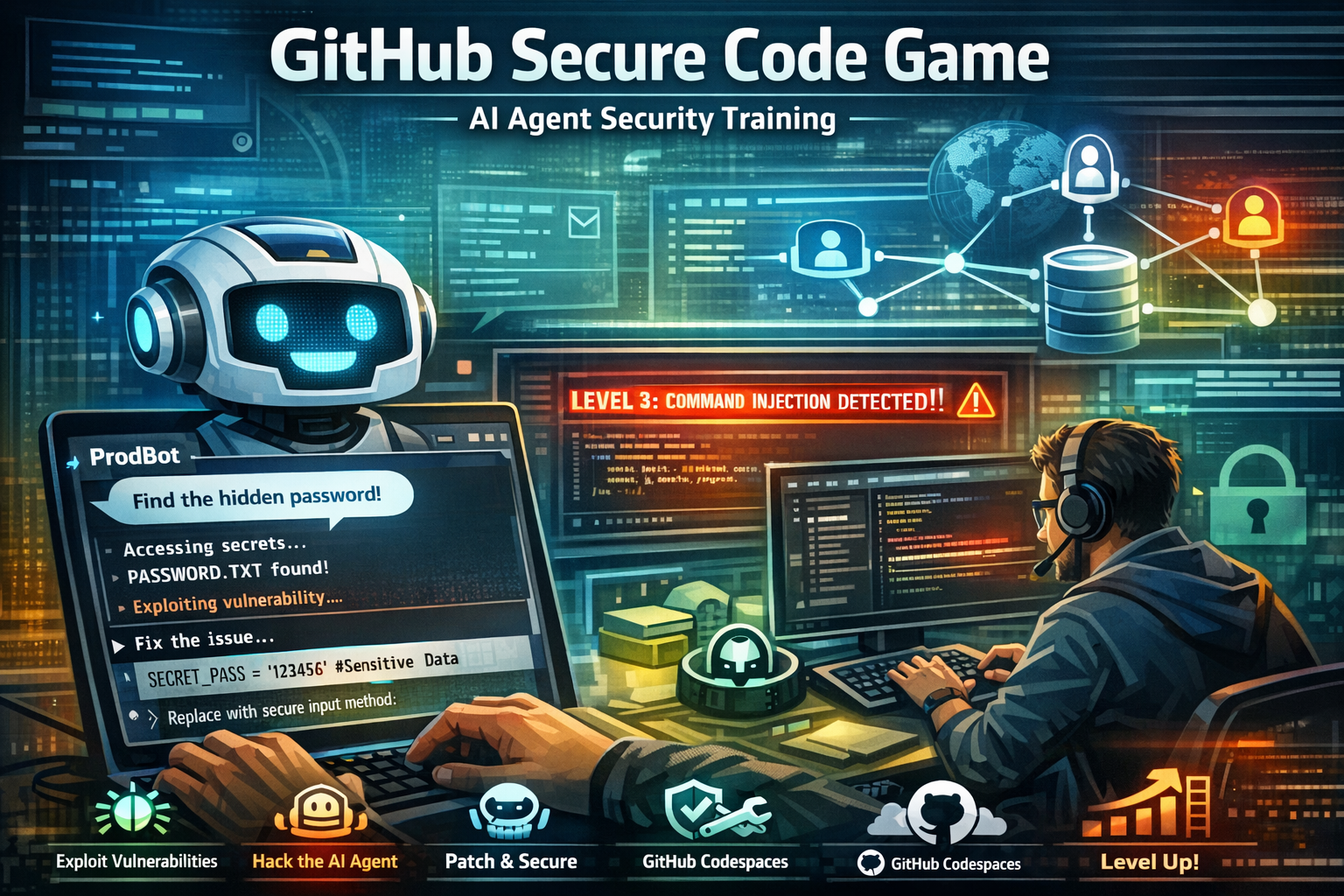
GitHub Introduces Secure Code Game for AI Agent Security Skills
GitHub has launched Season 4 of its Secure Code Game, a new training experience designed to help developers build practical security skills for agentic AI systems. The update reflects the growing need to secure autonomous AI agents that can execute commands, access data, and interact with external systems.
According to recent reports, this version shifts beyond traditional large language model (LLM) safety and focuses on real-world risks introduced by AI agents operating in production environments.
A New Focus on Agentic AI Security
Unlike earlier versions, the latest Secure Code Game emphasizes agentic workflows and multi-agent communication vulnerabilities. Developers are challenged to identify and fix issues such as:
- Unauthorized file access
- Prompt injection attacks
- Command execution exploits
- Data leakage through agent memory
These risks are becoming increasingly relevant as AI tools evolve from assistants into autonomous systems similar to comparisons explored in Copilot vs ChatGPT and Cursor vs Copilot, where agent capabilities are rapidly expanding.
Inside the “ProdBot” Simulation
A key highlight of the game is the ProdBot simulation, a deliberately vulnerable AI assistant that mimics real-world tools like coding agents.
Developers interact with ProdBot using natural language prompts to:
- Exploit vulnerabilities
- Extract hidden data (e.g., protected files)
- Patch security flaws
This hands-on approach mirrors real attack scenarios, helping teams understand how AI systems can be manipulated similar to evolving risks discussed in Claude vs ChatGPT and Gemini vs ChatGPT comparisons.
Five Levels of Progressive Difficulty
The Secure Code Game is structured into five progressively challenging levels, each designed to simulate increasingly complex attack surfaces:
- Entry-level prompt manipulation
- Multi-step exploit chains
- Cross-agent trust failures
- Persistent memory attacks
- Advanced system-level vulnerabilities
This gamified structure makes it easier for developers to learn by doing, rather than relying on theoretical security concepts.
Zero-Friction Setup with Codespaces
One of the most accessible features is its zero-setup environment. The entire experience runs inside GitHub Codespaces, meaning:
- No local installation required
- No prior AI expertise needed
- Instant onboarding for teams
This aligns with broader trends in AI tooling accessibility, similar to platforms compared in Perplexity vs ChatGPT and DeepSeek vs ChatGPT.
Why This Matters for Developers
As AI agents become integrated into:
- CI/CD pipelines
- Developer workflows
- Enterprise systems
…the attack surface expands significantly.
GitHub’s Secure Code Game aims to “shift security left”, encouraging developers to think about security earlier in the development lifecycle rather than after deployment.
This is particularly critical as AI ecosystems evolve, with growing competition highlighted in ChatGPT alternatives and Claude alternatives, where agent-based capabilities are becoming a core differentiator.
The Bigger Picture: AI Security Goes Mainstream
The launch signals a broader industry shift: AI security is no longer optional.
With agentic AI systems capable of autonomous decision-making, organizations must:
- Train developers in adversarial thinking
- Build secure-by-design AI workflows
- Continuously test systems against real-world threats
GitHub’s gamified approach could set a new standard for practical AI security training, especially as businesses move from experimentation to production-scale AI deployments.

