Best AI Chatbot in 2026
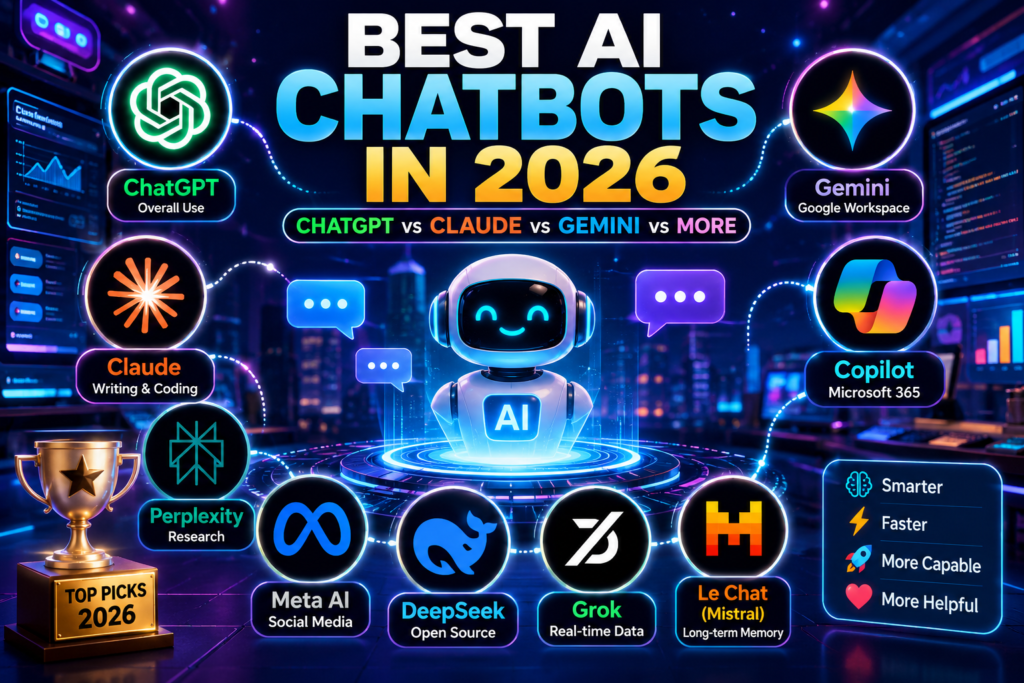
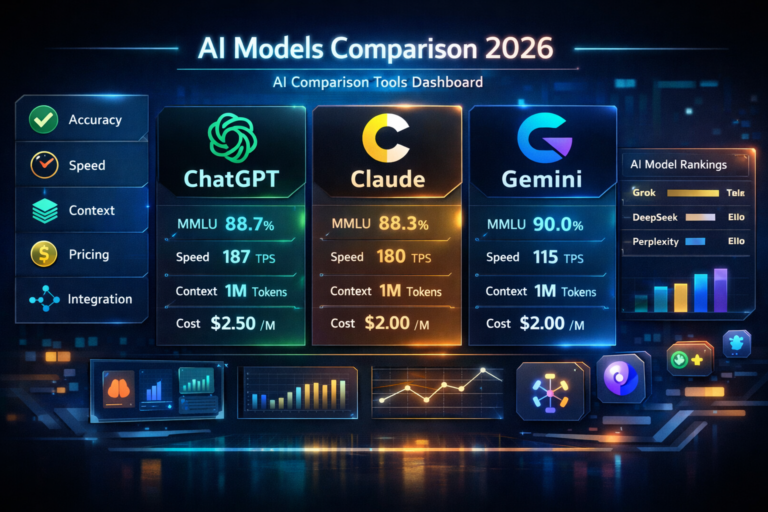
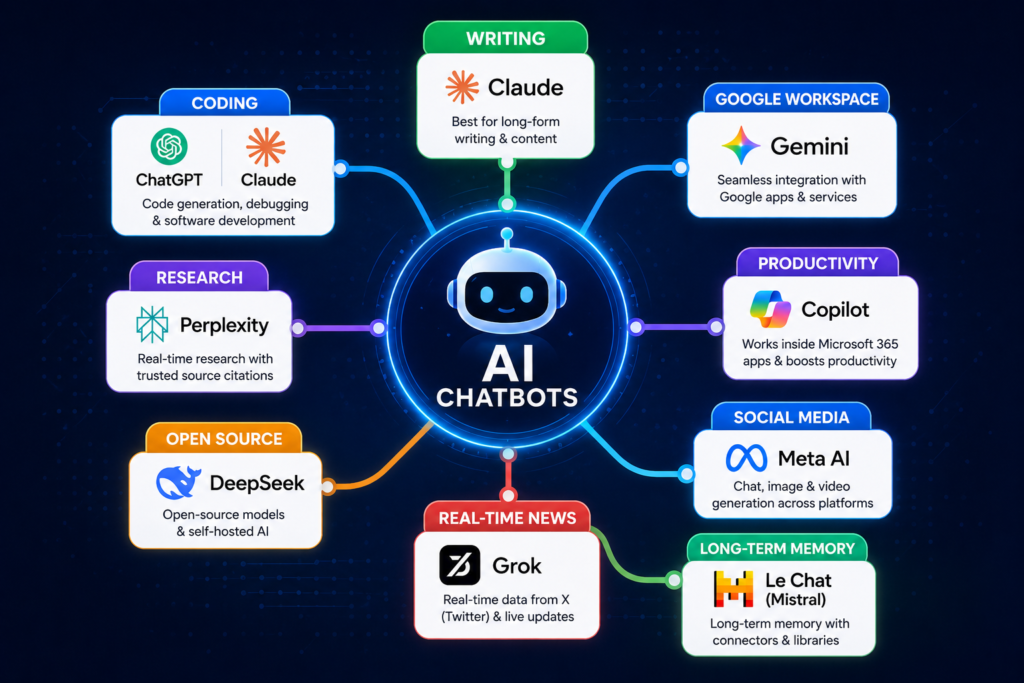
The best AI chatbot in 2026 are ChatGPT from OpenAI, Claude from Anthropic, Google Gemini, Microsoft Copilot, Perplexity, Meta AI, DeepSeek, Grok from xAI, and Mistral’s Le Chat. Each chatbot runs on a different underlying model and excels at a different task, so the right pick depends on the work in front of you rather than brand recognition alone.
ChatGPT remains the most widely used chatbot, with over 900 million weekly active users worldwide. Claude leads on long-form writing and software development, while Gemini and Copilot connect most directly into Google’s and Microsoft’s own products, and Perplexity and DeepSeek take a narrower, research-first or open-source approach instead.
This guide compares all nine chatbots on reasoning ability, available tools, and pricing. It then breaks down which chatbot fits specific roles, including coding, marketing, and customer support, before answering the most common questions people ask about AI chatbots as a category.
Best AI Chatbots at a Glance
The table below compares all nine AI chatbots by primary use case, standout feature, and starting price.
| AI Chatbot | Best For | Standout Feature | Starting Price |
| ChatGPT | Overall use | Deep Research and Agent mode | Free; $8/month |
| Claude | Writing and coding | Claude Code and Artifacts | Free; $17/month |
| Google Gemini | Google integration | Canvas app builder | Free; $7/month |
| Microsoft Copilot | Microsoft integration | Copilot Vision screen sharing | Free; paid 365 add-on |
| Perplexity | Web research | Built-in source citations | Free; $17/month |
| Meta AI | Social media | Unified chat, image, and video generation | Free |
| DeepSeek | Open-source reasoning | Free, self-hostable R1 model | Free |
| Grok | Real-time X data | Grok Imagine | Free; $10/month |
| Le Chat (Mistral) | Long-term memory | Connectors and Libraries | Free; $14.99/month |
Every chatbot on this list includes a free tier, so testing more than one costs nothing but time. The sections below cover what makes each one worth choosing, including direct breakdowns like Claude vs. ChatGPT and Gemini vs. ChatGPT.
What Is an AI Chatbot?
An AI chatbot is a conversational app powered by a large language model that generates original responses instead of selecting from pre-written scripts. ChatGPT, Claude, and Gemini all fit this definition, while older customer-service bots that only matched keywords to fixed replies do not.
Every AI chatbot follows the same basic process. A user’s prompt gets broken into smaller pieces called tokens, the underlying model predicts the next most likely token over and over, and the app streams the result back in a conversational format. Conversation history, hidden system instructions, and any tool results, like a web search, all get added to that same prompt behind the scenes.
Many chatbots on this list actually run on more than one model: a fast model for simple replies, a slower reasoning model for complex tasks, and a separate model for image or video generation. That’s why the same question can produce a noticeably different answer in ChatGPT versus Claude versus Gemini, even when all three are technically “AI chatbots.”
Voice assistants like Siri and Alexa are a related but distinct entity, since they’re built primarily for short commands and device control rather than open-ended conversation. The terms “AI chatbot,” “AI assistant,” and “conversational AI” get used interchangeably across the industry, but they all point to the same underlying category covered in this guide.
The next section covers exactly how this guide separated the strongest chatbots from the rest.
How We Evaluated the Best AI Chatbots
Each AI chatbot in this guide was scored on five criteria: reasoning ability, available tools, conversational memory, ease of use, and pricing.
- Reasoning ability: how accurately the model answers complex, multi-step questions.
- Available tools: whether the chatbot includes web search, Deep Research, image generation, or AI agents.
- Conversational memory: how well the model retains context across a long conversation or context window.
- Ease of use: how quickly a new user can switch models, revisit past chats, or customize the assistant.
- Pricing: what each chatbot includes for free versus what requires a paid plan.
These criteria mirror how OpenAI, Anthropic, and Google document their own models, so the comparisons below rely on each company’s published specs and pricing pages rather than third-party guesswork. Where two chatbots score closely on paper, the entity sections below note the practical difference that actually affects daily use, since a spec sheet rarely tells the whole story on its own.
The Best AI Chatbot Overall
ChatGPT
ChatGPT is the most capable general-purpose AI chatbot for everyday tasks, from drafting emails to debugging code. OpenAI’s chatbot has over 900 million weekly active users, the largest user base of any chatbot on this list.
The current GPT-5 model automatically decides how long to think before answering, switching between instant replies and deeper reasoning without manual toggles. Activate maximum thinking mode for higher-stakes questions, or check GPT-5 vs. GPT-5 Mini to see how the smaller model trades accuracy for speed.
Two tools separate ChatGPT from typical chatbots: Deep Research, which builds a sourced report in up to 20 minutes, and Agent mode, which operates a virtual browser to complete multi-step tasks. Voice input, file uploads, Projects for grouping related chats, and custom GPTs round out the feature set for both casual and professional use, while OpenAI’s separate Sora model extends the same account into AI video generation for users who need it.
ChatGPT’s main limitation is uneven reliability when it cites or sources information from the open web, which is one reason Perplexity exists as a research-first alternative. ChatGPT offers a free plan with limited access, an $8/month Go tier with more memory, and a $20/month Plus tier with full model access. For a head-to-head breakdown against Anthropic’s chatbot, see Claude vs. ChatGPT, or the full three-way matchup in Claude vs. ChatGPT vs. Gemini.
Best AI Chatbot for Writing and Coding
Claude
Claude is the strongest AI chatbot for writing and coding among the nine compared here. Anthropic built Claude around Constitutional AI, a training method that has the model critique and revise its own answers against a set of written principles instead of relying solely on human reviewers.
The Sonnet and Opus models deliver writing with clear structure and direct feedback rather than vague encouragement. Claude Code extends that same strength into software development, reading an existing codebase and adding working features through natural-language instructions rather than line-by-line edits.
Inside the chatbot itself, Claude can generate Artifacts: interactive documents, charts, or small apps that render next to the conversation instead of as plain text. Model Context Protocol connectors let Claude pull data from outside tools, such as a marketing spreadsheet, to build a working dashboard from a single prompt.
Claude’s largest practical drawback is how easily long conversations hit token limits without active context management. Claude includes a free plan, a Pro plan at $17/month, and a Max plan at $100/month for heavier use, with separate Team and Enterprise plans adding administrative controls for larger organizations. Compare it directly against Google’s chatbot in Claude vs. Gemini, or see how its coding tool stacks up in Claude Code vs. Cursor.
Best AI Chatbot for Google Integration
Google Gemini
Google Gemini is the best AI chatbot for working inside Google’s product ecosystem. Once enabled in settings, Gemini can search Gmail, look up Calendar events, and edit Google Docs without leaving the chat window.
Gemini’s Canvas tool goes further than most app builders: it generates a working interface, then calls the Gemini API behind the scenes to power it, without any manual setup on the user’s part. Gemini’s Deep Research tool produces an editable research plan before it starts, then exports the finished report as a webpage, infographic, or audio overview.
Gems, Gemini’s version of custom assistants, let users save instructions for repeated tasks the same way OpenAI’s GPTs do. Gemini also handles image generation natively through its Nano Banana model, giving it a built-in alternative to standalone tools when a task needs both text and visuals in the same conversation. Response quality is the main inconsistency reviewers flag, since Gemini can vary noticeably between a strong answer and a weaker one on similar prompts.
Google’s chatbot is free to use, with paid access through Google AI Pro at $19.99/month or Google AI Plus at $7 per user per month. See how it compares to OpenAI’s chatbot in Gemini vs. ChatGPT, or check the newest model matchup in Gemini 3 vs. GPT-5.1.
Best AI Chatbot for Microsoft Integration
Microsoft Copilot
Microsoft Copilot is the best AI chatbot for working inside Word, Excel, and Outlook. Copilot connects to Microsoft Graph, so it can read a user’s files, emails, and calendar to summarize a thread or draft a deck without any manual uploading.
Copilot Vision adds screen-sharing on top of that: point it at an open application, and it analyzes what’s visible to help troubleshoot an error or draft a reply in context. Copilot Studio extends the same underlying model to IT teams, letting them build custom agents grounded in company data with full governance controls, similar in purpose to a custom GPT but built for enterprise oversight.
Specialized variants are expanding the Copilot name into its own family: Copilot Analyst for multi-step research, and Copilot Groups for up to 32 people collaborating in a shared AI thread. Copilot is also built directly into Windows 11 itself, letting users search system files conversationally instead of digging through folders manually. The tradeoff is that custom GPT-style personalization, once available to regular users, has been retired in favor of these more structured tools.
Microsoft Copilot is free for core chat, web search, and image generation, with deeper Microsoft 365 integration requiring a paid Copilot license. For the Google equivalent of this comparison, see Gemini vs. Copilot, or Copilot vs. ChatGPT for the OpenAI matchup.
Best AI Chatbot for Web Research
Perplexity
Perplexity is the best AI chatbot for fast, sourced research. Unlike general-purpose chatbots, Perplexity is built specifically to scour the web and return an answer with linked citations attached by default, rather than as an optional extra step.
Perplexity offers three search depths: Search for a quick sourced answer, Research for a deeper multi-source report, and Labs for turning that research into a finished document, slide deck, or dashboard. Spaces extends this further into a shared research workspace, combining uploaded files, custom instructions, and collaborators into one searchable hub.
Perplexity runs on a mix of models rather than one of its own, including its Sonar model alongside GPT, Claude, Gemini, and Grok, switching between them based on the task. That breadth makes it better suited to factual research than to creative or open-ended writing, and a separate Discover feed curates trending searches into short, sourced articles for users who want news without a search bar.
Pricing starts free with a generous number of daily sources, with Perplexity Pro at $17/month adding the latest models and deeper sourcing, and Perplexity Max at $167/month for the most advanced reasoning. Compare it against two other chatbots in Perplexity vs. Gemini and Perplexity vs. Claude.
Best AI Chatbot for Social Media
Meta AI
Meta AI is the best AI chatbot for chatting directly inside WhatsApp, Instagram, and Facebook. Meta built it around the Llama model family, with chat, image generation, and short-video generation, which Meta calls Vibes, combined in one interface.
The Vibes feed showcases AI-generated clips that any user can remix from the original text prompt, turning the app into part chatbot and part creative feed. Meta AI can also connect to the web for current information when a user asks for it directly, even though that option isn’t exposed as a visible toggle the way it is in ChatGPT or Gemini.
Llama’s biggest advantage outside the app is that developers can self-host and customize it for free, though that changes once a company passes roughly 700 million monthly active users and needs a paid license. The clearest downside inside the app itself is the lack of an easy way to disable data sharing for model training.
Meta AI is free across its app, website, and integrated social platforms. For a direct comparison against OpenAI’s chatbot, see Meta AI vs. ChatGPT.
Best Open-Source AI Chatbot
DeepSeek
DeepSeek is the best free, open-source AI chatbot for reasoning tasks. Its R1 model gained attention for matching the performance of larger proprietary models while reportedly costing a fraction as much to train, which is part of why it’s still the benchmark open-source reasoning model on this list.
DeepSeek’s interface lets users toggle deep thinking on or off, attach images for analysis, and activate web search for current sources. Because the underlying models are open source, developers can self-host them and build custom AI solutions without paying any licensing fee at all.
Image recognition is a genuine strength: the model can identify objects and parse complex layouts, though it carries a training cutoff around 2025 and occasionally misreads optical illusions. Because the main app is hosted in China, users with data-privacy concerns may prefer the self-hosted version instead of the hosted one.
DeepSeek’s app and core models are free to use. Compare it against three other chatbots in DeepSeek vs. ChatGPT, DeepSeek vs. Claude, and DeepSeek vs. Gemini.
Best AI Chatbot for Real-Time Information
Grok
Grok is the best AI chatbot for real-time access to X (formerly Twitter). Built by xAI, Grok pulls directly from X’s content firehose, so it can answer questions about breaking news or ongoing discussions that chatbots without that access simply can’t see.
Grok Imagine adds image and video generation, including video with sound, directly inside the same interface, with results ranging from polished to clearly experimental depending on the prompt. A Socratic response style and several reasoning modes give users more control over how Grok approaches a given question than most competitors offer.
Grok’s content policies are noticeably looser than its competitors, which has led to documented accuracy issues and privacy concerns after shared conversations turned up in search results. xAI has also launched Grokipedia, an AI-generated encyclopedia that early reviewers flagged for political bias and factual gaps. That tradeoff makes Grok better suited to experimentation than to business-critical use for now.
Grok includes a free plan with limited chat modes, a SuperGrok Lite tier at $10/month, and a SuperGrok tier at $30/month for the Grok 4 model and extended memory. See how it stacks up against two other chatbots in Grok vs. Claude and Grok vs. Gemini.
Best AI Chatbot for Long-Term Memory
Le Chat (Mistral)
Le Chat is the best AI chatbot for managing long-term context across conversations. The French startup Mistral built it around its own Mistral, Codestral, and Pixtral models, with a privacy focus shaped by EU data sovereignty rules.
Three features work together to solve the memory problem: Connectors link external apps like Gmail and Calendar, Libraries act as uploaded knowledge bases the model can search before answering, and Memories let the chatbot recall facts about a user across entirely separate conversations. Mistral also offers deep research and extended thinking modes for more demanding requests, plus a library of pre-built agents for common tasks.
Several of these features are still in beta, so reliability can lag behind the more established chatbots on this list. Le Chat is free with limited features and up to 500 memories, with a Pro plan at $14.99/month adding more messages, web searches, extended thinking, and 15GB of document storage.
For comparisons against two other model families, see ChatGPT vs. Mistral and Llama vs. Mistral.
Other Mainstream AI Chatbots Worth Knowing
A handful of smaller chatbots don’t crack the top nine but still solve a specific problem well. Poe acts as a model aggregator, letting users pay for compute points instead of separate subscriptions and chain different models, like GPT and Claude, together in a single conversation.
Duck.ai takes the opposite approach to Grok on privacy: it strips a user’s IP address and identifying metadata before sending a prompt to GPT, Claude, or Llama, so the AI provider never sees who actually asked the question. Pi, built by Inflection AI, skips productivity features entirely in favor of short, supportive conversation, making it less a work tool than a daily check-in. None of these three chatbots displaced a top-nine pick on raw capability, but each one solves a narrow problem, model access, privacy, or personal wellbeing, better than a general-purpose chatbot would.
Other Role-Specific AI Chatbots
The nine chatbots above cover general use, but several roles benefit from purpose-built tools instead.
For Coding
GitHub Copilot acts as an AI autocomplete inside an IDE, suggesting code as a developer types rather than holding a full conversation. Cursor AI and Windsurf take this further with full chat-based project scoping and multi-file edits, while OpenAI’s Codex model powers code generation directly inside ChatGPT and other connected developer tools.
Compare these directly in Claude Code vs. Cursor, Claude Code vs. GitHub Copilot, Copilot vs. Windsurf, and DeepSeek vs. GitHub Copilot.
For Marketing and Sales
Jasper focuses on brand-consistent marketing copy at scale rather than general conversation, making it a narrower tool than the chatbots reviewed above. Copy.ai targets a similar audience with a stronger focus on sales outreach workflows over long-form content.
See how Jasper compares to a general-purpose chatbot in Jasper vs. ChatGPT, or to a direct content-writing alternative in Jasper vs. Copy.ai.
For Customer Support
HubSpot’s Breeze Assistant integrates AI directly into a company’s CRM, handling contact research, reporting, and customer replies inside a tool sales and support teams already use. Salesforce Agentforce applies the same idea to Salesforce specifically, streamlining data access with natural-language requests instead of manual dashboard digging. Both tools target support and sales teams that need AI embedded in an existing system of record, rather than a standalone chatbot running alongside it.
AI Chatbots vs. AI Agents: What’s the Difference?
An AI chatbot answers questions inside a conversation; an AI agent completes multi-step tasks with limited supervision. ChatGPT’s Agent mode and Claude’s MCP connectors already blur this line, since both let a chatbot take real actions instead of just replying with text.
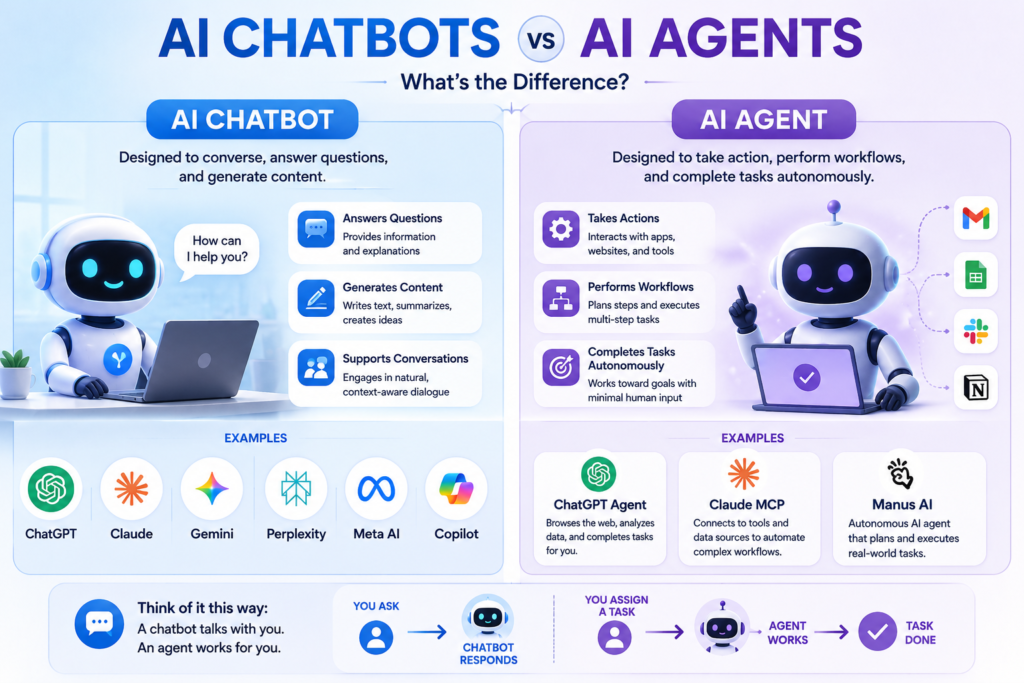
Agentic AI tools take this further outside the chat window itself. OpenAI’s Operator and newer agent platforms like Manus AI browse the web and operate software autonomously, while developer frameworks such as LangChain and CrewAI let teams chain multiple AI agents together for a single workflow. Devin AI applies the same agent approach specifically to software engineering, working through a coding task end-to-end rather than suggesting one snippet at a time.
Enterprise teams typically reach these capabilities through a platform rather than a consumer chatbot. Google’s Vertex AI and AI Studio package Gemini’s models for this kind of custom build, the same way Anthropic and OpenAI offer their own developer consoles. Chinese AI labs are pushing into this space too, with Alibaba’s Qwen and Moonshot AI’s Kimi both gaining attention as long-context alternatives to Western models.
Retrieval Augmented Generation, or RAG, is the technique behind much of this shift. Instead of relying only on what the model learned during training, RAG retrieves relevant documents first and grounds the answer in them. This is the same approach behind Claude’s connectors, Gemini’s Workspace search, and Perplexity’s citations, even though each company brands it differently. For most buyers, the practical takeaway is simple: if a task needs more than one step completed without supervision, look for agent or automation features specifically, rather than assuming any general-purpose chatbot can handle it equally well.
Best AI Chatbots FAQ
What is the best AI chatbot overall?
ChatGPT is the best AI chatbot overall for most users, thanks to its broad tool set and the largest active user base of any chatbot compared here.
What is the best free AI chatbot?
Meta AI and DeepSeek are both fully free with no paid tier required, while ChatGPT, Claude, and Gemini all offer capable free plans with usage limits attached.
Which AI chatbot is best for coding?
Claude is the best AI chatbot for coding among general-purpose options, largely due to Claude Code’s ability to read and extend an existing codebase directly.
Which AI chatbot is best for content writing?
Claude and ChatGPT both produce strong general writing, while Jasper is the better fit specifically for brand-consistent marketing copy at scale.
What is the difference between an AI agent and an AI chatbot?
A chatbot responds to a single prompt at a time, while an AI agent plans and executes several steps toward a goal with minimal additional input.
Which AI chatbot has the largest context window?
Claude and Gemini both market large context windows for handling long documents, though exact limits vary by specific model and subscription tier.
Are AI chatbots censored?
Most mainstream AI chatbots apply safety filters that block certain requests, while open-source models like DeepSeek can be self-hosted with those filters adjusted by the developer running them.
Can AI chatbots replace Google Search?
AI chatbots with built-in web search, such as Perplexity and ChatGPT, can answer many search-style questions directly, but they still rely on the same web sources Google indexes rather than an independent index.
Which AI chatbot is best for protecting personal data?
Duck.ai anonymizes a user’s IP address and metadata before any prompt reaches an AI provider, while Le Chat’s EU-based data handling appeals to users specifically concerned about cross-border data transfers.
Which AI chatbot is best for students and researchers?
Perplexity is the best AI chatbot for students and researchers because its citations make sources easy to verify, while ChatGPT’s Deep Research tool suits longer, more open-ended assignments.
Which AI chatbot is safest for business data?
Microsoft Copilot and Le Chat both emphasize enterprise data controls, with Copilot Studio’s governance tools and Le Chat’s EU-based privacy standards built specifically for business use rather than consumer chat.
Which AI Chatbot Should You Choose?
Choose ChatGPT if you want one chatbot that handles writing, research, and basic coding equally well. Choose Claude if your work centers on long-form writing or software development instead.
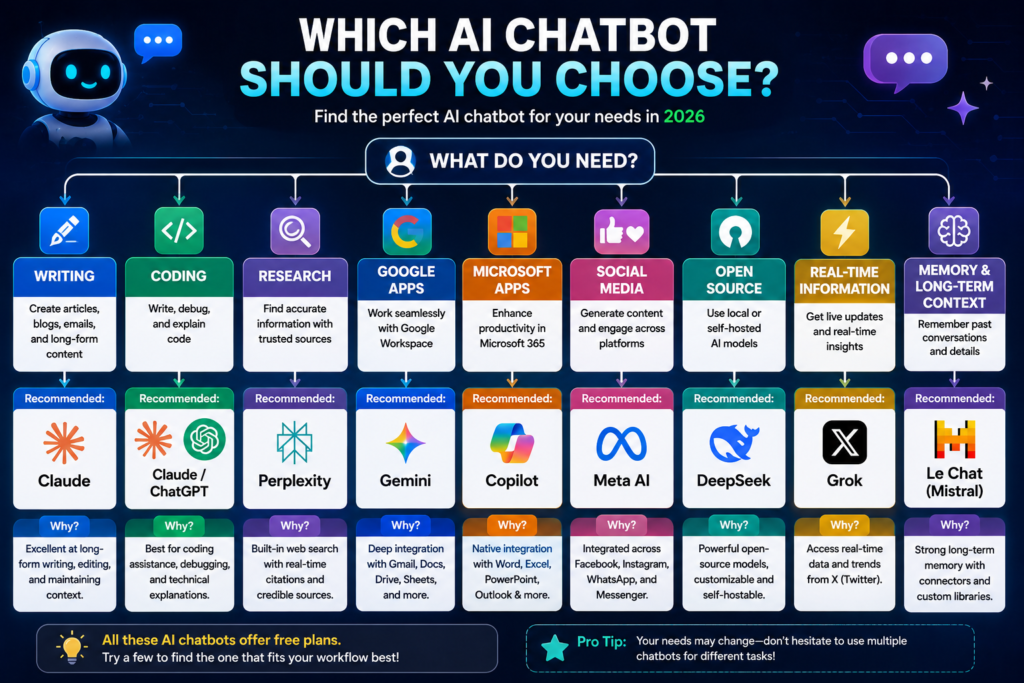
Choose Google Gemini if you already live inside Gmail, Docs, and Calendar. Choose Microsoft Copilot if your company runs on Word, Excel, and Outlook rather than Google’s suite.
Choose Perplexity if you need sourced answers faster than a manual search would deliver. Choose Meta AI if you want AI built directly into WhatsApp or Instagram instead of a separate app.
Choose DeepSeek if you want a free, open-source reasoning model you can self-host. Choose Grok if real-time access to X matters more to you than content-policy polish.
Choose Le Chat if long-term memory across conversations matters more than brand recognition. Whichever you pick first, every chatbot on this list offers a free way to try it, so the fastest path to the right answer is testing two or three directly against the work you actually do, rather than relying on a single ranking, including this one.
For more head-to-head breakdowns beyond the ones linked above, browse the full comparison library on the AI Comparison homepage.